Is your roof facing the wrong way for solar? Probably not as much as you think.
That’s the question that comes up in almost every solar conversation I’ve had with homeowners — usually right after they’ve gotten a quote and started second-guessing it. Their roof faces southwest instead of due south, or it’s pitched steeper than they’d like, and suddenly they’re convinced they’ve got a lemon of a system on their hands.
Here’s the short version: you probably don’t. The solar panel angle — meaning both the tilt and the direction your panels face — matters, but it’s a lot more forgiving than most online calculators make it seem. Get within a reasonable range, and you’re still capturing the vast majority of what’s possible.
Let’s break down exactly what “reasonable range” means, because that’s the part nobody explains clearly.
The Quick Answer, Before We Get Into the Weeds
If you don’t want to do any math: face your panels roughly south (if you’re in the Northern Hemisphere) and tilt them close to your latitude. That combination alone gets you into the high-90% range of maximum possible output for most homes.
For fixed-mount residential systems, the sweet spot tends to run a few degrees flatter than your exact latitude — think latitude minus 2 to 5 degrees — because summer sun delivers more of your annual energy than people assume. A home at 40 degrees north latitude, say Madrid or New York, does best with a tilt somewhere around 30 to 38 degrees rather than a flat 40.
And direction? Due south (180 degrees on a compass, measured from true north) is optimal, but drifting up to 30 degrees off that — southwest or southeast — only costs you about 3% of annual output. That’s the kind of loss you won’t notice on your electricity bill.
The Three Angles That Describe Where the Sun Is
Before we get to your roof, it helps to understand what’s happening in the sky, because your panel’s angle only matters in relation to the sun’s position.
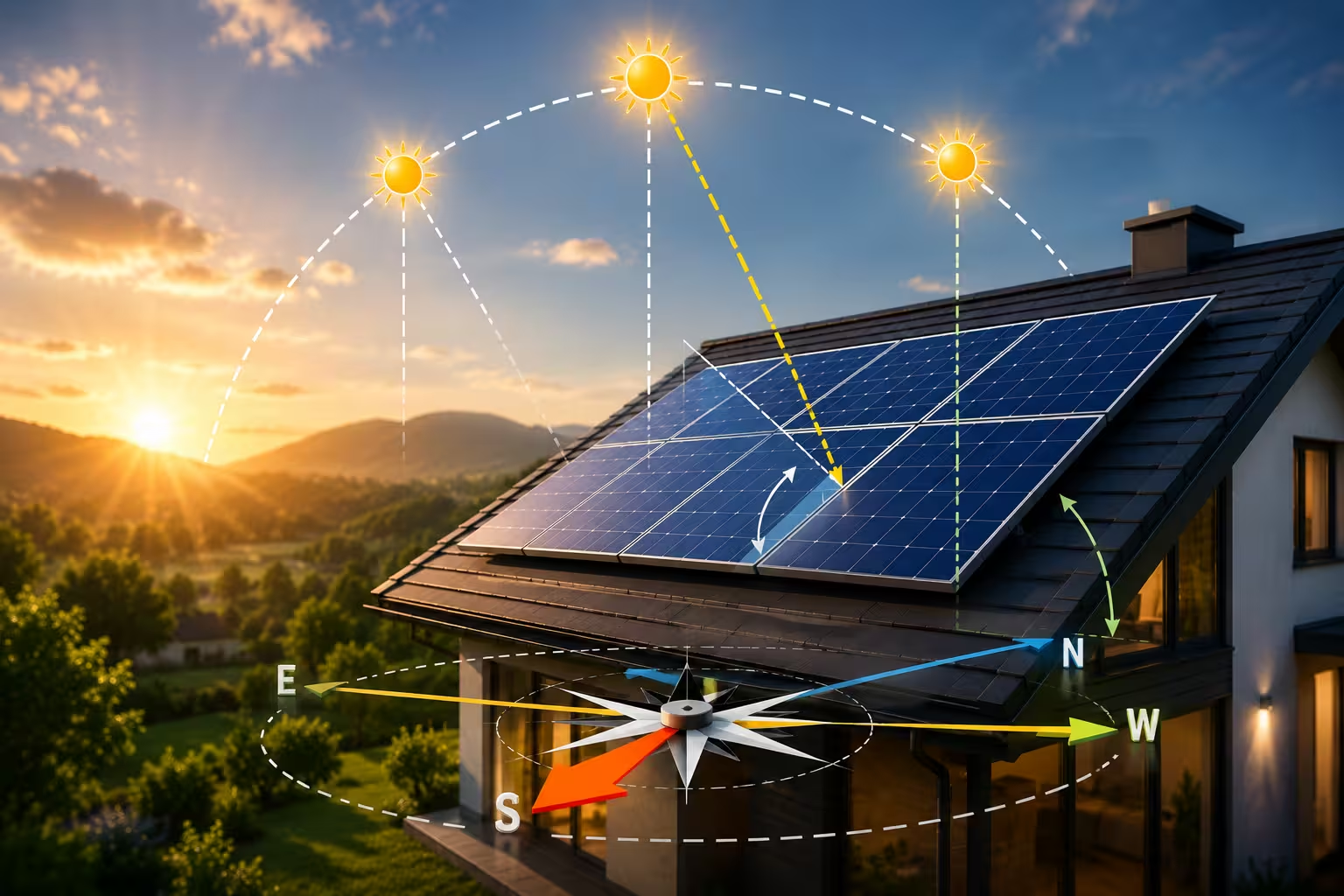
There are three numbers that describe where the sun sits at any given moment:
- Solar altitude (elevation) — how high the sun sits above the horizon. Zero at sunrise and sunset, 90 degrees if it were ever directly overhead.
- Solar zenith angle — basically the flip side of altitude. It measures the angle from straight overhead down to the sun. Altitude and zenith always add up to 90 degrees, so if one goes up, the other comes down.
- Solar azimuth — the sun’s compass direction. North is 0, east is 90, south is 180, west is 270. This one moves constantly through the day, sweeping from east to west.
Engineers doing shading and yield calculations tend to lean on zenith rather than altitude, mostly because it plugs more cleanly into the trigonometry used for tilted-surface irradiance. You don’t need to worry about that part — just know both terms describe the same relationship from opposite directions.
The Two Angles That Describe Your Panel
Now flip it around and look at the hardware on your roof. Two numbers describe how your panels sit:
- Tilt angle (slope) — the angle between the panel surface and flat ground. A panel lying flat has 0 degrees of tilt. One mounted straight up on a wall would be 90 degrees.
- Surface azimuth — which compass direction the panel faces. A south-facing panel has a surface azimuth of 180 degrees, matching the sun’s azimuth at solar noon.
The whole game is minimizing the gap between where the sun is and where your panel is pointed. When sunlight hits a panel dead-on, perpendicular to its surface, you get maximum direct energy capture. As that angle widens, you lose energy — gradually at first, then more steeply.
That’s really all six angles boil down to: three describing the sun, two describing your roof, and one combined number (the angle of incidence) that tells you how well they line up.
Tilt: Why “Equal to Latitude” Is a Starting Point, Not a Rule
The old rule of thumb — set your tilt equal to your latitude — isn’t wrong, but it’s not quite right either. It assumes you want your panel perpendicular to the sun at the spring and fall equinoxes, which is a reasonable target if energy were spread evenly across the year. It isn’t.
Summer months deliver something like 60 to 70% of your annual sunlight in northern latitudes. A flatter panel catches more of that summer sun, and the trade-off in winter performance is smaller than the summer gain. Net result: optimal fixed tilt usually lands 2 to 5 degrees below your exact latitude.
There’s a second wrinkle for cloudier climates. In places like the UK or the Netherlands, diffuse light — sunlight scattered by clouds rather than arriving as a direct beam — can make up more than half of total annual irradiance. Diffuse light comes from all directions at once, so a flatter panel picks up more of it. In those regions, optimal tilt can run 10 to 15 degrees below latitude, not just a handful of degrees.
There’s also a practical counterweight: snow. If you’re somewhere that gets real winter snowfall, a steeper tilt helps panels shed snow rather than sit buried under it for weeks. That can push the ideal angle a few degrees back up from the “pure energy maximum” number. It’s one of those judgment calls where the textbook-optimal angle isn’t always the field-optimal one.
Here’s roughly how optimal fixed tilt plays out across a few European cities, based on solar resource data:
| City | Latitude | Optimal Fixed Tilt |
| Seville, Spain | 37.4°N | 30° |
| Madrid, Spain | 40.4°N | 31° |
| Munich, Germany | 48.1°N | 33° |
| Paris, France | 48.9°N | 34° |
| London, UK | 51.5°N | 36° |
| Copenhagen, Denmark | 55.7°N | 38° |
Notice the pattern: the further north you go, the bigger the gap between latitude and optimal tilt tends to get, largely because cloudier, higher-latitude climates lean more heavily on diffuse light.
One honest note from the field: don’t overthink this number. The difference between a 33-degree and 37-degree tilt in a city like Munich is under 1% of annual output. Your roof pitch is what it is — chasing an extra degree or two of tilt optimization is rarely worth the effort compared to making sure your panels aren’t shaded for half the afternoon.
Direction Matters Less Than People Assume
This is the part that actually reassures most homeowners. Due south is ideal, but the drop-off from “ideal” is gradual, not a cliff.
Here’s roughly how azimuth deviation affects annual yield, using central European data as a reference:
| Deviation from South | Annual Yield (% of South-Facing) |
| 0° (due south) | 100% |
| 15° | 99% |
| 30° | 97% |
| 45° | 93–95% |
| 60° | 88–89% |
| 90° (due east/west) | 76–80% |
A southwest-facing roof, 30 to 45 degrees off true south, is still operating at 93% or better of what a perfectly south-facing system would deliver. That’s the number I wish more people saw before panicking about their roof orientation. The real cliff doesn’t show up until you pass 60 degrees off south — that’s when losses start climbing fast.
One correction worth making early: make sure you’re working from true south, not magnetic south. Depending on where you live, magnetic declination can shift a compass reading by several degrees, and in parts of Scandinavia it’s even more pronounced. For a typical home this costs under half a percent of yield if you’re slightly off, but it’s an easy thing to get right, so there’s no reason not to.
Putting Tilt and Azimuth Together: The “Good Enough” Zone
Real roofs don’t let you pick tilt and direction independently — your roof pitch and orientation are fixed by the house. What actually matters is how the two combine.
The data here is genuinely useful: any roof landing within about 15 degrees of optimal tilt and 30 degrees of due south holds onto roughly 94% or more of maximum theoretical output. A 40-degree pitched roof facing southwest-ish in a place like London, for instance, typically performs at somewhere around 95 to 96% of the theoretical best case.
That’s the number I’d want a homeowner to remember above all the tables: if your roof falls in that zone, stop worrying about the angle and start paying attention to shading, because that’s where the real losses tend to hide.
Outside that zone — say a steep, wall-mounted array facing southwest — output can drop to somewhere near 78% of maximum. Still workable in some cases, particularly with strong local electricity rates, but it’s the kind of project that needs a proper look at the numbers before committing.
When “Wrong” Direction Still Makes Financial Sense
East-west flat-roof layouts break every rule above, and commercial installers use them constantly anyway — for good reason.
Two rows of panels tilted low, one facing east and one west, practically eliminate the shading that forces wide row spacing on south-facing systems. That means significantly more panel capacity fits on the same roof, sometimes 30 to 50% more.
There’s also a timing angle to this that pure yield numbers miss. East-west arrays generate power earlier in the morning and later into the evening, which lines up well with commercial demand and, in markets with time-of-use electricity rates, can be worth more per kilowatt-hour than a south-facing system’s midday peak. A system producing 20% less total energy but shifting a big chunk of it into higher-rate evening hours can come out ahead financially, even though it loses on raw output.
That’s a distinction worth sitting with: orientation isn’t purely about maximizing kilowatt-hours. It’s about maximizing value, and those aren’t always the same thing.
Why Winter, Not Summer, Should Drive Your Shading Decisions
If there’s one habit that separates careful system design from a rushed one, it’s using the winter solstice — December 21 — as the benchmark for shading analysis rather than summer.
The sun sits at its lowest point of the year on that date, and at higher latitudes it barely clears the horizon at midday. A system that’s shade-free at noon on the winter solstice will stay shade-free every other day of the year. Row spacing, obstruction clearances, and setback distances all get calculated from that one low sun angle — not from the comfortable, high summer sun that makes everything look easy.
This is also why a flat commercial roof further north can end up fitting noticeably fewer panels than the same-sized roof closer to the equator — not because there’s less sunlight overall, but because the rows need more breathing room to avoid winter shadows falling across the array.
Bifacial Panels and Trackers: Worth Knowing, Not Always Worth Chasing
A quick word on two variations that change the angle math, without turning this into a separate topic.
Bifacial panels capture light on both sides — the front gets direct sun, the back picks up reflected light off the ground. Steeper tilts actually help bifacial panels more than standard ones, because a steeper angle lets more reflected light reach the rear surface. Pairing bifacial panels with a light-colored roofing surface or ground cover can meaningfully boost that rear-side gain.
Single-axis trackers rotate panels to follow the sun’s azimuth through the day, essentially erasing the azimuth-deviation losses covered above. The energy gain is real — often somewhere in the range of 15 to 25% over a fixed system in sunnier regions — but the added cost and mechanical complexity mean they show up almost exclusively in larger commercial and utility projects, not typical residential rooftops.
Dual-axis trackers, which adjust both tilt and azimuth simultaneously, push gains even higher but come with enough added cost and maintenance that they’re mostly reserved for niche and off-grid applications rather than standard rooftop solar.
What to Actually Take Away From All This
If you’re evaluating a quote or planning your own system, three things matter more than chasing a perfect number:
First, check whether your roof’s tilt and orientation land in that forgiving zone — within about 15 degrees of ideal tilt and 30 degrees of due south. If it does, the angle isn’t your problem.
Second, get a proper shading assessment based on winter sun angles, not summer. This tends to matter more than an extra degree or two of tilt optimization ever will.
Third, if your roof genuinely sits outside the ideal range — very steep, or facing well off south — don’t assume it’s a bad project. Run the actual numbers, because a system’s real-world peak sun hours and site-specific irradiance often tell a more encouraging story than a rule-of-thumb calculation.
Solar angle math connects back to how sunlight becomes usable energy in the first place — if you want the fuller picture of that process, it’s worth reading up on how the photovoltaic effect actually works and how sunlight gets converted into electricity at the panel level. Understanding solar radiation and insolation also helps explain why some regions get more usable sunlight than raw daylight hours would suggest, and the difference between direct, diffuse, and reflected solar radiation is exactly why flatter tilts help in cloudier climates.
If you’re comparing your specific setup against a temperate versus tropical climate baseline, that’s covered in more detail in our piece on tropical vs. temperate solar performance, and if you’re weighing solar against other options entirely, our comparison of solar vs. wind energy digs into how site-specific factors like this play out across renewable technologies.
Frequently Asked Questions
What is the best angle for solar panels?
The best fixed tilt is roughly equal to your latitude, though reducing it by 2 to 5 degrees usually performs slightly better because it captures more summer sunlight. At 50 degrees latitude, that typically works out to a tilt somewhere around 33 to 38 degrees.
What’s the difference between azimuth and zenith angle?
Azimuth tells you the sun’s compass direction — where it is on the horizon. Zenith tells you how high it is in the sky, measured as the angle down from directly overhead. They describe different things: one is direction, the other is height.
Does the direction solar panels face really matter?
Yes, but less than most people fear. Due south is ideal in the Northern Hemisphere, but a 30-degree deviation costs only about 3% of annual yield. Losses stay modest until you pass roughly 60 degrees off south, at which point they start climbing more steeply.
Can solar panels be too steep?
In terms of pure annual energy capture, an overly steep tilt reduces output compared to the optimal angle for your latitude, though it can help shed snow and reduce dust buildup in the right climates. It’s a trade-off worth weighing against your local conditions rather than a fixed rule.
What happens if solar panels face east or west instead of south?
East- or west-facing panels typically produce 20 to 25% less annual energy than south-facing ones. That said, they generate more power earlier or later in the day, which can be financially worthwhile in markets that pay more for morning or evening electricity.
How do you calculate the sun’s angle at a specific location?
Solar altitude at solar noon equals 90 minus your latitude, plus the sun’s declination for that date, which ranges from about +23.45 degrees at the summer solstice to -23.45 degrees at the winter solstice. For a full hour-by-hour picture including azimuth, most people rely on tools like PVGIS rather than manual calculation.