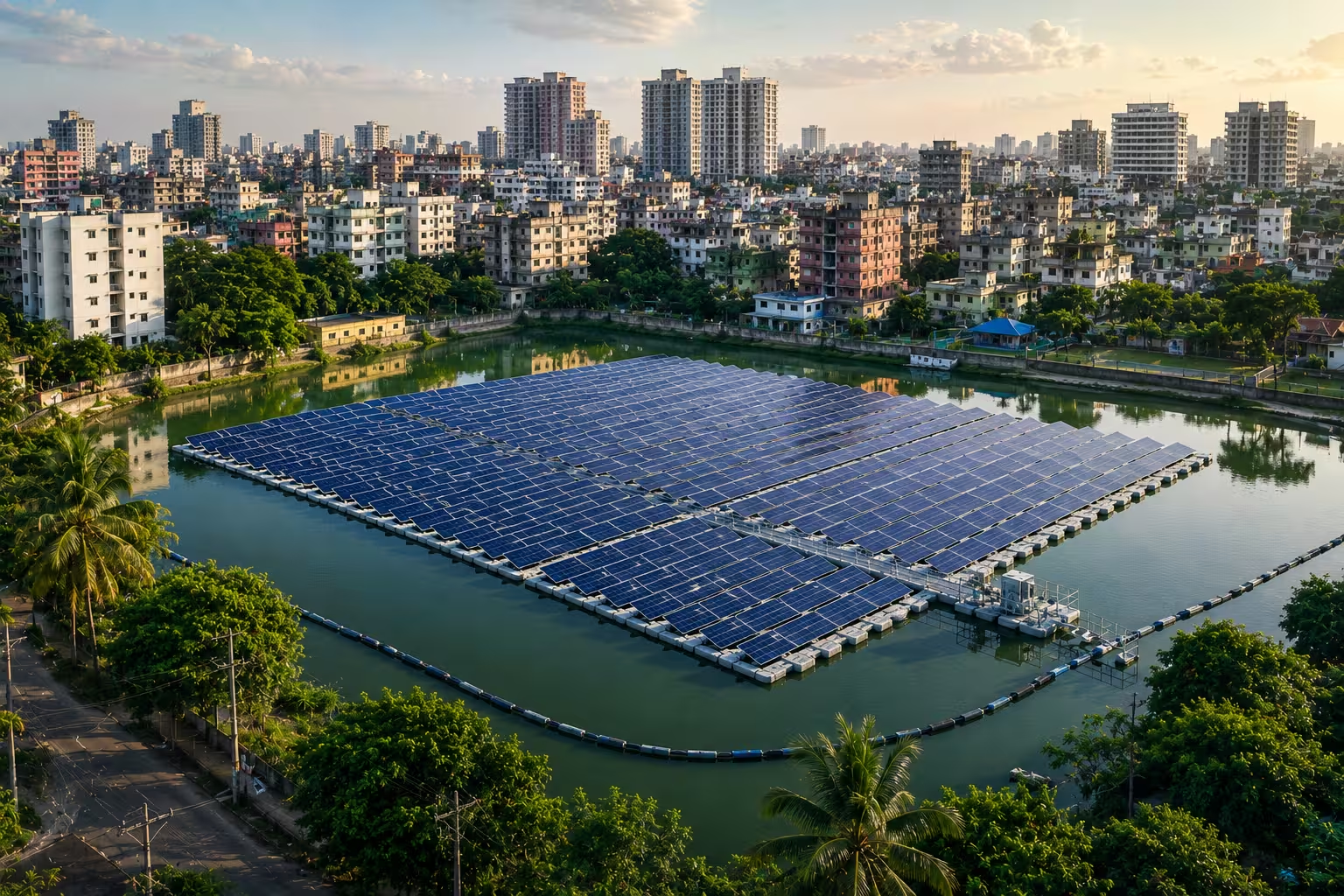
Solar panels have always had a land problem before they had an energy problem. You need space — a lot of it — and space is exactly what a lot of countries don’t have to spare. That’s the whole reason floating solar exists, and it’s a genuinely clever workaround. But it’s also not the free lunch a lot of glossy renewable energy articles make it sound like.
I want to walk you through this the way I’d explain it to a friend who just saw a photo of solar panels bobbing on a reservoir and texted me “wait, is this actually a thing?” Yes, it’s a thing. It’s also more complicated — and more interesting — than most articles let on.
What Is Floating Solar (Floatovoltaics)?
Floating solar, sometimes called floatovoltaics, is exactly what it sounds like: solar panels mounted on buoyant platforms that sit on top of water instead of on land or rooftops. These platforms usually float on reservoirs, hydropower dams, irrigation ponds, or old quarry lakes — anywhere there’s a large, calm body of water that isn’t being used for much else.
The panels themselves aren’t that different from the ones you’d see on a warehouse roof or a ground-mounted solar farm. What changes is everything underneath them: pontoons instead of racking, anchoring cables instead of concrete footings, and marine-grade wiring instead of standard cabling. It’s the same photovoltaic effect turning sunlight into electricity — the engineering challenge is keeping the whole system stable and dry while it floats.
Quick answer: Is floating solar more efficient than ground-mounted solar? Generally, yes, mostly because the water underneath keeps the panels cooler, and cooler panels convert sunlight into electricity more effectively. It’s not a massive leap, but it’s a real, measurable one.
How Floating Solar Actually Works
Picture a raft made of high-density polyethylene pontoons, the kind of plastic that doesn’t degrade in sunlight or water over decades. Solar panels get bolted onto that raft in rows, tilted at an angle just like they would be on land. The whole array is then tied down with an anchoring and mooring system so it doesn’t drift off during a storm or a sudden change in water level.
That anchoring system is doing more work than people realize. On a shallow, still pond, it might just be a few cables running to the shore. On a deep reservoir with fluctuating water levels — think a hydropower dam that rises and falls with seasonal rainfall — the anchoring has to account for vertical movement, not just horizontal drift. This is one of those details that separates a well-designed floating solar project from a poorly engineered one, and it’s also a big reason installation costs swing so widely from project to project.
Power generated by the panels travels through waterproof, marine-grade cables to an inverter, usually mounted on a floating platform of its own or on the shore, and from there into the grid — the same way electricity from any other solar installation, whether it’s an on-grid system or a hybrid solar setup, eventually gets there.
The Real Advantages of Floating Solar
Space Efficiency Without the Land Fight
This is the headline benefit, and it’s not exaggerated. Countries with dense populations and limited open land — South Korea, Japan, Singapore, parts of India — have thousands of unused reservoirs and irrigation ponds just sitting there doing nothing but evaporating. Putting solar panels on that water means you’re not competing with farmland, forests, or housing for space. That land-use conflict is a real political and economic headache in a lot of regions, and floating solar sidesteps it almost entirely.
The Efficiency Boost From Water Cooling
Solar panels lose efficiency as they heat up — that’s just how semiconductors behave, not a design flaw. On a hot day, a ground-mounted panel can get uncomfortably warm, and its output drops as a result. Water has a cooling effect on the panels floating above it, and that cooling effect can lift energy output by somewhere in the range of 5% to 15% compared to an equivalent land-based system, depending on climate, water temperature, and how the array is ventilated underneath. It’s not a fixed number — a floating array in a tropical, humid region behaves differently than one on a cooler, temperate reservoir — but the direction is consistent: cooler panels, better output.
Water Conservation You Wouldn’t Expect
Covering part of a reservoir’s surface with panels reduces the surface area exposed to direct sun and wind, which slows evaporation. For reservoirs that supply drinking water or irrigation in drought-prone regions, that’s not a minor side benefit — it can be one of the more compelling reasons a water authority chooses floating solar over a ground-mounted alternative nearby.
The Albedo Effect
Water reflects sunlight differently than soil or rooftop material does, and in the right conditions, that reflected light can bounce back up onto the underside or edges of nearby panels, adding a small extra boost to power generation. It’s a secondary benefit, not a headline one, but it’s part of why floating arrays sometimes slightly outperform their land-based equivalents on paper.
Better Water Quality
Shade from the panels limits sunlight penetration, which can reduce algae growth in reservoirs. Excessive algae blooms are a genuine problem for water treatment plants and aquatic ecosystems, so this is one of those advantages that benefits more than just the energy company running the project.
The Trade-Offs Nobody Glosses Over
The Cost Premium Is Real
Floating solar typically costs somewhere between 10% and 40% more upfront than a comparable ground-mounted system. That range isn’t random — it depends heavily on water depth, how far the site is from shore, and how aggressive the local weather conditions are. A shallow, calm irrigation pond sits toward the lower end of that range. A deep reservoir exposed to strong wind and wave action pushes costs toward the higher end, because the anchoring and pontoon systems have to be built tougher to survive.
The specialized pontoons, marine-grade cabling, and anchoring hardware are the main cost drivers, and none of them are optional — you can’t cut corners on anchoring a multi-megawatt array without risking the whole thing drifting or capsizing in a storm.
Maintenance Means Boats, Not Ladders
Cleaning and repairing panels on a rooftop or a field is straightforward — you walk over, do the work, walk back. On water, you need boats, trained technicians comfortable working on floating platforms, and sometimes specialized equipment just to reach the array safely. That logistical layer adds cost and time to routine maintenance that a land-based rooftop or ground-mounted system simply doesn’t have.
Anchoring Gets Complicated in Deep Water
The deeper and more turbulent the water, the more engineering goes into keeping the array in place. Seasonal water level changes on hydropower reservoirs add another layer of complexity — the anchoring system has to flex with the water rising and falling by meters over the course of a year without snapping or letting the array drift into the dam wall.
Weather and Ecosystem Risk
Strong winds and waves can damage poorly designed floating arrays, and there have been real cases of projects underestimating local weather patterns. There’s also a legitimate ecological question mark: shading too much of a reservoir’s surface can disrupt fish populations, interfere with fishing and irrigation activity, or throw off the local aquatic balance if the project isn’t planned with input from environmental engineers. This isn’t a reason to dismiss floating solar — it’s a reason to be skeptical of any project that skips proper environmental assessment.
Floating Solar vs. Ground-Mount vs. Rooftop
| Factor | Floating Solar | Ground-Mount | Rooftop |
| Land use | None — uses water surface | Requires open land | Uses existing roof space |
| Upfront cost | Highest (10-40% more than ground-mount) | Moderate | Lowest per kW typically |
| Efficiency | Highest, due to water cooling | Standard | Can suffer from roof heat |
| Maintenance | Hardest — needs boats/specialized access | Easiest | Moderate — needs roof access |
| Best suited for | Reservoirs, dams, water-scarce regions | Open, cheap land | Homes, commercial buildings |
None of these is objectively “the best.” It genuinely depends on what land or water you have access to, and what you’re optimizing for.
Where Floating Solar Actually Makes Sense
This is the part most articles skip entirely, and it’s the part that actually matters if you’re trying to figure out whether this technology applies to you.
Floating solar makes the most sense in places where land is scarce and expensive but water bodies — especially reservoirs tied to hydropower dams — are abundant. China’s Huainan floating solar farm, built over a flooded former coal mining area, is one of the more well-known examples, and it demonstrates a neat secondary benefit: reclaiming land that was otherwise unusable. South Korea’s Saemangeum project pairs floating solar with existing tidal infrastructure. India’s NTPC has rolled out floating solar installations on reservoirs tied to its hydropower and thermal plants, largely because pairing floating solar with existing hydropower infrastructure means you can share the same grid connection and transmission lines, cutting costs significantly.
That pairing with hydropower is actually one of the most underrated angles in this whole conversation. When a floating solar array sits on a reservoir that already feeds a hydropower dam, the two energy sources can complement each other — solar generates during sunny daylight hours, hydropower can ramp up when the sun goes down, and they share the same grid infrastructure instead of each needing their own.
Who should actually consider floating solar? Realistically, this isn’t a homeowner’s decision — it’s a utility, a municipality, an industrial facility with an unused pond, or a hydropower operator looking to add generation capacity without buying new land. If you’re comparing options for a home or small business, rooftop or ground-mounted solar is almost always the more practical and affordable route. Floating solar earns its cost premium at scale, in water-scarce or land-scarce regions, where the alternative is either not building solar at all or fighting over land that’s needed for other things.
There’s also a cost-recovery angle worth being honest about: because floating solar costs more upfront but generates more energy per panel thanks to that cooling effect, the payback period isn’t dramatically longer than ground-mount in many cases — it just depends on local electricity prices and how favorable the site conditions are. Sites with calm, shallow water and strong sun exposure recover that premium fastest.
Compared to other renewable options like solar vs wind energy, floating solar carves out its own niche rather than competing head-to-head — it’s less about which renewable source wins and more about matching the right technology to the land, water, and grid infrastructure already available.
FAQ
Is floating solar more efficient than rooftop solar?
Generally yes, mainly because of the cooling effect from the water underneath, which can boost output by roughly 5-15% over comparable land-based systems, depending on climate and site conditions.
How long do floating solar panels last?
The panels themselves typically last 25-30 years, similar to standard ground-mounted panels. The pontoons and anchoring hardware are usually designed for a comparable lifespan, though they require more regular inspection due to constant water exposure.
Can floating solar be installed on the ocean?
Technically yes, and offshore floating solar projects exist, but they’re far more expensive and complex due to saltwater corrosion, wave action, and storm exposure. Most current projects stick to calmer inland water — reservoirs, lakes, and ponds — where conditions are more predictable.
What happens to floating solar in a storm?
Well-designed systems are engineered to withstand regional wind and wave conditions, but poorly planned installations have suffered real damage during extreme weather. This is why site-specific anchoring design isn’t optional — it’s the difference between a system that survives a storm season and one that doesn’t.
Does floating solar reduce evaporation?
Yes, meaningfully. By shading part of the water’s surface and reducing wind exposure, floating arrays can noticeably cut evaporation rates, which is a real advantage for reservoirs used for drinking water or irrigation in drought-prone areas.