Solar carports cost roughly 60-75% more per watt than rooftop solar. That number alone stops most property owners in their tracks, and honestly, it should. Before you spend that kind of premium, you deserve a real answer on whether it pays off — not a sales pitch dressed up as an article.
I’ve sat through enough vendor calls to know how this usually goes. Someone shows you a glossy rendering of shaded parking spaces, throws around a “20-year payback,” and skips straight past the part where you ask “compared to what?” So let’s actually do the comparison.
What Is a Carport Solar System, Exactly?
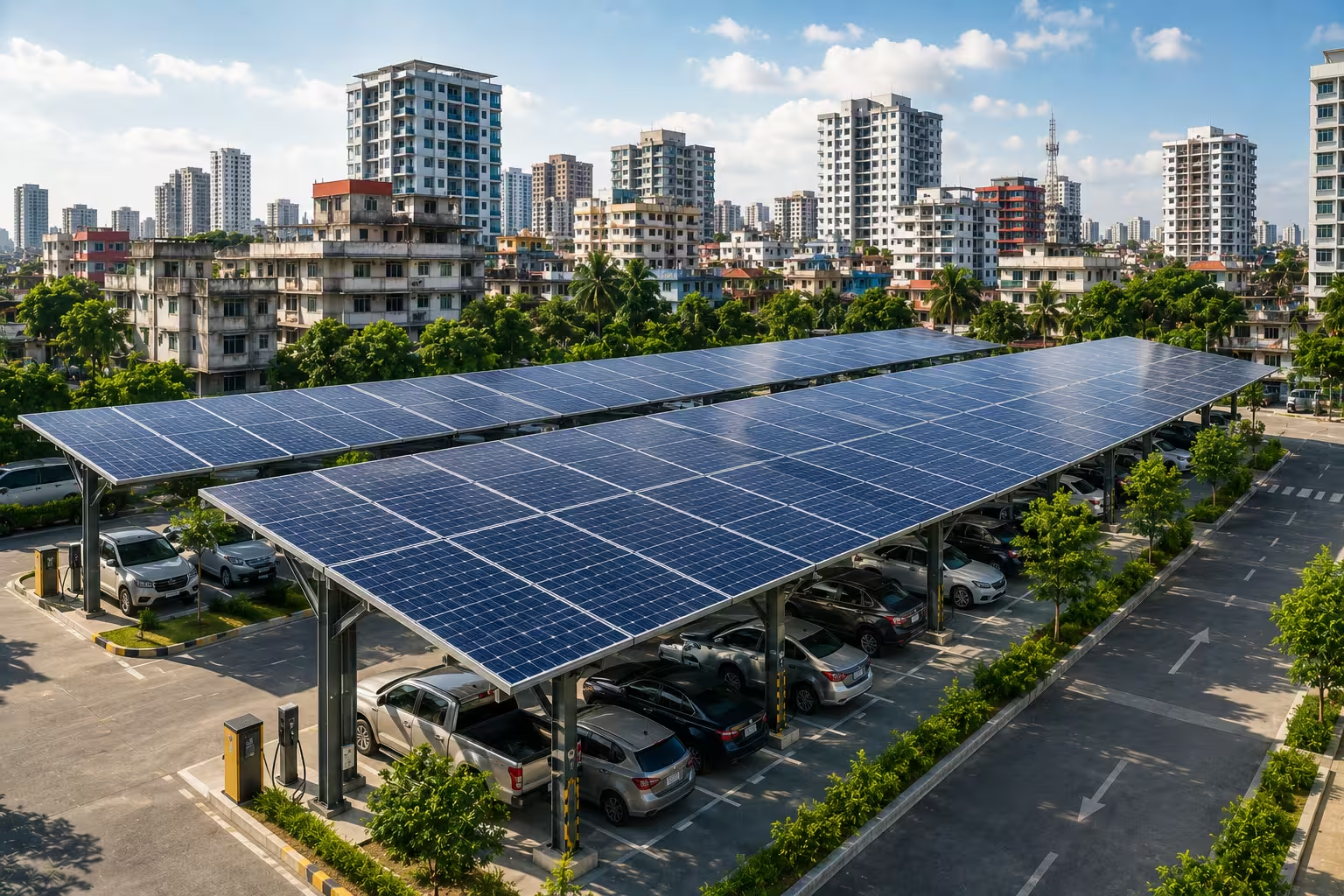
A solar carport is a raised structure — usually around 14 feet high — that holds photovoltaic panels above a parking area instead of on a rooftop. The vehicles park underneath, shaded and protected, while the panels above do the work of generating electricity.
The appeal is obvious once you see it: you’re not competing for roof space, you’re not limited by a roofline’s pitch or shading from HVAC units, and you get to angle the panels exactly where the sun wants them, not where your building happens to face. For a lot of commercial sites — think retail centers, office parks, warehouses, university campuses — that flexibility is the whole reason carport solar even comes up as an option.
Is a Solar Carport Actually Worth It?
Here’s the honest, short version: if you have the space, high enough electricity rates, and you’re planning to hold the property for a decade or more, carport solar tends to pencil out — just not as fast as rooftop solar. Commercial systems typically run $3.00 to $3.50 per watt installed, against roughly $1.80 to $2.00 per watt for rooftop. Payback usually lands in the 5 to 8 year range for commercial sites with strong incentive stacking, according to industry cost benchmarks tracked by SEIA and NREL.
If your roof already has usable space and doesn’t need extra parking coverage, rooftop solar is the cheaper, faster-payback choice, full stop. Carport solar earns its premium when you need the parking canopy anyway — vehicle protection, EV charging infrastructure, or a shaded amenity for tenants and customers — and the solar panels are essentially riding along on a structure you’d want to build regardless.
What Does a Commercial Solar Carport Actually Cost?
Commercial carport solar installations generally run $3.00 to $3.50 per watt, with systems in the 200kW-800kW range averaging closer to $3.25 per watt once you factor in structural steel, foundations, and the electrical build-out. A 150kW system — enough to cover a mid-sized parking lot — typically lands around $450,000 to $500,000 before incentives.
That’s a real number, and it’s higher than most people expect walking in. Here’s what’s actually driving the cost:
- Structural steel and foundations — the carport frame has to carry wind, snow, and seismic loads on its own, since there’s no existing building to lean on
- Elevated mounting systems — panels need to sit at vehicle-clearance height with the right tilt angle
- Electrical infrastructure — string inverters or power optimizers, DC combiners, AC disconnects, and metering
- Engineering and permitting — geotechnical studies, structural calculations, and local code compliance
Residential solar carports run a bit less steep proportionally — around $3.00 to $4.00 per watt for a typical 10-12kW home system — but they hit the same basic cost logic: you’re paying for a purpose-built structure, not just panels.
Carport Solar vs. Rooftop Solar: The Real Comparison
| System Type | Cost per Watt | Typical Payback | Best Fit |
| Carport Solar (Commercial) | $3.00–$3.50 | 5–8 years | Sites needing parking coverage anyway |
| Rooftop Solar (Commercial) | $1.80–$2.00 | 4–6 years | Sites with usable, unshaded roof space |
| Ground Mount | $1.90–$2.20 | 5–7 years | Large open land, low land-value pressure |
If you’re weighing this decision purely on installed cost, rooftop wins every time. Carport solar wins when the land use itself has value — parking that stays dry, EV charging that’s already wired in, or a site where the roof simply can’t take the load or doesn’t have the orientation for it. For a deeper look at how these mounting types compare structurally and financially, our guide on rooftop vs. ground-mounted solar breaks down the trade-offs in more detail.
ROI, Incentives, and What Actually Moves the Payback Number
The Federal Investment Tax Credit currently covers 30% of the project cost, and when you stack that with MACRS accelerated depreciation, the net cost of a commercial system can drop meaningfully — often somewhere in the 40-50% range once both are applied, though the exact figure depends on your tax position and should be confirmed with your accountant, not a solar quote.
Beyond the tax side, the actual return comes from three places:
- Direct electricity savings — commercial sites in high-rate regions with demand charges often see 30-40% reductions in their utility bills
- Avoided demand charges — this is the quiet one that vendors underplay, and it’s often where carport solar actually beats rooftop economically, since larger arrays can offset peak demand more aggressively
- Financing structure — Power Purchase Agreements and lease-to-own arrangements let you skip the upfront capital hit entirely, trading ownership economics for immediate cash flow relief
A 150kW commercial system saving $40,000-$50,000 a year in electricity costs isn’t unusual, but that number swings hard based on your local utility rates. Anyone quoting you a payback period without asking about your rate structure first is skipping a step they shouldn’t skip.
The Honest Downsides Nobody Puts on the Brochure
1. The upfront cost is genuinely high
Residential carport systems often start around $18,000-$25,000 even with incentives applied. Commercial projects routinely run into the hundreds of thousands. If your business doesn’t have the balance sheet for that — or the financing options available to smaller operations aren’t great — this is where a lot of projects stall before they start.
2. You need real space, and cities don’t always have it
A residential carport needs roughly 400-700 square feet. Commercial installations usually need 20+ parking spaces to make the economics work at all. In dense urban areas, zoning setbacks, emergency access requirements, and land value alone can rule this out before engineering even enters the conversation.
3. Output still depends on weather
Cloudy days and winter months cut production, sometimes by 30-50% compared to peak summer output. Snow load adds another wrinkle — panels need clearing in some climates, and that’s an ongoing operational cost, not a one-time thing. If you need guaranteed uptime, you’re pairing this with grid connection or battery storage regardless, which our on-grid solar systems overview covers in more depth.
4. Maintenance is harder because everything’s up in the air
Panel cleaning, electrical checks, and structural inspections all need lifts or specialized equipment because of the elevation. Commercial upkeep typically runs a few hundred dollars annually per system at minimum, climbing with array size and climate demands. It’s not a dealbreaker, but it’s a real recurring line item that’s easy to underestimate at the proposal stage.
5. The engineering is more complex than people expect
Because there’s no building to share structural load with, every carport system needs its own wind, seismic, and snow-load calculations, plus geotechnical work for the foundations. This is exactly where design software like PVsyst and HelioScope earns its keep — PVsyst for detailed energy yield modeling with tight error margins, and HelioScope for fast layout iteration during the early design phase. Skipping thorough engineering here isn’t a shortcut; it’s how you end up with a structure that underperforms or, worse, fails a load inspection.
Is a Solar Carport Right for Your Property? A Quick Gut Check
Ask yourself these before getting quotes:
- Do I need covered parking or EV charging infrastructure anyway, regardless of solar?
- Is my roof space limited, poorly oriented, or structurally unsuited for panels?
- Do I have 20+ parking spaces I’m willing to dedicate to this?
- Am I planning to hold this property for 10+ years?
- Are my electricity rates and demand charges high enough that the savings actually compound?
If you answered yes to most of these, carport solar is worth a serious feasibility study. If you answered no to the space or holding-period questions, rooftop or ground-mount solar will almost certainly get you a better return with less complexity — worth exploring further in our comparison of DC vs. AC coupled solar systems if you’re also weighing electrical configuration options.
Where This Actually Goes From Here
None of this replaces a proper site assessment. Local utility rates, your roof condition, shading patterns, and available incentives all shift the math enough that a generic guide — this one included — can only get you to “probably worth investigating,” not a final number. What it can do is arm you with the right questions before you sit across from an installer who’s counting on you not asking them.
FAQs
How much does a solar carport cost?
Commercial solar carports typically cost $3.00 to $3.50 per watt installed, which puts a 150kW system in the $450,000-$500,000 range before incentives. Residential systems run somewhat lower per watt but follow the same cost logic — you’re paying for a purpose-built structure, not just the panels.
What are the disadvantages of solar carports?
The main drawbacks are high upfront cost, significant space requirements (20+ parking spaces for commercial viability), weather-dependent output, elevated maintenance complexity, and more involved structural engineering compared to rooftop systems.
Is a solar carport cheaper than rooftop solar long-term?
Not usually on cost alone — rooftop solar wins on pure installed cost and payback speed. Carport solar becomes competitive when the covered parking or EV charging infrastructure has independent value to the property, effectively splitting the structure’s cost across two benefits instead of one.
How much space does a commercial solar carport need?
Most commercial installations need at least 20 parking spaces to justify the engineering and installation costs with a reasonable return. Residential carports typically need 400-700 square feet.
Do solar carports work in winter or during snow?
Yes, but output drops — often 30-50% compared to peak summer production — and in snow-heavy climates, panels may need periodic clearing to maintain performance. Grid connection or battery storage is standard practice to cover the gap.
What is the lifespan of a solar carport?
The structural framework and foundation typically last 25-30 years or more, matching standard solar panel warranties, while electrical components like inverters usually need replacement somewhere in the 15-25 year range.