If you’ve ever stood on a tin-roof rooftop in Savar or Cumilla with an electrician arguing over whether 4mm or 6mm cable is “enough” for your panels, you already know the real problem — everyone has an opinion, and almost nobody shows you the math.
So here’s the number first, then we’ll get into why it’s the right one.
For most home solar setups in Bangladesh — whether it’s a rooftop grid-tied system in Dhaka or an off-grid Solar Home System (SHS) in a char area with no grid access — your DC cable from panel to inverter usually falls between 4mm² and 6mm², and your AC cable from inverter to distribution board sits between 2.5mm² and 10mm² depending on system size. The exact number depends on how far the cable has to run and how much current is flowing through it, not just on how big your system is.
That’s the part most local vendors skip. Let’s fix that.
Why Cable Size Actually Matters More Than People Think Here
In Bangladesh, a huge share of solar installations are done by small local vendors or the electrician who also wires ceiling fans and tube lights. Nothing wrong with that — many of them are genuinely skilled — but cable sizing for solar isn’t quite the same game as household wiring. A slightly undersized cable in your bedroom circuit just gets warm. A slightly undersized DC cable between your panel and inverter quietly eats your production every single day, for the next 20-25 years, and you’ll probably never notice because your bill just looks “a bit high” instead of obviously broken.
Given how much rooftop solar has grown under IDCOL-supported programs and the government’s Net Metering Guideline, and how many off-grid SHS units are still running in areas with unreliable REB grid supply, getting this right isn’t just a technical detail — it’s the difference between a system that pays for itself on schedule and one that quietly underperforms for two decades.
The Quick-Reference Sizing Chart
This is the number most people actually came here for. Use it as a starting point, not gospel — your specific roof, run length, and heat exposure can push you up a size.
| System Size | DC Cable (Panel → Inverter) | AC Cable (Inverter → Board) | Typical Max Run (DC) |
| 1–3 kW (common SHS / small rooftop) | 4 mm² | 2.5–4 mm² | 15–30 m |
| 5 kW (typical urban rooftop) | 6 mm² | 6 mm² | 15–40 m |
| 10 kW (commercial/large rooftop) | 6–10 mm² | 10 mm² | 40–60 m |
A quick note for readers comparing this against Indian or Southeast Asian sources: Bangladesh generally follows IEC-based standards through the Bangladesh National Building Code (BNBC) rather than the US NEC code, so if you’re cross-checking against an American blog, don’t be surprised the numbers and calculation method look a bit different. We’ll cover both below so you know which one actually applies to you.
How to Actually Calculate It Yourself (Not Just Trust a Table)
Every table has limits. If your roof run is longer than the chart accounts for — which happens a lot with larger tin-roof houses or when the inverter sits on the ground floor while panels are on the roof — you need to run the actual formula.
The voltage drop formula:
Vdrop (%) = (2 × L × I × ρ) / (A × V) × 100
Where:
- L = one-way cable length (meters)
- I = current (amps)
- ρ = copper resistivity, 0.0175
- A = cross-sectional area of the cable (mm²)
- V = string voltage
Worked example (this is the part most guides skip):
Say you’ve got a 5kW rooftop system in Dhaka, string voltage around 380V, panel short-circuit current (Isc) of about 11A, and your DC run from the roof to the ground-floor inverter room is 25 meters one way.
Under IEC guidance, you’d typically use the corrected Isc directly (rather than the NEC 1.25 multiplier), so let’s work with I = 11A.
Plugging into the formula with a 6mm² cable:
Vdrop = (2 × 25 × 11 × 0.0175) / (6 × 380) × 100 Vdrop = 9.625 / 2280 × 100 Vdrop ≈ 0.42%
That’s comfortably under the 2% ceiling industry standards recommend for DC runs — so 6mm² is doing its job here with room to spare. Now if that same run stretched to 45 meters, which isn’t unusual for a bigger house with the inverter tucked away in a ground-floor utility room, the drop nearly doubles to around 0.76% — still fine, but you can see how length eats into your margin fast. Push past 60-70 meters on a 6mm² cable and you’d want to size up to 10mm² before it becomes a real efficiency problem.
This is honestly the exercise worth doing once with your own numbers, even if you end up just using the chart afterward — it tells you whether you’re sitting comfortably inside the 2% limit or right up against it.
DC Cable: What Bangladesh’s Heat and Humidity Actually Demand
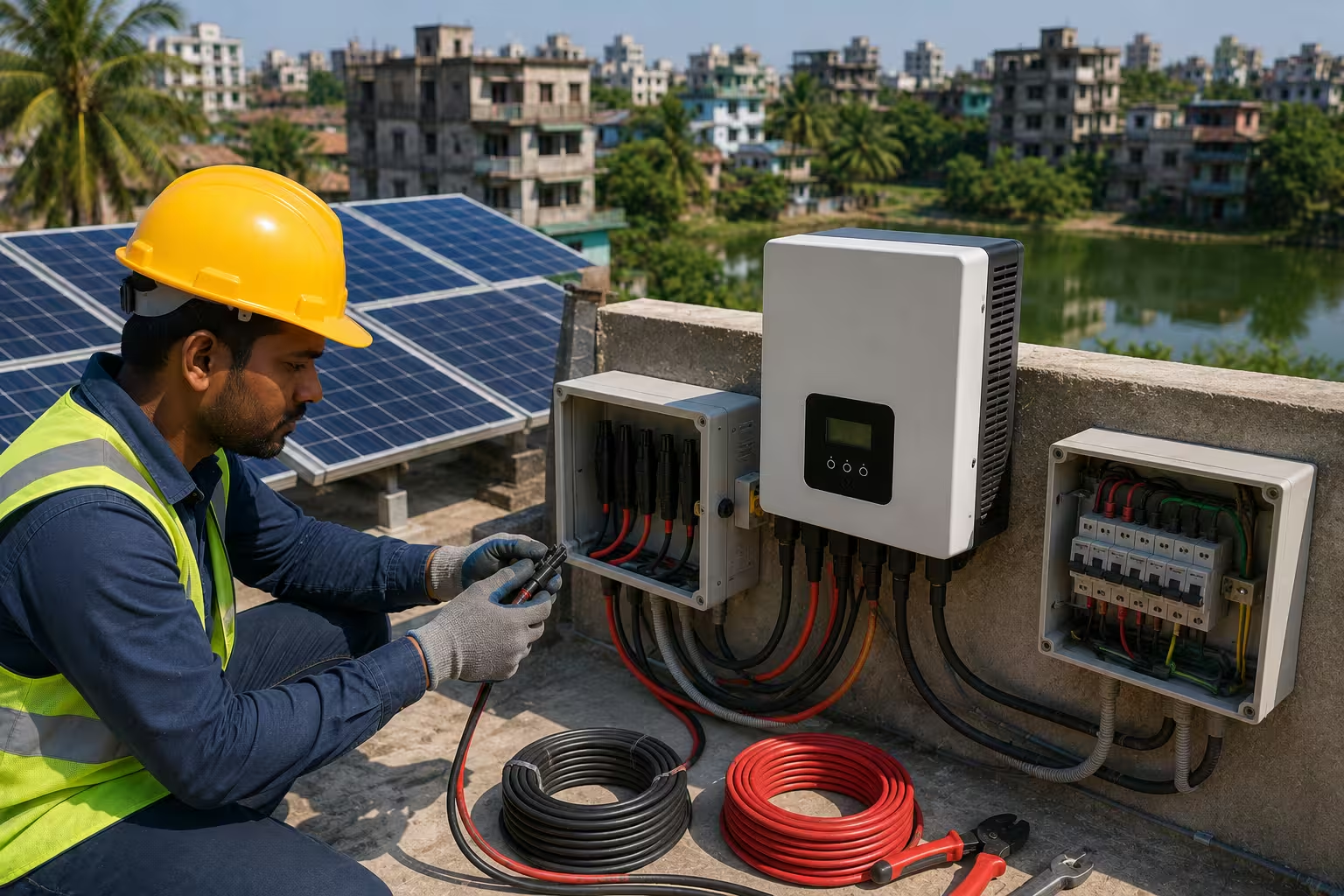
DC cable running from your panels to the inverter isn’t just about the mm² number — it has to survive Bangladesh’s climate, which is not gentle on wiring. We’re talking direct sun exposure on black tin roofs that can push cable surface temperatures well past what the cable rating assumes, plus monsoon humidity for four to five months a year.
That means your DC cable absolutely needs to be UV-resistant and double-insulated — look for EN 50618-rated cable or standard PV Wire, not repurposed household wire, even if a local shop tries to sell you something cheaper “that’ll work fine.” It won’t, not for 20 years on an exposed rooftop.
One practical note from the field: on rooftops with two or three 90-degree bends around parapet walls or conduit runs, a lot of experienced installers just round up to the next cable size rather than trust the calculator to the decimal point. It costs a little more upfront, but it removes one more variable in a climate that’s already working against your cable.
AC Cable: Sizing From the Inverter to Your Board
AC cable sizing works off a tighter target — 1% voltage drop or less from the inverter to your distribution board, compared to the 2% allowance on the DC side. That’s because you’re closer to your actual appliances at this point, and losses here hit your usable power more directly.
For a typical 3kW inverter common in mid-size Dhaka apartments and houses, 2.5mm² to 4mm² AC cable usually covers it. Step up to a 5-10kW system — more common in commercial rooftop installs or larger homes — and you’re looking at 6mm² to 10mm² AC cable. Unlike the DC side, standard THWN-type residential wiring is acceptable here since it’s not exposed to the same UV and weather stress.
Why DC and AC Cables Can Never Share a Conduit
This one trips up a surprising number of DIY installations and small local jobs: DC and AC cables must run in separate conduits, full stop. It’s not a bureaucratic rule — if a DC fault and an AC fault happen close together in a shared conduit, you get arc fault risk that’s genuinely dangerous, not a hypothetical one. Any BNBC-compliant inspection will flag shared conduits immediately, and honestly, it should.
If you’re working with a small local installer who suggests running both together “to save on conduit,” that’s a fair moment to push back.
When You Should Size Up Beyond the Chart
The chart above assumes reasonably straightforward conditions. Size up a level if:
- Your cable run is longer than what’s listed for your system size — every extra meter costs you a fraction of a percent
- Your cable is bundled tightly with other cables in conduit, which traps heat and derates the effective current rating
- You’re in a particularly hot zone — Rajshahi and Khulna summers especially — where ambient temperatures regularly climb hard enough to affect copper’s real-world capacity
- You’re running a ground-mounted array with a long trench or overhead run back to the house, which is common for off-grid systems on larger rural plots
None of these mean you need to jump to the maximum cable size available. It just means don’t assume the base chart number is automatically right for your specific roof and layout.
What Actually Happens If You Undersize It
This is the part that doesn’t get said clearly enough. Undersized DC cable doesn’t trip a breaker and announce itself — it just quietly reduces the voltage reaching your inverter, which reduces your system’s efficiency every single day, invisibly, for as long as the system runs. Over 20-25 years, that’s real money left on the table, on top of the fire risk that comes with cable running hotter than it should under continuous load.
On the AC side, undersizing shows up as voltage drop your appliances actually feel — dimming, motor strain on things like fridge compressors during peak load — plus it’s one of the more common reasons rooftop systems fail inspection under net metering applications.
Bigger cable is technically “safer” in almost every case, but it’s not free — thicker cable costs more, and it’s stiffer to route through tight rooftop conduit runs, especially in older buildings. You don’t need to jump straight to the largest size available; you need the size that keeps you comfortably under the voltage drop limit for your actual run.
This decision connects directly to how your inverter is sized in the first place, and whether you’ve gone with an on-grid setup with net metering or an off-grid system — the cable sizing conversation looks slightly different depending on which path you’re on, since off-grid battery-based systems often run lower string voltages and higher currents for the same wattage.
A Quick Word on Rooftop vs Ground-Mount Runs
If you’re comparing a rooftop installation against a ground-mounted array, cable run length is one of the quieter factors that should influence your decision. Rooftop systems usually keep DC runs short and manageable. Ground-mounted systems — increasingly used on rural plots with more open land — often mean longer trenched runs back to the inverter room, which pushes you toward the higher end of the cable sizing chart almost by default.
Frequently Asked Questions
Can I use regular household electrical wire for solar panels?
No. DC cable running from panels to the inverter needs to be UV-resistant and double-insulated, typically EN 50618-rated or standard PV Wire. Regular household wire isn’t built to survive direct rooftop sun exposure and will degrade far faster, especially through Bangladesh’s monsoon and summer heat cycles.
What size cable do I need for a 5kW solar system in Bangladesh?
For most 5kW rooftop systems, 6mm² DC cable and 6mm² AC cable is the standard starting point, assuming a typical run of 15-40 meters. Longer runs or hotter installation zones may require sizing up — run the voltage drop formula with your actual measurements to confirm.
Do DC and AC solar cables need to be in separate conduits?
Yes, always. Running DC and AC cable together in the same conduit creates arc fault risk and will fail inspection under BNBC-compliant standards. This isn’t optional even on small residential installs.
What happens if my solar cable is undersized?
You lose efficiency silently through voltage drop, which reduces your system’s daily output without any obvious warning sign — no tripped breaker, just a slowly underperforming system. It also increases fire risk from cable running hotter than rated under continuous current.
How do I calculate voltage drop for my solar system?
Use the formula Vdrop (%) = (2 × L × I × ρ) / (A × V) × 100, where L is one-way cable length in meters, I is current in amps, ρ is copper resistivity (0.0175), A is cable cross-section in mm², and V is your string voltage. Keep the result under 2% for DC runs and 1% for AC runs.
Should I follow NEC or IEC sizing standards in Bangladesh?
IEC-based standards apply through the Bangladesh National Building Code (BNBC), not the US NEC code. If you’re referencing an American source, double-check whether their current calculation uses the NEC 1.25 continuous-load multiplier, since IEC guidance typically works from the corrected Isc directly.