
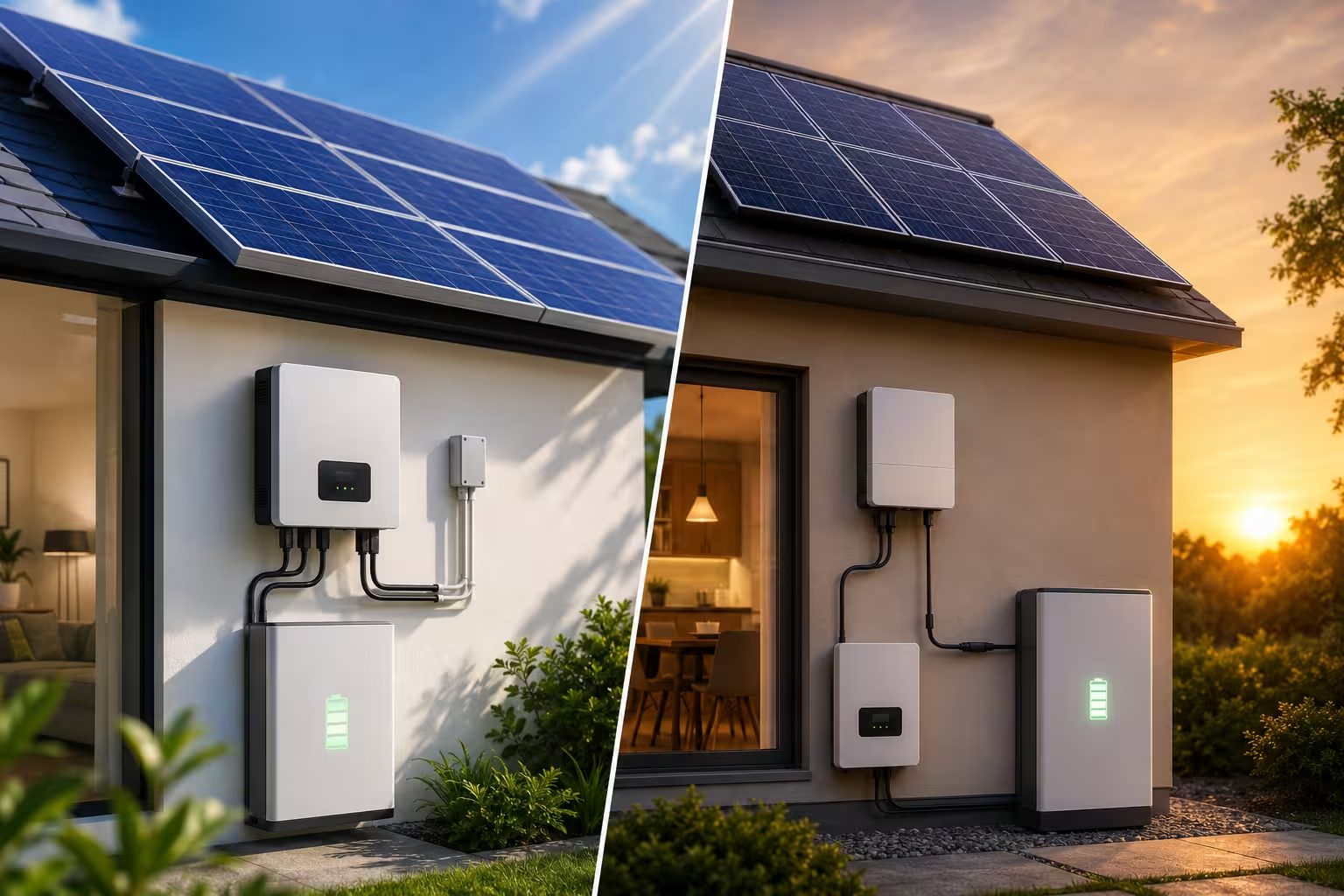
You just decided to add a battery to your solar setup, and now your installer (or your own late-night research) has thrown a new decision at you: AC-coupled or DC-coupled?
Nobody tells you this question is coming until it’s already on the table. And honestly, most of what’s written about it online reads like the same textbook paragraph copied six different ways — DC becomes AC, AC becomes DC again, repeat, repeat, repeat. It’s technically accurate and completely useless if you’re just trying to figure out what to actually buy.
So let’s skip that. Here’s the real answer, the honest numbers, and a straightforward way to figure out which setup fits your house.
The Quick Answer
DC-coupled systems connect your solar panels and battery through one shared hybrid inverter, so the power barely gets converted before it’s stored — that’s what makes them slightly more efficient. AC-coupled systems use two separate inverters, one for the panels and one for the battery, which costs a little efficiency but makes them far easier to bolt onto solar you already have.
If you’re building solar and battery storage from scratch, DC-coupling usually makes sense. If you already have solar panels and just want to add a battery, AC-coupling is almost always the simpler, cheaper path.
That’s the whole decision in two sentences. Everything below is the “why,” plus the parts most articles skip entirely.
How Each System Actually Moves Power
Solar panels produce direct current. Your house — lights, fridge, TV, everything — runs on alternating current. Batteries store direct current. So somewhere in the chain, a conversion has to happen, sometimes more than once.
DC-coupled setups keep it simple: the panels feed DC power straight into the battery through a hybrid inverter, no detour. That inverter only flips the power to AC once it’s on its way out to your home or the grid. One box, one conversion for storage.
AC-coupled setups take a longer route. The panels send power to a solar inverter, which converts it to AC so your home can use it right away. Any extra that’s headed to the battery then gets converted back to DC by a second inverter (the battery’s own inverter) before it’s stored. When you pull that power back out later, it converts to AC one more time. Three conversions total instead of one.
Once you’ve read that paragraph, you don’t need it explained again a different way further down. It’s the same mechanic every time — just remember “DC-coupled: one box, one conversion” and “AC-coupled: two boxes, three conversions,” and you’re set.
AC-Coupled vs DC-Coupled Solar at a Glance
| Factor | DC-Coupled | AC-Coupled |
| Number of inverters | One (hybrid) | Two (solar + battery) |
| Conversions before storage | One | Three |
| Efficiency | Slightly higher | Slightly lower |
| Best for | New solar + battery installs | Adding a battery to existing solar |
| Retrofit friendliness | Harder, often needs new hardware | Easy — works with almost any existing inverter |
| Reliability | Single point of failure | Two inverters, so one failing doesn’t take down the other |
| Brand flexibility | Often locked to one manufacturer | Mostly brand-agnostic |
| Grid charging | Possible, but less common | Common — battery can charge from the grid, not just panels |
| Typical cost | Lower hardware cost for new builds | Slightly higher due to two inverters, but cheaper as a retrofit |
Keep this table handy — it answers most of what people actually want to know before they even finish reading the rest of the article.
Okay, But Which One Is Actually More Efficient?
Here’s where a lot of articles get sloppy, and it’s worth clearing up because the numbers floating around genuinely don’t agree with each other.
You’ll see claims that DC-coupling is “4 to 8% more efficient.” You’ll also see round-trip efficiency numbers like 98% for DC systems versus 90-94% for AC systems. Those aren’t contradicting each other — they’re measuring different things. The 98% vs 90-94% figures describe how much energy survives the round trip into and out of the battery. The 4-8% figure is a rougher, real-world estimate of the overall efficiency gap you’d notice across a whole system, factoring in how the power actually gets used.
The honest takeaway: DC-coupling saves you somewhere in the low single digits to maybe 8% in energy losses compared to AC-coupling, depending on your setup and how much of your solar power goes straight into the battery versus straight into running your house during the day. It’s a real gap, but for most households it’s not going to make or break your electric bill on its own. It matters more for larger systems, off-grid setups, or homes with heavy daytime loads pushing a lot of power through the battery constantly.
If efficiency is your only priority and you’re starting from zero, DC wins. If efficiency is one of five things you care about, keep reading, because the other four might matter more.
New Build vs Retrofit: The Question That Actually Decides This
This, more than efficiency, is what determines which system you’ll end up with.
If you’re installing solar panels and a battery at the same time — new construction, or a full system replacement — DC-coupling is worth strongly considering. You’re buying one hybrid inverter instead of two separate ones, your equipment costs come down, and you get that efficiency edge from day one.
If you already have solar panels with a working inverter and you’re just adding storage, switching to DC-coupling usually means ripping out your existing inverter and starting over. That’s expensive, and it throws away hardware that’s probably still doing its job fine. AC-coupling lets you keep what you have and just bolt a battery system onto the side of it. That’s the whole reason AC-coupling exists as the dominant retrofit choice — it was built for exactly this situation.
If I had to bet, most retrofit situations lean AC-coupled — the flexibility and lower disruption usually outweigh the small efficiency loss, especially once you factor in the cost of tearing out a perfectly good inverter.
The Part Everyone Skips: Reliability and Brand Lock-In
This is genuinely underexplained across most of what’s written on this topic, and it’s a real factor in your decision.
DC-coupled systems run everything through one hybrid inverter. That’s efficient, but it’s also a single point of failure — if that inverter has a problem, you can lose both your solar production and your battery backup at the same time until it’s repaired. AC-coupled systems split the job across two separate inverters, so a fault in one doesn’t necessarily take down the other. Some AC-coupled battery products, like Enphase’s setup, go even further and use multiple small inverters instead of one big one, so a single component failing barely dents the system.
There’s also the brand question. DC-coupled systems generally need the battery and inverter to come from the same manufacturer to talk to each other properly — buy a hybrid inverter from one brand and you’re often locked into that brand’s battery too. AC-coupled systems are much more brand-agnostic, since the battery just needs to plug into your home’s AC side, which basically every inverter can supply. If you like the idea of shopping around for the best battery deal in a few years without replacing your whole system, that flexibility is worth something.
What About Cost?
Nobody gives you a clean answer here, and honestly, the true number depends heavily on your installer, your region, and what brand you go with. But here’s a reasonable, grounded way to think about it.
For a new installation, DC-coupling tends to come out cheaper on hardware, since you’re buying one inverter instead of two. For a retrofit, AC-coupling tends to come out cheaper overall, because you’re not throwing away a working inverter and starting from scratch. The efficiency gap from DC-coupling might save you a bit on your electric bill over the years, but it’s rarely enough to offset the cost of an unnecessary hardware replacement.
The real cost question to ask your installer isn’t “which is cheaper” in the abstract — it’s “given what I already have, which path actually costs less for me.”
A Quick Way to Check What You Already Have
If you’re not sure whether your current solar setup is even AC or DC-coupled, look at your inverter. If it’s a single unit with connections for both your solar panels and a battery, you likely have — or are set up for — a DC-coupled, hybrid system. If you’ve got a standard solar inverter and would need to add a separate battery unit with its own inverter built in, you’re looking at an AC-coupled setup. It’s not a perfect test, but it’s a decent starting point before you call anyone.
Choose DC-Coupled If…
- You’re installing solar panels and a battery at the same time
- You want the highest efficiency and don’t mind being tied to one hybrid inverter brand
- You’re fine with a single point of failure in exchange for simpler, more direct energy flow
- Your home has heavy daytime loads where every bit of conversion loss adds up
Choose AC-Coupled If…
- You already have solar panels and just want to add a battery
- You want the flexibility to mix and match brands, or upgrade your battery later without touching your inverter
- You want built-in redundancy so one component failing doesn’t take out your whole system
- You’re interested in charging your battery from the grid during off-peak hours, or joining a time-of-use or Virtual Power Plant program
Questions Worth Asking Your Installer
- Will I need to replace my current inverter, and what does that add to the cost?
- What’s the actual efficiency difference for a system my size, not just the industry average?
- If one inverter fails, does the rest of my system keep working?
- Am I locked into your battery brand if something changes down the line?
- Can this setup support grid charging or a time-of-use rate plan?
A good installer should be able to answer all five without dodging. If they can’t, that’s worth noting.
Where This Fits Into the Bigger Picture
Coupling type is just one piece of how a solar power system is actually designed. If you’re still getting your head around the basics of how sunlight becomes usable electricity in the first place, it helps to start with how solar energy actually works and the photovoltaic effect that makes panels generate power at all.
It’s also worth understanding how coupling relates to your broader system type. AC and DC coupling both apply within on-grid and off-grid solar systems, and if you’re weighing a hybrid solar system against a fully grid-tied or fully independent setup, that decision will shape which coupling method makes more sense for you. For a broader look at how these system types stack up against each other, comparing solar system types is a good next stop, and if you’re weighing battery storage against staying off-grid entirely, grid-tied battery vs off-grid setups covers that trade-off directly.
Neither AC nor DC coupling is objectively “better” — they’re built for different starting points. DC-coupling rewards you for building clean and building once. AC-coupling rewards you for working with what you’ve already got. Most homeowners aren’t choosing based on a spec sheet; they’re choosing based on whether they’re starting fresh or adding onto something that already works. Once you know which of those two situations you’re in, the rest of the decision mostly makes itself.
FAQs
What’s the difference between AC-coupled and DC-coupled solar?
DC-coupled systems connect solar panels and batteries through a single hybrid inverter, so power converts once before storage. AC-coupled systems use two separate inverters, so power converts up to three times. DC-coupling is slightly more efficient; AC-coupling is easier to retrofit onto existing solar.
Which is more efficient, AC or DC coupled solar?
DC-coupled systems are generally more efficient, with real-world losses roughly 4-8% lower than AC-coupled systems, thanks to fewer power conversions. The gap matters more for larger systems and heavy daytime loads than for the average household.
Can I retrofit a DC-coupled battery onto my existing solar panels?
It’s possible but usually impractical. Switching to DC-coupling on an existing system typically means replacing your current inverter with a compatible hybrid inverter, which adds cost and complexity. AC-coupling is the more common and cost-effective retrofit route.
Do AC-coupled batteries charge from the grid?
Yes. Because AC-coupled batteries connect on the AC side of the system, they can charge from the grid as well as from solar panels, which is useful for time-of-use rate plans or joining a Virtual Power Plant.
Is DC coupling worth the efficiency gain?
For new installations, often yes, since you also save on hardware by using one inverter instead of two. For retrofits, the efficiency gain rarely offsets the cost of replacing a working inverter, so AC-coupling is usually the more practical choice.
Which is safer, AC-coupled or DC-coupled solar?
Both are safe when installed correctly by a qualified electrician. DC wiring carries some additional handling considerations due to higher voltages in certain configurations, but a properly installed system of either type meets standard electrical safety codes.