You Just Spent a Lot on a Solar System. Who’s Covering It If Something Goes Wrong?
Most people who install solar in Bangladesh don’t think about insurance until something happens — a storm rips a panel loose, an inverter catches fire, or an installer’s crew damages a roof during setup. At that point, the question becomes urgent: who pays for this?
The honest answer is: it depends on how you bought the system, and in Bangladesh, that answer is genuinely less standardized than it is in markets like the US or India. There’s no widely marketed “solar insurance” product sitting on a shelf here the way there is for car or health insurance. What exists instead is a patchwork — general fire and property policies, industrial risk covers, and contractual obligations buried inside financing agreements — and most buyers never read that fine print until they need it.
This piece walks through who’s typically responsible for what, for both home and industrial systems, and what you should actually check before you’re relying on someone else’s promise.
Does Home Insurance Cover Solar Panels in Bangladesh?
Short answer: only if you already have a home insurance policy that includes your solar system, and for most Bangladeshi households, that’s a big “if.”
Home insurance simply isn’t as common a household purchase in Bangladesh as it is in the US or UK, where nearly every mortgage requires it. If you don’t already carry a property policy, your solar panels aren’t sitting under some invisible safety net — they’re exposed the same way the rest of your roof and household electronics are.
If you do have a property or content insurance policy, don’t assume solar panels are automatically included just because they’re bolted to your roof. Call your insurer and ask directly. In many cases, a system needs to be specifically declared and added to the policy’s schedule of covered property before a claim will be honored.
The Three Ways Bangladeshis Actually Own Solar Systems — And Who’s Responsible in Each
This is the part most guides — almost all of them written for a US audience — get wrong for Bangladesh. American articles talk about “owned vs. leased” panels as if there are just two categories. Here, there are effectively three, and the insurance responsibility shifts with each one.
1. You bought the system outright (CAPEX). You own it, you’re liable for it, and if you want it insured against fire, storm, or theft, that responsibility sits with you. This is the most common setup for homes and smaller commercial rooftops.
2. It was financed and installed under an EPC/OPEX arrangement (common for factories). Under an OPEX-style model, an EPC company or developer typically owns the equipment and sells you the power it generates, similar in spirit to a lease. In this case, the developer generally carries the insurance obligation — but “generally” isn’t good enough when a fire happens. This needs to be spelled out clearly in your contract, not assumed.
3. It’s part of a shared or apartment-building installation. This one rarely comes up in foreign guides, but it’s a real question for urban Bangladesh: if a system sits on a shared apartment rooftop, is it the individual flat owner’s responsibility, or the building’s management committee’s? There’s no universal rule — it depends entirely on how the building’s bylaws and any homeowners’ association handle shared structures. If your building doesn’t have this written down anywhere, that’s worth raising at the next committee meeting, before there’s a claim to argue about.
| Ownership model | Who typically carries insurance responsibility | What to verify |
| Self-owned (CAPEX) | The homeowner or business owner | Whether your property policy actually lists the system, or whether you need a separate fire/property cover |
| EPC/OPEX-financed | The developer or EPC company | Get this in writing in the contract — don’t rely on a verbal assurance |
| Shared apartment rooftop | Unclear by default | Check your building’s bylaws or raise it with the management committee |
If you’re still working out which financing route makes sense for your situation, our breakdown of CAPEX vs. OPEX solar financing and PPA vs. owned systems covers the trade-offs in more depth.
What Actually Gets Covered — and What Doesn’t
Where a policy does exist (whether a dedicated fire policy, an Industrial All Risk cover, or an add-on to an existing property policy), it typically protects against:
- Fire and electrical faults
- Storm, lightning, and cyclone damage — genuinely relevant given Bangladesh’s monsoon season and coastal cyclone exposure
- Theft of panels or inverters
- Structural collapse of the mounting system
What it usually does not cover:
- Gradual performance loss or degradation — that’s a manufacturer warranty matter, not an insurance one
- Damage caused by poor installation workmanship — this is where installer liability comes in, covered below
- Equipment that was never properly declared to the insurer in the first place
It’s worth understanding this distinction clearly, because a lot of first-time solar buyers assume their 20-25 year panel warranty functions like insurance. It doesn’t. A warranty protects against manufacturing defects; insurance protects against external events like fire and storms. Our warranty guide goes into how the two are structured differently.
Who’s Liable If Something Goes Wrong During Installation?
This is where residential and industrial readers often overlap in concern, and it’s a gap most competitor content barely touches.
Before your system is switched on, damage or accidents during installation — a cracked roof tile, a panel dropped and shattered, a worker injured on-site — should be the installer’s or EPC contractor’s liability, not yours. A credible installer should already be carrying their own liability insurance for exactly this reason.
Before signing any installation contract, it’s worth asking directly:
- Does your company carry liability insurance covering installation-period accidents?
- Who is responsible for damage to my roof or property during the work?
- What happens if equipment is damaged before commissioning?
If an installer hesitates or can’t answer clearly, treat that as a warning sign. Our checklist for choosing a solar installer and guide to evaluating solar quotes both cover questions worth asking before you commit.
Industrial and Commercial Solar: A Bigger Liability Picture
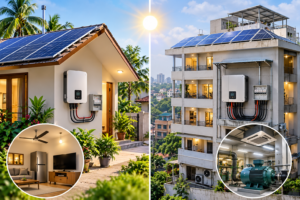
For factories — particularly the RMG and light manufacturing facilities that make up a large share of Bangladesh’s rooftop solar demand, often concentrated around Dhaka, Gazipur, and Narayanganj’s industrial belts — the insurance conversation extends well beyond fire and theft.
A few risks specific to commercial-scale systems:
- Business interruption. If a rooftop system that offsets a meaningful share of your electricity bill goes down, the financial impact isn’t just repair cost — it’s the higher grid electricity bill you’re paying in the meantime. Larger operations sometimes build this into their existing business interruption cover rather than treating it as a solar-specific product.
- Product and installation liability. If a component fails and causes damage, or if faulty workmanship causes a fire, who’s on the hook — the manufacturer, the EPC contractor, or the facility owner? This should be defined in your installation contract, not left to assumption.
- Existing Industrial All Risk (IAR) policies. Many factories already carry a broader property or IAR policy. Rather than assuming solar assets are automatically swept into that cover, it’s worth confirming with your insurer whether the system needs to be specifically added.
Bangladesh’s insurance sector is regulated by IDRA (the Insurance Development and Regulatory Authority), and while private power generation companies now have the freedom to choose any licensed insurer rather than being tied to a single state provider, that flexibility only helps if you actually use it — shop the cover, don’t just accept whatever your EPC contractor bundles in by default.
If you’re weighing financing structures for a factory-scale system, our guides on solar for industries and net metering vs. gross metering are useful next reads, since your metering arrangement affects how a production loss actually hits your bottom line.
What to Actually Ask Before You’re Relying on “It’s Covered”
Whether you’re a homeowner or a facility manager, the practical move is the same: don’t take “it’s covered” at face value from an installer, a developer, or a well-meaning neighbor who installed solar last year. Ask your insurer or contractor directly:
- What perils are specifically included, and what’s excluded?
- Does this system need to be individually listed on the policy, or is it assumed to be covered?
- What documentation will I need at claim time — installation invoice, contract, photos, commissioning report?
- If this is a financed or EPC-owned system, where exactly does that obligation appear in my contract?
At Muspana, this is a conversation we have often with people midway through a solar decision — not because insurance is complicated in principle, but because the market here hasn’t standardized it the way it has for more established products. Getting clear, written answers before you sign anything saves a lot of frustration later.
The Bottom Line
There’s no single “solar insurance” box to tick in Bangladesh the way there might be for car insurance. What protects your system depends on whether you own it outright, whether it’s financed under an EPC arrangement, and whether your existing property or industrial policy has actually been updated to include it. The safest assumption is the least comfortable one: nothing is automatically covered until you’ve confirmed it in writing.
FAQs
Does home insurance automatically cover solar panels in Bangladesh?
No. Most Bangladeshi households don’t carry a home insurance policy to begin with, and even where one exists, solar panels usually need to be specifically declared to the insurer rather than being automatically included.
Who insures a solar system installed under an EPC or financed arrangement?
Typically the EPC company or developer that owns the equipment, since they retain ownership under most OPEX-style models. This should be confirmed in writing in your contract rather than assumed.
What’s the difference between a solar warranty and solar insurance?
A warranty covers manufacturing defects and guarantees a certain performance level over time. Insurance covers external events like fire, storms, theft, or structural damage. They’re not interchangeable.
Is the installer responsible if my roof is damaged during installation?
Generally, yes — damage or accidents during the installation period should fall under the installer or EPC contractor’s own liability insurance, not the homeowner’s policy. Confirm this before signing a contract.
Who is responsible for insuring a solar system on a shared apartment rooftop?
There’s no fixed rule — it depends on your building’s bylaws or management committee arrangements. If this isn’t documented, it’s worth raising with the committee before an issue comes up.
Do factories need a separate policy for their solar systems, or does an existing Industrial All Risk policy cover it?
Not automatically. Even if a factory already carries a broader property or Industrial All Risk policy, the solar system typically needs to be specifically added and confirmed with the insurer rather than assumed to be included.