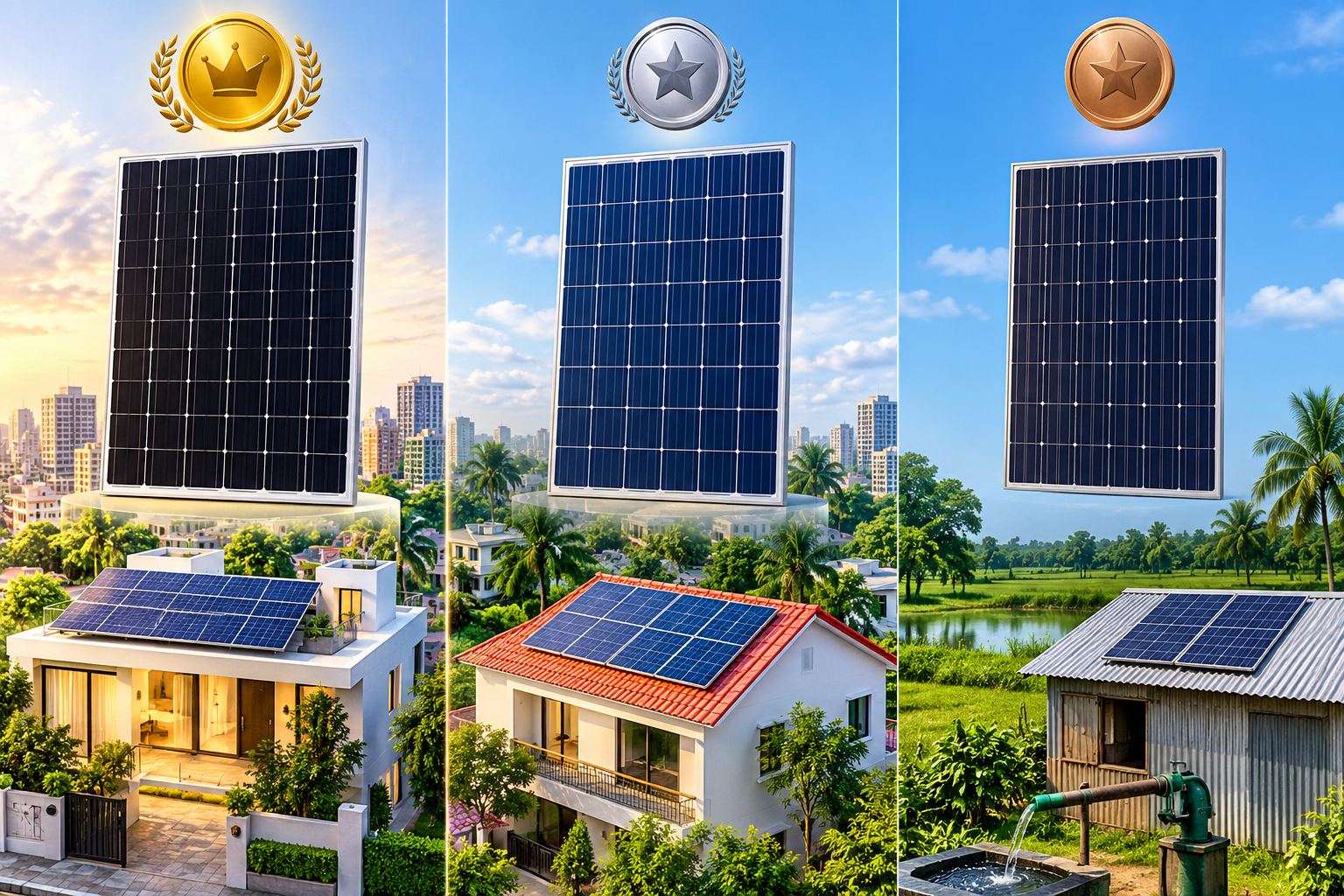
Open almost any solar panel listing in Bangladesh right now — a marketplace page, a distributor’s Facebook post, a printed quotation — and you’ll see the same word stamped across it: Tier 1. It shows up so often that it’s stopped meaning much to most buyers. It’s just there, like “genuine” or “original,” a word sellers add because they think it should be there.
That’s a problem, because the term actually does mean something specific. It just doesn’t mean what most people assume.
Tier doesn’t rate the panel — it rates the company behind it
Here’s the direct answer: a solar panel’s “tier” measures how financially stable and established its manufacturer is, not how good the panel itself performs. It’s a bankability rating, not a quality grade.
The classification comes from Bloomberg New Energy Finance (BloombergNEF, or BNEF), a research arm of Bloomberg that tracks the renewable energy industry. BNEF publishes a quarterly list of manufacturers it considers “Tier 1” — companies that banks and project financiers are comfortable lending against, because they’ve been producing panels for several years, have a strong balance sheet or public listing, and run highly automated, vertically integrated factories.
That list exists for one audience originally: banks financing large solar projects, who needed a quick way to judge whether a manufacturer would still be solvent enough, years down the line, to honour a warranty claim. It was never designed as a consumer buying guide. Retailers borrowed the term because “Tier 1” sounds authoritative, and over time it drifted from a finance term into a marketing sticker.
There’s an important detail almost no BD product page mentions: only Tier 1 is an official BNEF classification. “Tier 2” and “Tier 3” aren’t published lists — they’re informal shorthand the industry uses for “everyone else,” roughly split by how established and quality-controlled the manufacturer appears to be. When you see “Tier 2” or “Tier 3” on a spec sheet, understand it as an industry description, not a certificate.
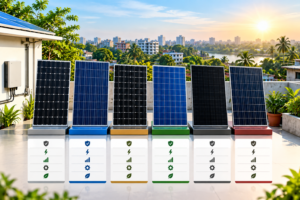
Tier 1 vs Tier 2 vs Tier 3, side by side
| Tier 1 | Tier 2 | Tier 3 | |
| What it signals | Financially established, bankable manufacturer (BNEF-recognised) | Mid-sized manufacturer, moderate track record | Small or new manufacturer, limited track record |
| Typical cost | Highest — often cited at roughly 10–30% above Tier 2/3 pricing (industry estimate, varies by market and time) | Lower than Tier 1 | Lowest upfront cost |
| Manufacturing | High automation, strong quality control, vertically integrated | Moderate automation; quality varies by factory | Often manual assembly, minimal in-house R&D |
| Warranty enforceability | Strongest — company more likely to still exist to honour a 20–25 year warranty | Uncertain — depends on the specific company’s stability | Weakest — real risk the manufacturer won’t exist when a claim is due |
| Best suited for | Residential rooftops, bank-financed commercial projects | Commercial projects, only when backed by independent test data | Short-lifespan or non-critical uses; generally not recommended for permanent installations |
Treat the cost figures as a general industry pattern, not a fixed rule — actual pricing depends on the specific brand, order volume, and market conditions at the time you buy.
“Tier 1” and “Grade A” are not the same thing
This is where most confusion happens, and it’s worth being blunt about it: Tier 1 tells you about the company. Grade A tells you about the individual cells.
Grade A cells are the ones that pass a manufacturer’s own quality inspection with no visible defects, consistent output, and no micro-cracks. Grade B or C cells have minor cosmetic or performance flaws and get sold at a discount, sometimes without being labelled as such. A Tier 1 company can still produce Grade B panels — bankability doesn’t guarantee every unit off the line is flawless. And in principle, a smaller Tier 2 factory can turn out excellent Grade A panels, if its quality control is genuinely strong.
In practice, though, the two tend to correlate. Tier 1 manufacturers generally have the automation and inspection systems (like electroluminescence, or EL, testing on every panel) that catch defects Tier 3 factories might miss with spot-checks alone. So while tier and grade aren’t the same measurement, tier is a reasonable proxy for the consistency of quality control behind a panel — just not a guarantee of it.
How to actually check if a panel is Tier 1
Don’t take a seller’s word for it. BNEF’s Tier 1 list is public, and checking a manufacturer against it takes a few minutes:
- Ask for the exact manufacturer name printed on the panel’s datasheet — not the reseller’s brand, the factory that made the cells and assembled the module.
- Search that manufacturer name against BNEF’s most recently published Tier 1 PV Module Maker list.
- If the manufacturer isn’t on the list, that doesn’t automatically mean the panel is bad — but it does mean you’re relying on that specific company’s track record, not a recognised bankability rating.
- For a commercial or industrial order, ask whether independent reliability data exists for that model — PVEL’s annual PV Module Reliability Scorecard is the most commonly cited independent source, and it tests panels regardless of tier.
If a supplier can’t or won’t tell you the actual manufacturer name, that’s worth treating as a warning sign in itself.
Why the tier matters more in Bangladesh than the term suggests
Nearly every solar panel sold in Bangladesh is imported — the country doesn’t have large-scale domestic cell manufacturing, so brands like Longi, Jinko, Trina, JA Solar, Canadian Solar, and REC reach buyers through local distributors and installers rather than direct factory relationships.
That changes what a warranty is actually worth. In the manufacturer’s home market, a buyer with a failed panel and an unresponsive company has courts, consumer protection bodies, and industry associations to lean on. A homeowner in Bogura or Sylhet doesn’t have that same direct line to a factory in China or Southeast Asia. In practice, your warranty claim almost always runs through your local installer or distributor — which means the manufacturer’s long-term stability matters, but so does whether the local company you bought from is still around and willing to chase the claim on your behalf.
This is the real reason Tier 1 carries extra weight for a rooftop system in Bangladesh: it’s one of the few signals you have that the company behind the panel is unlikely to disappear before your 25-year warranty period ends. It doesn’t replace due diligence on your local installer — it complements it.
Which tier actually fits your project
For a home rooftop system, Tier 1 is generally the safer default. A residential system is a long-term, largely unmonitored investment — most homeowners aren’t checking panel output daily, so a slow, undetected performance drop from a lower-quality panel can go unnoticed for years. The extra upfront cost buys peace of mind on a purchase you’re not going to revisit for two decades.
For commercial and industrial projects, the picture is a little more flexible. If your facility team or contractor has access to independent reliability data — PVEL scorecards, third-party test reports, or a track record with a specific Tier 2 manufacturer — a Tier 2 panel can be a defensible choice, particularly where procurement is optimising for total project cost across a large array. It’s not a blanket downgrade; it’s a decision that should be backed by data rather than price alone.
Tier 3 panels are generally best avoided for any installation you expect to last. The upfront saving rarely holds up against 20+ years of higher defect risk, faster degradation, and warranty terms that may be unenforceable in practice.
If you’re evaluating a specific quotation, it helps to read it alongside a guide on evaluating solar quotes and the common pitfalls covered in solar buyer mistakes — tier is one factor among several, including inverter quality, mounting design, and the installer’s own track record.
Muspana works with panel sourcing decisions like this regularly, and if you want a second opinion on whether a specific panel in your quotation is genuinely Tier 1 — or whether a Tier 2 option makes sense for your project — that’s a conversation worth having before you sign anything.
FAQs
Is Tier 1 the same as A-Grade?
No. Tier 1 rates the manufacturer’s financial stability and bankability; A-Grade rates the quality of the individual solar cells. A Tier 1 company can still produce lower-grade panels, though strong Tier 1 manufacturers generally have better quality control overall.
Does a Tier 1 rating guarantee the panel won’t have defects?
No. Tier 1 lowers the risk of buying from a manufacturer that disappears before your warranty ends, but it doesn’t guarantee zero defects. Ask about the specific panel’s test data and inspection process, not just its tier.
Is Tier 2 ever a reasonable choice?
Yes, particularly for commercial projects where independent reliability data (such as PVEL scorecards) supports a specific manufacturer’s performance. For most home installations, Tier 1 remains the lower-risk default.
How can I check if a panel is really Tier 1?
Get the exact manufacturer name from the panel’s datasheet and check it against BloombergNEF’s current Tier 1 PV Module Maker list. A reseller’s brand name isn’t always the same as the actual manufacturer.
Why does tier matter more for buyers in Bangladesh?
Almost all panels sold in Bangladesh are imported, so warranty claims typically run through a local distributor or installer rather than the manufacturer directly. A financially stable, Tier 1 manufacturer is less likely to disappear during your system’s 20–25 year warranty period, which matters when your recourse is already indirect.
Are Tier 3 panels worth buying to save money?
Generally not for a permanent rooftop installation. The upfront savings are usually outweighed by higher defect rates, faster degradation, and warranty terms that may be difficult or impossible to enforce years later.