One Big Inverter, or Many Small Ones?
Every utility-scale solar project eventually runs into this question. Do you convert DC power to AC in one large, centralized unit, or spread that job across dozens of smaller string inverters scattered across the site? For a 5 MW or 50 MW plant on flat land, the answer used to be obvious. It’s less obvious now — but for the right site, a central inverter is still the most efficient way to run a large plant.
Here’s what that choice actually involves, and where it fits into a Bangladeshi solar developer’s decision.
What Is a Central Inverter?
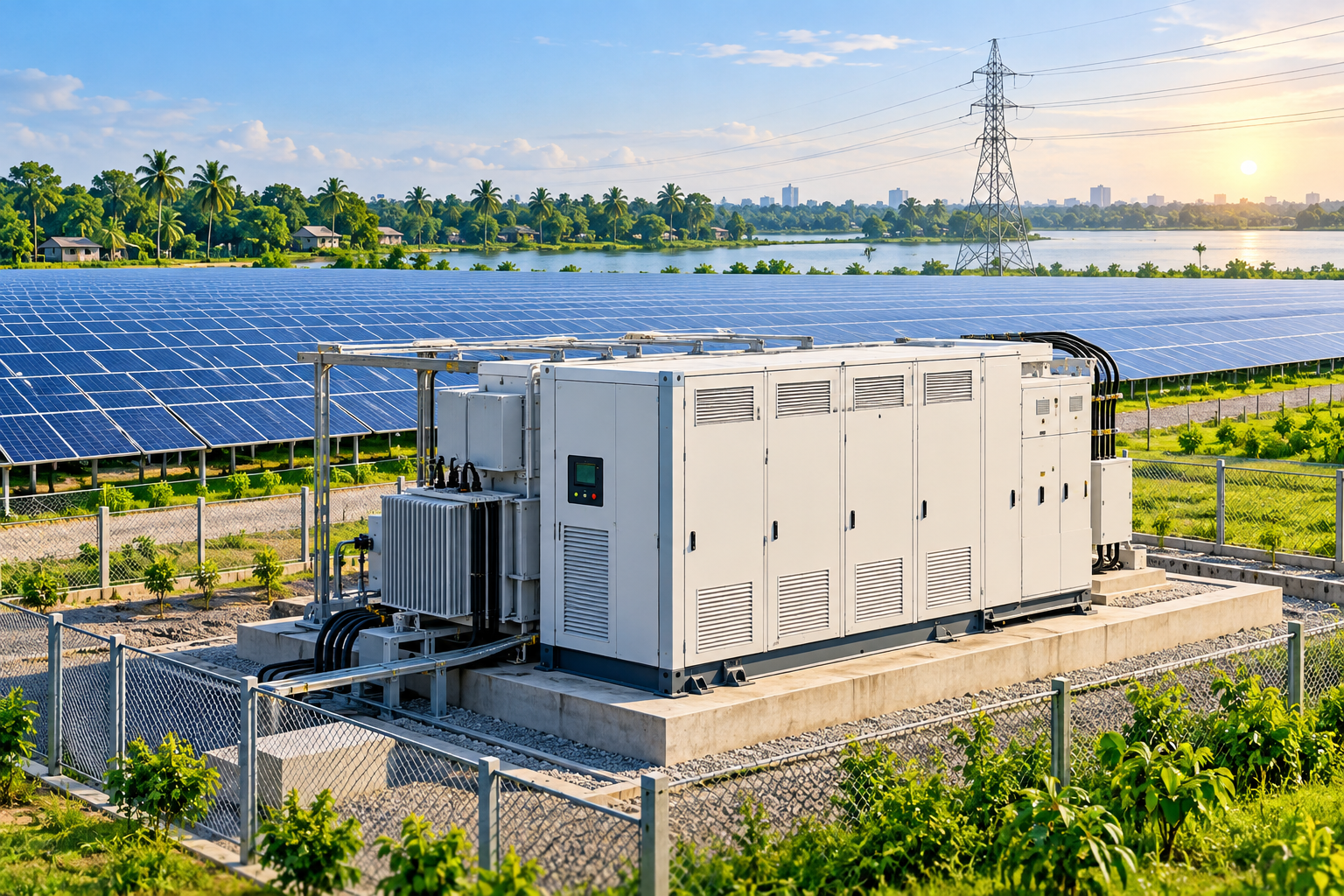
A central inverter is a high-capacity power conversion unit — typically ranging from around 500 kW up to 6.8 MW — built specifically for utility-scale and large ground-mounted solar farms. Instead of converting DC to AC panel-by-panel or in small clusters, it pulls DC power from thousands of panels through combiner boxes and converts it all in a single, centralized station.
Think of it as the difference between many small water pumps versus one large pumping station feeding an entire irrigation network. Fewer moving parts, one place to manage, and — done right — a lower cost per watt.
How Central Inverters Actually Work
The process is straightforward in concept, even if the hardware is substantial:
- Panels are grouped into strings.
- Strings feed into combiner boxes distributed across the array.
- Combiner boxes aggregate DC power and send it to the central inverter.
- The central inverter performs a single, large-scale DC-to-AC conversion.
- AC power moves to a transformer and onward to the grid connection point.
That aggregation step is what defines the architecture. You’re not managing conversion at thousands of individual points — you’re funneling everything toward one power block.
Why Developers Choose Central Inverters
Lower cost per watt at scale. Fewer conversion units generally means less hardware, less wiring complexity, and lower cost per watt for large plants — though the exact figure depends heavily on project size, site conditions, and supplier, so treat any specific number you see quoted as an estimate rather than a fixed price.
Simple, scalable design. Central inverters typically come in discrete capacity blocks — say, 3 MW increments — which makes scaling a plant a matter of adding blocks rather than redesigning the whole system.
Fewer components to manage. With one main conversion point instead of dozens scattered across the site, monitoring and physical infrastructure stay simpler, which matters when your O&M team is small.
That’s the appeal. But it comes with real trade-offs.
The Catch: One Big Unit Means One Big Risk
This is the part that gets glossed over in a lot of technical write-ups. If a central inverter goes offline, a large portion of the plant’s output goes down with it — not just one string, the whole block. On a 30 MW site with a handful of central units, losing one for a few days during a fault is a meaningful revenue hit, not a rounding error.
Modern designs help here. Many manufacturers now build central inverters with modular internal power blocks, so a technician can swap a failed section rather than take the whole unit offline for repair. It reduces the downside, but it doesn’t erase it — the failure impact is still concentrated in a way that string inverter setups avoid by design.
There’s also a terrain constraint. Central inverters have fewer MPPT (Maximum Power Point Tracking) inputs than string inverter systems, which makes them less forgiving on sites with partial shading, mixed panel orientations, or uneven terrain. They perform best on flat, uniform land with consistent sun exposure across the whole array — not a rooftop with three different roof angles, and not a site boxed in by trees or nearby structures.
Central Inverter vs. String Inverter: A Quick Comparison
| Factor | Central Inverter | String Inverter |
| Typical capacity | 500 kW – 6.8 MW | A few kW – tens of kW per unit |
| Best site type | Flat, uniform terrain | Mixed terrain, shading, varied orientation |
| MPPT flexibility | Low (fewer inputs) | High (more granular tracking) |
| Cost per watt at scale | Generally lower | Generally higher at utility scale |
| Failure impact | High — one unit affects a large output share | Low — failure isolated to one string |
| O&M complexity | Fewer units, but specialized service required | More units, but simpler individual servicing |
| Ideal project type | Large, uniform utility-scale farms | Smaller, complex, or mixed-condition sites |
Neither one is universally “better.” It’s a fit question, and the site tells you the answer more than the spec sheet does.
When a Central Inverter Makes Sense — and When It Doesn’t
A central inverter is worth serious consideration when:
- The site is large (typically several MW and up) with flat, consistent terrain
- Sun exposure is uniform across the array, with minimal shading concerns
- The project has, or can access, a professional O&M team capable of specialized servicing
- Cost per watt at scale is a priority over architectural flexibility
It’s probably the wrong fit when:
- The land is uneven, partially shaded, or has mixed panel orientations
- The project is smaller and doesn’t benefit from the economies of scale central units offer
- Local service support for the chosen brand is uncertain, and downtime risk is a serious operational concern
That last point matters more in Bangladesh than in a market with dense local service networks.
Where Central Inverters Fit in Bangladesh
Bangladesh’s larger utility-scale solar parks — several of which sit on flat delta land or char (river-formed) terrain in regions like Rajshahi or the north — actually suit the terrain profile central inverters need. Uniform land with predictable sun exposure is exactly the setup where a central inverter’s limited MPPT flexibility isn’t a real drawback.
The harder question is service. None of the major manufacturers — Sungrow, SMA, FIMER, Gamesa Electric, or Chint Power Systems — are based in Bangladesh, which means spare parts and specialized repair support depend on import logistics and whichever local partners the manufacturer works with. That’s not a reason to avoid central inverters, but it is a reason to ask hard questions before signing a contract: How fast can a technician actually get to site? Is a spare power block held locally, or does it ship from abroad if something fails? For a plant where downtime on one unit can affect a meaningful share of output, those answers matter as much as the spec sheet.
Bangladesh’s pool of technicians trained specifically on central inverter systems is also still growing. It’s not a dealbreaker for a project with a competent EPC partner, but it’s worth building into the O&M plan and budget from day one rather than assuming support will simply be available when needed.
On cost, expect central inverters to generally run lower per watt than string inverter setups at true utility scale — that’s a widely observed industry pattern, not a guaranteed number for any specific project. Landed cost in Bangladesh will also carry import duty, freight, and installation on top of the base equipment price, so any per-watt figure you see quoted from a foreign source needs local adjustment before it means anything for your budget.
Leading Central Inverter Manufacturers
A handful of manufacturers dominate this segment globally:
- Sungrow
- SMA
- FIMER
- Gamesa Electric
- Chint Power Systems
Each has its own strengths in efficiency, modularity, and regional support networks — worth a direct comparison based on your project’s location and available local servicing before choosing, rather than picking on brand recognition alone.
Getting the Decision Right
Choosing between central and string architecture isn’t really an inverter question first — it’s a site and O&M question. The inverter choice follows from those answers, not the other way around. If you’re planning a utility-scale project in Bangladesh and want help thinking through inverter architecture against your specific site conditions and service constraints, Muspana works with developers on exactly this kind of planning decision.
FAQs
What capacity range do central inverters cover?
Central inverters typically range from about 500 kW up to 6.8 MW per unit, which is why they’re used almost exclusively on utility-scale and large ground-mounted projects rather than rooftop systems.
Are central inverters cheaper than string inverters?
At true utility scale, central inverters generally offer a lower cost per watt due to fewer components and simpler large-block infrastructure. The exact difference depends on project size, site conditions, and supplier, so it’s worth getting project-specific quotes rather than relying on a general figure.
What happens if a central inverter fails?
A failure can take a significant share of the plant’s output offline, since one unit typically handles a large portion of the array. Many modern central inverters use modular internal power blocks, which allows a technician to replace the failed section rather than shutting down the entire unit for an extended repair.
Are central inverters suitable for shaded or uneven sites?
Not usually. Central inverters have fewer MPPT inputs than string inverter systems, so they perform best on flat, uniform terrain with consistent sun exposure. Sites with partial shading or mixed panel orientations are generally better served by string inverters.
How much maintenance do central inverters need?
They require specialized servicing, and any downtime affects a larger share of output than with distributed string inverters. Because none of the major manufacturers are based in Bangladesh, it’s worth confirming local spare-parts availability and technician response time before committing to a brand.
Do Bangladesh’s solar parks suit central inverter architecture?
Many of Bangladesh’s utility-scale sites sit on flat delta or char land with fairly uniform sun exposure, which generally suits central inverters well. The bigger consideration locally is service and support access rather than the terrain itself.