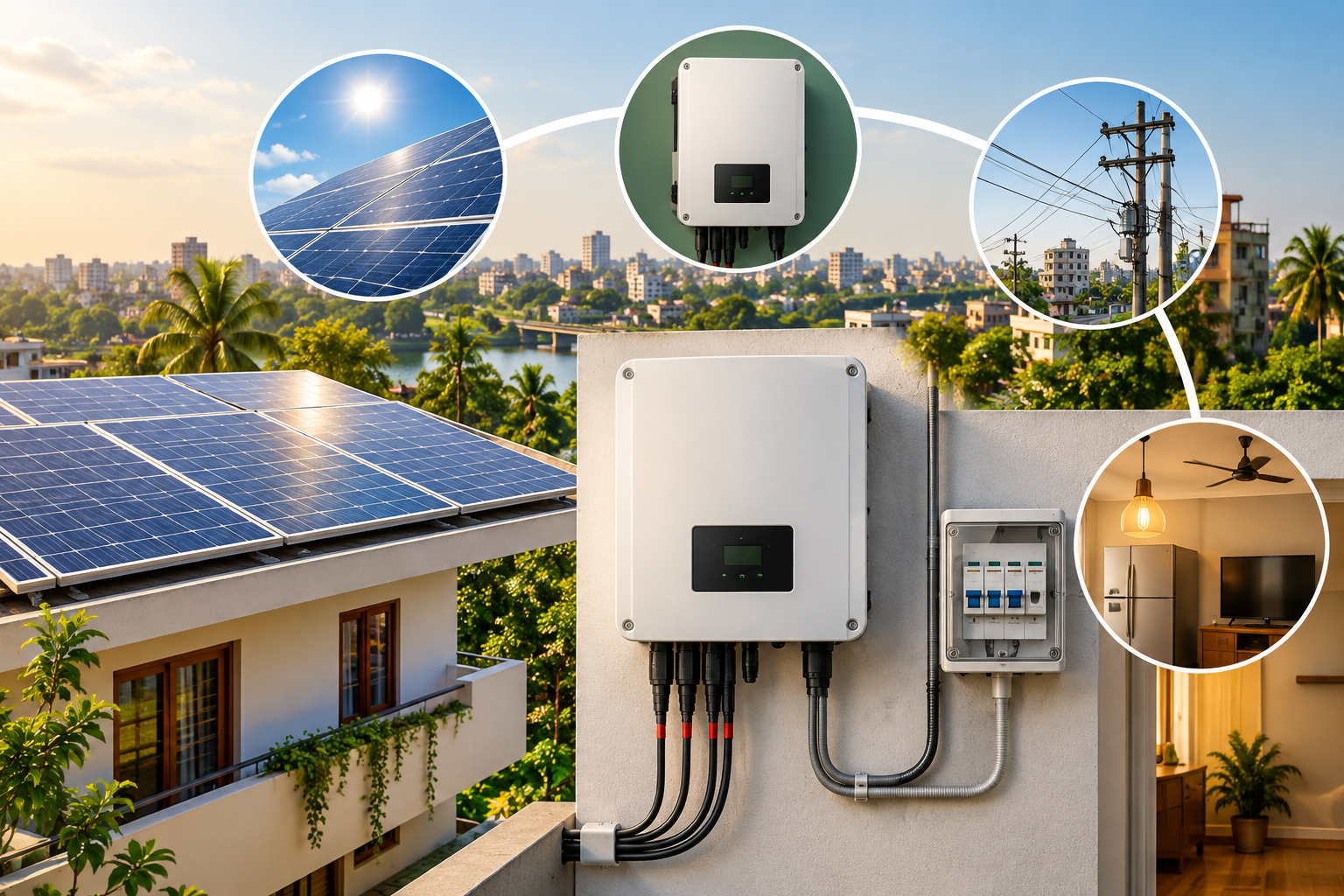
Your installer mentioned a “string inverter” — now what?
If you’ve gotten even one solar quote in Bangladesh, you’ve probably run into this term without much explanation attached to it. Someone hands you a proposal, points at a line item, and moves on to the panel brand instead. That’s a problem, because the inverter is arguably the part of your system most likely to need attention again before the panels do.
Here’s the short version: a string inverter is the most common way solar systems convert power today, and for most rooftops in Bangladesh, it’s a sensible choice. But “most rooftops” isn’t “every rooftop,” and there are a few Bangladesh-specific questions — about load-shedding, battery backup, and grid rules — that most guides on this topic never touch. Let’s fix that.
What a string inverter actually does
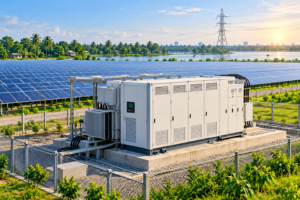
A string inverter takes the direct current (DC) electricity produced by a group of solar panels wired together — a “string” — and converts it into the alternating current (AC) electricity your home or business actually runs on. One inverter typically handles several strings at once, each with anywhere from a handful to over a dozen panels wired in series.
Inside, the inverter is constantly doing something called Maximum Power Point Tracking (MPPT) — adjusting itself to pull the most usable power out of each string as sunlight conditions shift through the day. Think of it as one manager overseeing several small teams: efficient when everyone’s working under similar conditions, less efficient if one team is stuck in the shade while the others are in full sun.
That last point matters more than most people realize, and we’ll come back to it.
Why string inverters dominate the market
Cost is the biggest reason. String inverters are generally the cheapest option per watt among the main inverter types, which is a large part of why they’ve become the default for residential and commercial rooftop solar worldwide — in markets like India, they account for roughly 85% of solar installations as of 2025. That figure is a regional data point, not a Bangladesh statistic, but it reflects a broader pattern that holds here too: for a straightforward, unshaded roof, a string inverter usually gives you the best balance of performance and price.
Modern units also run efficiently — up to around 98% at their peak — and because there’s one central unit instead of dozens of small components spread across the roof, monitoring and troubleshooting tend to be simpler. If something needs attention, there’s one place to look.
One detail worth knowing: many current string inverters support what’s called DC oversizing, where you connect a bit more panel capacity than the inverter’s rated output (commonly 115–130%). This sounds counterintuitive, but it can lift annual energy yield by roughly 4–9%, since it helps the system produce closer to full output during the hazier, lower-light hours rather than only at solar noon.
String vs. microinverter vs. central inverter
| Feature | String Inverter | Microinverter | Central Inverter |
| Optimization level | Per string (group of panels) | Per individual panel | Per large array |
| Shade tolerance | Low to medium — shading one panel drags down its whole string | High — each panel works independently | Lowest — shading affects the entire array |
| Typical cost | Low | High | Very low per watt, but only at utility scale |
| Best fit | Unshaded residential/commercial roofs | Complex, shaded, or multi-orientation roofs | Utility-scale ground-mounted farms (5 MW+) |
If your roof gets consistent sun across its full surface — no chimney shadow creeping across it mid-afternoon, no tree line clipping one corner — a string inverter will usually perform close to its full potential. If your roof has genuinely mixed shading or panels facing two or three different directions, that’s when the per-panel independence of a microinverter starts to earn its higher price tag.
Where string inverters fall short
This is the part sales conversations tend to skip. A string inverter treats each string as one unit, so if a single panel in that string is shaded, dirty, or degraded, it can pull down the output of every other panel wired to it — not just its own production. On a roof with awkward angles, partial shading from a neighboring building, or a water tank casting a shadow for part of the day, this can quietly cost you more energy than the inverter’s price tag saved you.
They also operate at fairly high DC voltages — often in the 300–1000V range — which is standard and safe when installed correctly, but it does mean installation quality matters. This isn’t a DIY component.
What actually matters for a Bangladesh rooftop
This is where most string inverter guides — largely written for the US, UK, or Indian markets — stop being useful. A few things deserve more weight here than they get elsewhere.
Load-shedding and battery readiness. In much of Bangladesh, grid outages aren’t a rare inconvenience — they’re a planning consideration. A plain grid-tied string inverter shuts down during a grid outage by design (it’s a safety requirement, not a flaw), which means it won’t power your home when the grid goes down, even if the sun is out. If backup power during outages matters to you, you’ll want a hybrid-capable string inverter, built to work with a battery bank — worth reading up on if you’re comparing on-grid, off-grid, and hybrid solar systems.
Net metering fit. Bangladesh’s net metering framework ties your allowed system size to your sanctioned electrical load, and the specifics have been updated in recent years. Your inverter capacity needs to line up with what your utility will actually approve — this is something to confirm directly with your installer or utility at design stage, not something to assume from a generic guide (rules like this shift, so treat any number you read online as a starting point for a conversation, not a final answer).
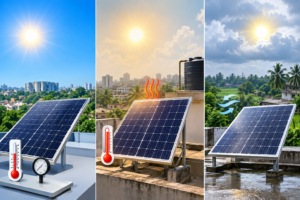
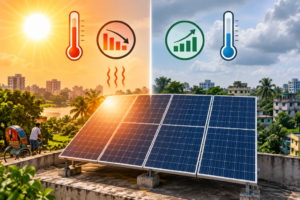
Heat, humidity, and dust. Bangladesh’s climate is harder on electronics than the mild climates a lot of source material for these guides is written in. Look for an inverter rated for adequate ambient temperature tolerance, and make sure it’s mounted somewhere with real airflow — a cramped, sun-baked utility room will shorten the life of almost any inverter, regardless of brand.
Budget sensitivity. For most households and small businesses here, upfront cost carries real weight, not just theoretical weight. String inverters being the lower-cost option isn’t a footnote — it’s often the deciding factor, provided your roof doesn’t have the shading problems that would make a microinverter worth the premium.
Home vs. industrial: does the calculation change?
For a home in Dhaka or a smaller city, the decision usually comes down to roof shape, shading, and whether backup power during outages matters enough to justify a hybrid setup.
For a factory rooftop in an industrial area like Gazipur or Narayanganj, the calculation shifts. Larger arrays typically use several string inverters rather than one, partly for redundancy — if one unit needs servicing, it doesn’t take the whole system offline, unlike a single central inverter failure on a very large array. Facility managers also tend to care more about per-string monitoring, since catching an underperforming string early on a large commercial roof can mean the difference between a quick fix and months of quietly lost output. If you’re managing a larger site, it’s worth looking into string monitoring systems specifically.
How long do they last, and what does upkeep involve?
String inverters generally have a shorter expected lifespan than solar panels — panels are often rated for 25+ years, while inverters more commonly last somewhere in the 10–15 year range before needing replacement or major servicing, though this varies by brand, build quality, and operating conditions. That’s not a flaw unique to string inverters; it’s true of inverter technology generally.
Reduced output compared to your system’s historical performance, unusual noise, or error codes on the display are typically the first signs something needs attention. Keeping the unit’s vents clear of dust, ensuring it isn’t installed somewhere that traps heat, and checking connections periodically (especially in humid environments) goes a long way toward avoiding early failures. This is a good area to plan for rather than react to — our breakdown of preventive vs. reactive solar maintenance covers this in more depth.
What does a string inverter cost?
Globally, string inverters are consistently the lowest-cost-per-watt inverter option — figures from the Indian market, for example, put them in the ₹2–6 per watt range (roughly $0.02–0.07 USD), well below microinverter pricing. That’s a useful reference point, but it isn’t a Bangladesh price, and converting it directly to Taka would be misleading given differences in import costs, duties, and local supply.
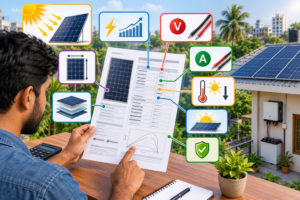
In practice, Bangladesh retailers list standalone inverter units across a fairly wide range depending on capacity and brand, and installed system pricing (inverter bundled with panels, mounting, and labour) varies further by system size and installer. Treat any number you see quoted online as a rough planning estimate, and always ask for an itemized, price-per-watt breakdown from your installer rather than a single bundled figure — it’s the only reliable way to compare quotes fairly. Our guide to evaluating solar quotes walks through what to look for.
Making the actual decision
If you’re weighing this for your own roof, it usually comes down to three honest questions: How much shading does your roof genuinely get through the day? Does outage backup matter enough to you to justify a hybrid setup? And does your budget favor the lower entry cost of a string inverter over the shade-tolerance of a microinverter?
There’s rarely a universally “right” answer — it depends on your specific roof and priorities, which is exactly the kind of assessment worth doing before you commit to a quote rather than after. If you’re trying to work out which setup fits your situation — including whether hybrid or battery-ready configuration makes sense given your area’s outage patterns — that’s the kind of question worth walking through with someone who can look at your actual roof and load requirements before you sign anything.
FAQs
How many solar panels can one string inverter handle?
It depends on the inverter’s rated capacity and voltage range, but a typical residential string inverter might handle two to four strings of 8–12 panels each. Your installer will size this based on your specific panel specifications and inverter model.
Is a string inverter good for a shaded roof?
Not ideally. Because panels in a string are optimized as a group, shading on even one panel can reduce output across its entire string. If your roof has recurring shade from trees, buildings, or fixtures like water tanks, a microinverter or power optimizer setup will typically perform better.
Can a string inverter work with a battery for load-shedding backup?
A standard grid-tied string inverter cannot power your home during a grid outage — that’s a safety design requirement. For outage backup, you need a hybrid-capable string inverter designed to integrate with a battery bank.
How long do string inverters last?
Most last somewhere around 10–15 years before needing replacement or major servicing, though this varies by brand, installation quality, and operating conditions — noticeably shorter than the 25+ year lifespan typical of solar panels.
Is a string inverter cheaper than a microinverter?
Generally, yes — string inverters are typically the lowest-cost-per-watt option among inverter types. The trade-off is reduced performance on shaded or multi-orientation roofs, so the “cheaper” option isn’t automatically the better value depending on your roof.
Does a string inverter size need to match Bangladesh’s net metering rules?
Yes — your system’s inverter capacity generally needs to align with your sanctioned electrical load under current net metering guidelines. Since these rules can be updated, confirm the current requirements with your installer or utility before finalizing your system size.