String Inverter vs. Microinverter: Which One Does Your Roof Actually Need?
Ask two different solar installers which inverter you need, and you’ll probably get two different answers — each one convinced their choice is the right one. That’s not because one of them is wrong. It’s because the “right” inverter has less to do with the technology itself and more to do with your specific roof: its shape, its shade, and how you might want to expand later.
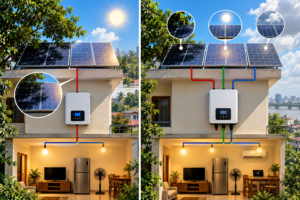
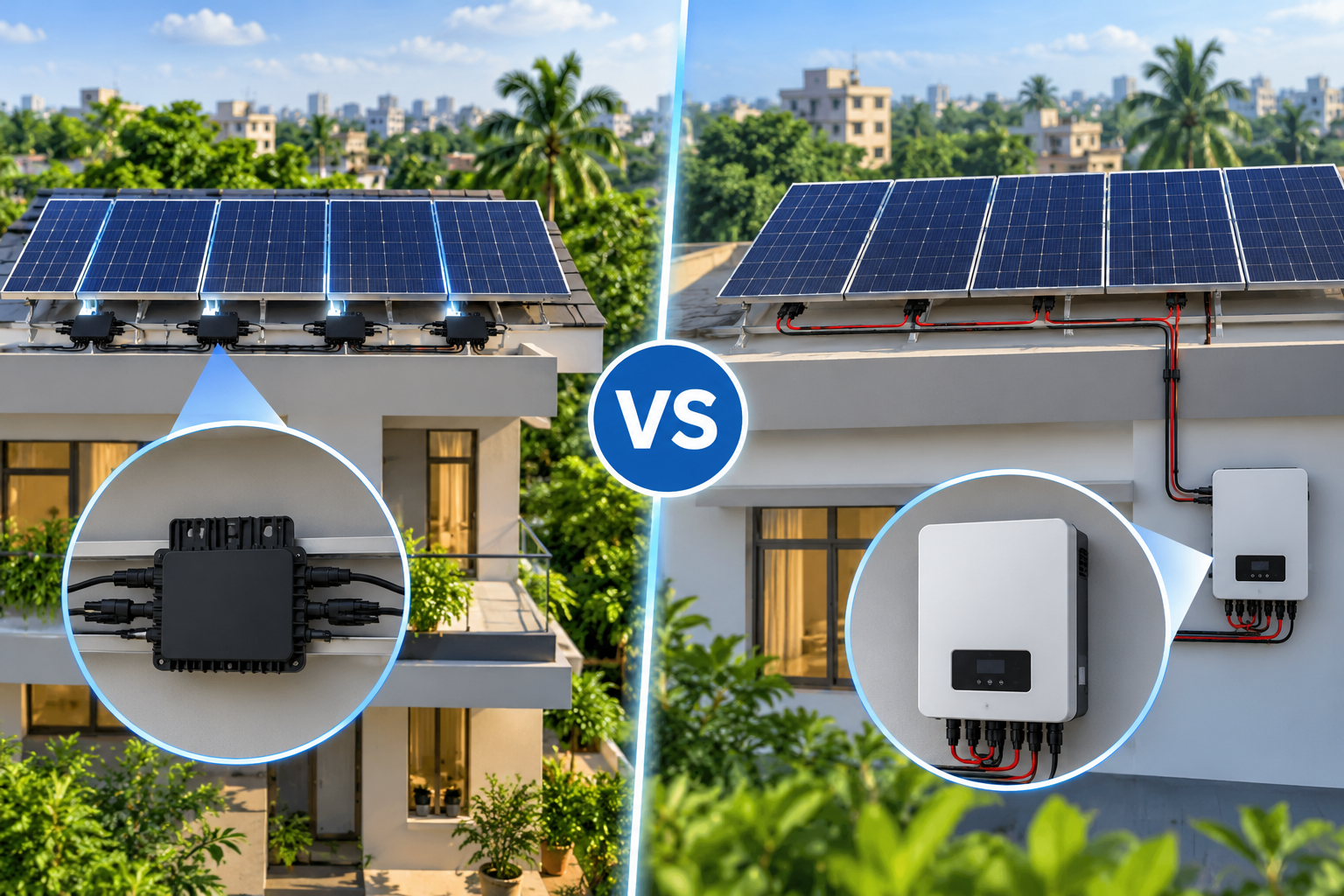
Here’s the short version. A solar panel produces DC (direct current) electricity, but your home or business runs on AC (alternating current). Something has to convert one into the other. A string inverter does that conversion once, centrally, for a whole group — or “string” — of panels wired together. A microinverter does it separately, at each individual panel. That single difference in where the conversion happens is what drives almost every other trade-off between the two.
The Real Difference: Central Conversion vs. Panel-by-Panel Conversion
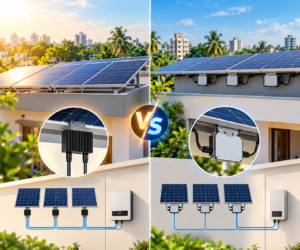
With a string inverter, your panels are wired together in a series, feed into one inverter box (usually mounted near your meter or on a wall at ground level), and that one box handles the DC-to-AC conversion for the entire array.
With microinverters, each panel has its own small inverter attached to its back, converting power right there before it ever combines with output from other panels.
This sounds like a minor engineering detail. It isn’t. It’s the reason string systems are cheaper but more vulnerable to a single point of failure, while microinverter systems cost more but let every panel perform independently.
Quick Answer: Which Should You Choose?
If your roof gets consistent sun all day with no obstructions — a fairly open rooftop with one clean orientation — a string inverter will do the job well and cost less. If your roof has partial shade at any point in the day, an irregular layout, or you’re planning to expand the system later panel-by-panel, microinverters are usually worth the higher upfront cost.
That’s the short version. The reasoning behind it matters more than the rule itself, so here’s how each factor actually plays out.
String Inverters vs. Microinverters: Side-by-Side
| Factor | String Inverter | Microinverter |
| Upfront cost | Lower | Higher — typically a noticeable premium per watt |
| Best suited for | Open, unshaded roofs with uniform panel orientation | Roofs with partial shading, multiple angles, or complex layouts |
| Shading impact | One shaded or failing panel can drag down the whole string’s output | Each panel operates independently — shading on one doesn’t affect the rest |
| Maintenance access | Ground-level, easier to service | Mounted on the roof at each panel — repairs need roof access |
| Monitoring | System-level (whole array) | Panel-level — you can see exactly which panel is underperforming |
| Expansion | Often requires resizing or replacing the central inverter | Add panels individually without touching the existing setup |
| Typical warranty | Usually shorter than microinverters | Often longer — many manufacturers offer around 25 years, though this varies by brand |
Why Shading Matters More in Bangladesh Than the Brochures Suggest
Most inverter comparisons you’ll find online are written with a fairly generous assumption: a detached house, a wide-open roof, full sun from sunrise to sunset. That’s not what most rooftops in Dhaka, Chattogram, or Narayanganj actually look like.
Urban Bangladeshi rooftops are frequently boxed in — a neighboring building a few feet away, a water tank in the wrong corner, a staircase enclosure that throws a shadow across two or three panels for part of the day. None of that is unusual. It’s just the reality of dense urban construction.
This is exactly the scenario where the “weakest link” problem with string inverters shows up. If three panels in a ten-panel string are shaded for even part of the day, the string inverter doesn’t just lose the output of those three panels — it can drag down the output of the entire string, because all the panels in that string are electrically tied together. With microinverters, those three shaded panels underperform on their own, and the other seven keep producing at full capacity.
If you’ve walked your rooftop at different times of day and noticed a shadow creeping across even a portion of your panel area, that’s worth mentioning to your installer specifically — it’s often the single biggest factor in whether the microinverter premium is worth paying.
What Happens When Something Actually Fails
This is the part most comparisons skip, and it’s worth thinking through before you buy.
With a string inverter, if the inverter itself fails, your entire system typically stops producing power until it’s repaired or replaced. The upside is that because it’s mounted at ground level — often near your meter box — a technician can usually diagnose and fix it without climbing onto the roof at all.
With microinverters, a single unit failing only affects that one panel; the rest of your system keeps running normally. The trade-off is that fixing or replacing that unit means someone has to physically get up onto the roof to reach it, which in Bangladesh can mean scheduling around technician availability and, for taller buildings, arranging proper access.
Neither situation is “worse” outright — it depends on whether you’d rather have occasional full-system downtime with easy ground-level repairs, or continuous partial output with occasional rooftop repair visits.
Cost and Long-Term Value
String inverters cost less to buy and install, and that’s not a minor factor for most Bangladeshi households working within a fixed solar budget. As a general rule, expect microinverters to carry a meaningfully higher upfront cost per watt — exact percentages vary by brand and system size, so treat any specific figure you’re quoted as something to confirm directly with your installer rather than a fixed market rate.
Where the long-term math can shift in favor of microinverters is in shaded conditions. If shading would otherwise be costing you meaningful output every single day for the next 20+ years, the extra upfront cost of microinverters can pay for itself through higher lifetime energy yield. On a genuinely open, unshaded roof, that argument mostly disappears — you’d be paying a premium for a benefit you’re not shaded enough to need.
The panel-level monitoring that comes with microinverters is also worth factoring in beyond pure electricity output. Being able to see exactly which panel is underperforming — rather than just knowing your system-wide output dropped — makes it much easier to catch a dust buildup, a loose connection, or early degradation on one specific panel before it becomes a bigger issue. In a climate with real dust and monsoon-season soiling, that visibility has genuine practical value.
If You’re Planning to Expand Later
One thing worth deciding upfront: do you see yourself adding panels down the line — maybe after adding a floor to your building, or once your budget allows a second phase?
Microinverters make that straightforward. You add the new panels with their own microinverters, and they simply join the existing system without disturbing what’s already installed. With a string inverter, expansion is more constrained — your existing inverter has a fixed capacity, so adding a meaningful number of panels later often means upsizing or replacing the central unit rather than just bolting on more panels.
If phased expansion is part of your plan from day one, it’s worth telling your installer that explicitly, because it changes which inverter type makes more long-term sense even if your first-phase budget would otherwise point toward a string inverter.
One Common Point of Confusion: This Isn’t About Backup Power
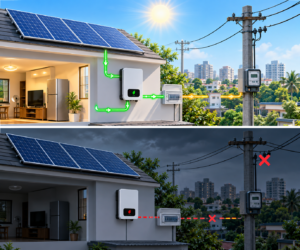
If you’re researching inverters partly because you’re thinking about load-shedding backup, it’s worth clearing this up: the string-vs-microinverter choice has nothing to do with whether your system can store energy or keep your lights on during a grid outage. That capability comes from whether your system is grid-tied, off-grid, or hybrid, and whether it includes battery storage — a separate decision entirely.
You can pair either string inverters or microinverters with a hybrid, battery-backed setup. The two decisions — inverter type, and grid/battery configuration — are worth discussing separately with your installer rather than assuming one determines the other.
So, Which One Fits Your Situation?
For most straightforward home rooftops — open orientation, no significant shading through the day, single roof plane — a string inverter remains a sensible, cost-effective choice. You’re not paying for panel-level independence you don’t need.
For homes and small commercial buildings with any real shading, multiple roof sections, or panels facing more than one direction, microinverters generally earn their higher cost through better real-world output and far easier fault diagnosis.
For larger commercial or industrial installations, the decision often comes down to scale and maintenance philosophy as much as shading — larger arrays sometimes use string inverters with power optimizers as a middle-ground approach, which is a separate topic worth exploring on its own.
If you’re not sure which category your roof falls into, the honest answer is that it usually takes an actual look at your roof — sun path, obstructions, and orientation — to know for certain. That’s something worth getting evaluated properly rather than guessing from a product brochure. It’s the kind of assessment Muspana can walk through with you directly, looking at your specific roof rather than a generic recommendation.
Frequently Asked Questions
Are microinverters worth the extra cost?
It depends heavily on shading. If your roof has little to no shade through the day, the premium is harder to justify. If parts of your roof are shaded at any point — common on urban Bangladeshi rooftops surrounded by other buildings — the extra cost often pays off through better real-world output.
Can I mix string inverters and microinverters in one system?
Typically, a system is designed around one architecture, though power optimizers (a separate, related technology) can sometimes bridge some of the gap for string systems with mild shading. This is worth a direct conversation with your installer based on your specific setup rather than a general rule.
Do microinverters work with battery storage?
Yes, though the specifics depend on whether your battery setup is AC-coupled or DC-coupled. String inverters tend to integrate a little more simply with DC-coupled battery storage; microinverter systems generally use AC-coupled storage. Either can work — it’s a design detail your installer should walk you through.
Which lasts longer, a string inverter or a microinverter?
Microinverters are often sold with longer warranties — commonly around 25 years from some manufacturers — compared to typically shorter warranty terms for central string inverters. Actual warranty length varies by brand, so it’s worth confirming the specific terms for whatever product you’re being quoted rather than assuming a standard figure.
Is a shaded roof automatically a dealbreaker for string inverters?
Not automatically. Light or occasional shading may not justify the switch, especially on a tight budget. It becomes a stronger case for microinverters when the shading is regular, affects several panels, or happens during peak sun hours when you’d otherwise be generating the most.
How do I know how much shading my roof actually has?
This is hard to judge accurately just by eye, since shade patterns shift through the day and across seasons. A proper site assessment — checking sun path across your actual roof — is the reliable way to know, rather than guessing from a single afternoon observation.