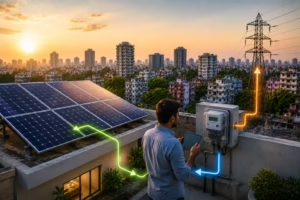

The power went out last summer during a heatwave, and my neighbor’s solar panels were sitting there in full sun, doing absolutely nothing. That’s the moment most people first hear the phrase “hybrid solar” — usually from someone standing in their dark kitchen, furious that a $20,000 investment couldn’t keep the fridge running.
That confusion is basically the entire reason this comparison exists. Solar isn’t just solar anymore. There are three real ways to set it up — on-grid, off-grid, and hybrid — and picking the wrong one means either overpaying for backup you’ll never use, or underpaying and getting caught without power exactly when you need it most.
So let’s actually sort this out, without the sales pitch.
The Short Answer, If You’re in a Hurry
An on-grid (grid-tied) system connects your panels straight to the utility and shuts off during outages, no matter how sunny it is. It’s the cheapest option and works great if your grid is reliable.
An off-grid system disconnects from the utility completely and relies on panels plus a big battery bank to cover everything. It’s expensive and mostly makes sense for remote properties with no utility access at all.
A hybrid system stays connected to the grid but adds a battery, so it can keep your essential circuits running when the power drops. It costs more than on-grid, less than off-grid, and splits the difference on almost every other metric too.
That’s the 30-second version. Here’s the part that actually matters for your decision.
How Each System Actually Works
Every solar setup starts the same way — panels convert sunlight into DC electricity through the photovoltaic effect. What happens after that is where the three system types split apart completely.
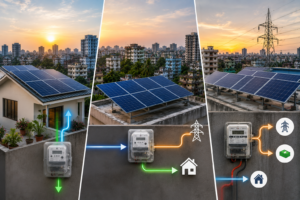
On-grid systems send that DC power through an inverter, convert it to AC, and feed your home first. Anything extra goes straight to the utility grid, often earning you bill credits through net metering. There’s no battery in the mix, which keeps things simple and cheap — but it also means the moment the grid goes down, a safety feature called anti-islanding forces your inverter to shut off within about 200 milliseconds. That’s not a flaw, by the way — it protects utility workers repairing lines who’d otherwise assume the wires were dead.
Off-grid systems skip the utility connection entirely. All the power comes from your panels, and a charge controller manages how it flows into a battery bank sized to cover your entire household — day and night, rain or shine. Because there’s no grid to fall back on during a stretch of cloudy days, off-grid setups usually need a generator as backup, and the batteries alone can run into the tens of thousands of dollars.
Hybrid systems borrow from both. They stay wired to the grid like an on-grid setup, but the hybrid inverter also manages a battery — deciding in real time whether to power your home from solar, draw from the battery, or pull from the grid. When an outage hits, the inverter detects the loss of grid power and flips into “island mode,” disconnecting from the grid and running your home off the battery instead. It’s the same anti-islanding logic as a grid-tied system, just paired with an actual backup plan.
If you want the deeper mechanics of how solar cells generate current in the first place, that’s covered in our sunlight to electricity breakdown — worth a read if the DC-to-AC part feels fuzzy.
The Comparison, Side by Side
| On-Grid | Off-Grid | Hybrid | |
| Grid connection | Yes | No | Yes |
| Battery required | No | Yes (large) | Yes (smaller) |
| Works during outage | No | Yes | Yes |
| Typical upfront cost (7kW system) | $14,000–$19,000 | $40,000–$80,000+ | $22,000–$36,000 |
| Net metering eligible | Usually | No | Usually |
| Best for | Reliable grid, lowest cost priority | Remote properties, no utility access | Frequent outages, want backup without full off-grid cost |
| Maintenance complexity | Low | High | Medium |
Those cost ranges aren’t pulled from thin air — they line up with what installers are actually quoting in 2026 for a mid-size residential setup. Off-grid costs so much more because the battery bank has to be sized for total independence, often 90–165 kWh of storage for a typical home, compared to 13–27 kWh for a hybrid battery that only needs to cover outages and evening peak usage.
What It Actually Costs (and Why the Range Is So Wide)
Cost is where most articles get vague, so let’s not do that.
A straightforward on-grid system for an average home lands around $14,000 to $19,000 before incentives, mostly because there’s no battery and no backup-capable hardware. It’s the cheapest path to solar, full stop.
Add a single battery — say, one Powerwall-class unit — and you’re looking at $22,000 to $36,000 installed for a hybrid setup. The hybrid inverter itself carries a premium of roughly $1,500 to $3,000 over a standard grid-tied inverter, because it’s doing double duty: managing solar, battery charging, and the switch to island mode, all in one box.
Off-grid is where costs really jump. Without the grid to lean on, you need enough battery capacity to survive multiple cloudy days in a row — and batteries are still the most expensive part of any solar system by far. That’s why off-grid rarely makes financial sense for a home that already has utility access. It’s a great option for a cabin fifteen miles past the last power line. It’s a hard sell for a suburban house that loses power twice a year.
The federal solar tax credit currently applies to both panels and battery storage when installed together, which softens the hybrid premium somewhat — but it doesn’t erase it.
The Outage Question, Honestly Answered
This is the part installers tend to gloss over, so here’s the straight version: a single home battery does not mean your whole house runs normally during a blackout.
A typical residential battery holds somewhere around 10–13 kWh and outputs about 5 kW at once. That’s enough to keep your fridge, some lighting, your router, and maybe a few outlets running. It is not enough to run central air conditioning, an electric dryer, and an oven all at the same time — try that, and you’ll drain the battery a lot faster than you’d expect.
If whole-home backup for multiple days is the actual goal, you’re either looking at multiple batteries stacked together (which starts closing the cost gap with off-grid) or accepting that “backup power” means “the important stuff stays on,” not “nothing changes.” That’s not a knock against hybrid systems — it’s just the reality nobody puts on the brochure.
Who Should Actually Pick Which One
Go on-grid if: your utility is reliable, outages are rare where you live, and your main goal is lowering your electric bill. This is still the best return on investment for most grid-connected homes, and there’s no shame in choosing the simple option — it’s simple because it works.
Go off-grid if: you genuinely have no utility connection, or getting one would cost more than the solar system itself. Remote cabins, rural land, agricultural buildings — this is off-grid’s actual home turf. For anyone already tied into the grid, off-grid is almost always the wrong tool for the job.
Go hybrid if: you experience regular outages, your utility has moved to less generous net billing, or you just want a middle ground between full independence and full reliance on the grid. It’s not the cheapest option and it’s not the most independent one — it’s the compromise, and for a lot of households, that compromise is exactly right.
One thing worth saying plainly: if you barely ever lose power and your electric bill is already low, a hybrid system might not pay for itself in any reasonable timeframe. Don’t let a sales conversation talk you into “future-proofing” you don’t actually need.
There’s also a middle-ground question worth asking yourself: how much is peace of mind actually worth to you? Some homeowners run the numbers, see a longer payback period on the battery, and still choose hybrid anyway — because the thought of losing power during a heatwave with a family member on medical equipment, or just watching a freezer full of food spoil, isn’t something they want to gamble on. That’s a legitimate reason to spend more, even if it doesn’t show up cleanly on a spreadsheet. Just be honest with yourself about which reason is driving the decision, because the two conversations — “what saves me the most money” and “what lets me sleep better during a storm” — often point to different systems.
It’s also worth thinking about how your usage patterns line up with sunlight. If most of your electricity use happens during the day — you work from home, run a home office, or have equipment that operates on daytime schedules — a simpler on-grid system captures more of that value directly, since you’re using solar power as it’s generated rather than pulling it back out of storage later. Homes with evening-heavy usage, on the other hand, get more out of a battery, because that’s exactly the gap a battery is built to fill. Panel placement matters here too — a rooftop versus ground-mounted decision can shift how much usable sunlight you’re actually capturing before any of this battery math even comes into play.
Can You Switch Systems Later?
This question comes up constantly and rarely gets a straight answer. If you install grid-tied solar now and want to add a battery down the road, it depends entirely on your inverter. Some modern inverters are “battery-ready” out of the box and can add storage with minimal extra hardware. Older string inverters usually need a full replacement to support a battery, which adds a few thousand dollars to the retrofit.
The practical move: if there’s any chance you’ll want backup power later, ask your installer directly whether the proposed inverter supports battery integration, and get the answer in writing before you sign anything. It’s a five-minute question that can save you a very expensive redo.
For more on how these systems fit into the bigger picture of solar setups — including microgrids and centralized versus decentralized designs — take a look at our guides on microgrid solar systems and centralized vs decentralized solar.
The Real Bottom Line
None of these three systems is objectively “best.” On-grid wins on cost. Off-grid wins on independence. Hybrid wins on flexibility. The right answer depends on how often your power actually goes out, what your utility’s export rates look like, and how much you’re willing to pay upfront for peace of mind during a blackout.
If you’re still deciding between grid-tied-with-battery and a full off-grid build, our detailed grid-tied battery vs off-grid comparison walks through sizing math in more depth than we could fit here. And if you want to go back to fundamentals first — how solar actually captures peak sun hours and converts them into usable power — that’s a good next stop before you talk to an installer.
Whatever you choose, get the numbers in writing, ask about backup-ready inverters even if you’re not adding a battery today, and don’t let anyone talk you into more system than your actual outage history justifies.
FAQs
Is hybrid solar worth the extra cost over on-grid?
It depends on how often you lose power and what your utility charges for grid electricity. If outages are rare and your bill is already low, on-grid usually pays back faster. If you deal with regular outages or unfavorable time-of-use rates, the hybrid premium tends to earn its keep.
Can a hybrid solar system power my whole house during an outage?
Not with a single battery, in most cases. A typical home battery covers essential loads — fridge, lights, internet, a few outlets — but running central AC, a dryer, and an oven at once will drain it quickly. Whole-home backup usually needs multiple batteries.
Does off-grid solar make sense if I already have utility power?
Rarely. Off-grid systems require large, expensive battery banks sized to cover every cloudy stretch without any fallback. If you’re already connected to the grid, hybrid almost always delivers similar peace of mind for meaningfully less money.
Can I add a battery to my grid-tied system later?
Sometimes, and it depends on your inverter. Newer inverters are often “battery-ready” and can add storage with minimal extra equipment. Older string inverters may need a full replacement, which adds cost to the retrofit. Ask your installer this question before you buy.
How long does a hybrid solar battery actually last during a blackout?
It depends on battery size and what you’re running. A single 10–13 kWh battery might carry essential loads for a day or more, but a full household running AC and major appliances will drain it in a matter of hours. Sizing the battery to your actual essential loads matters more than the marketing number on the box.
What’s the main difference between a hybrid inverter and a regular grid-tied inverter?
A standard grid-tied inverter only converts solar DC power to AC and shuts off during outages. A hybrid inverter does that too, but also manages battery charging and switches your home into island mode when the grid drops — combining the jobs of a grid-tied inverter and an off-grid inverter in one unit.