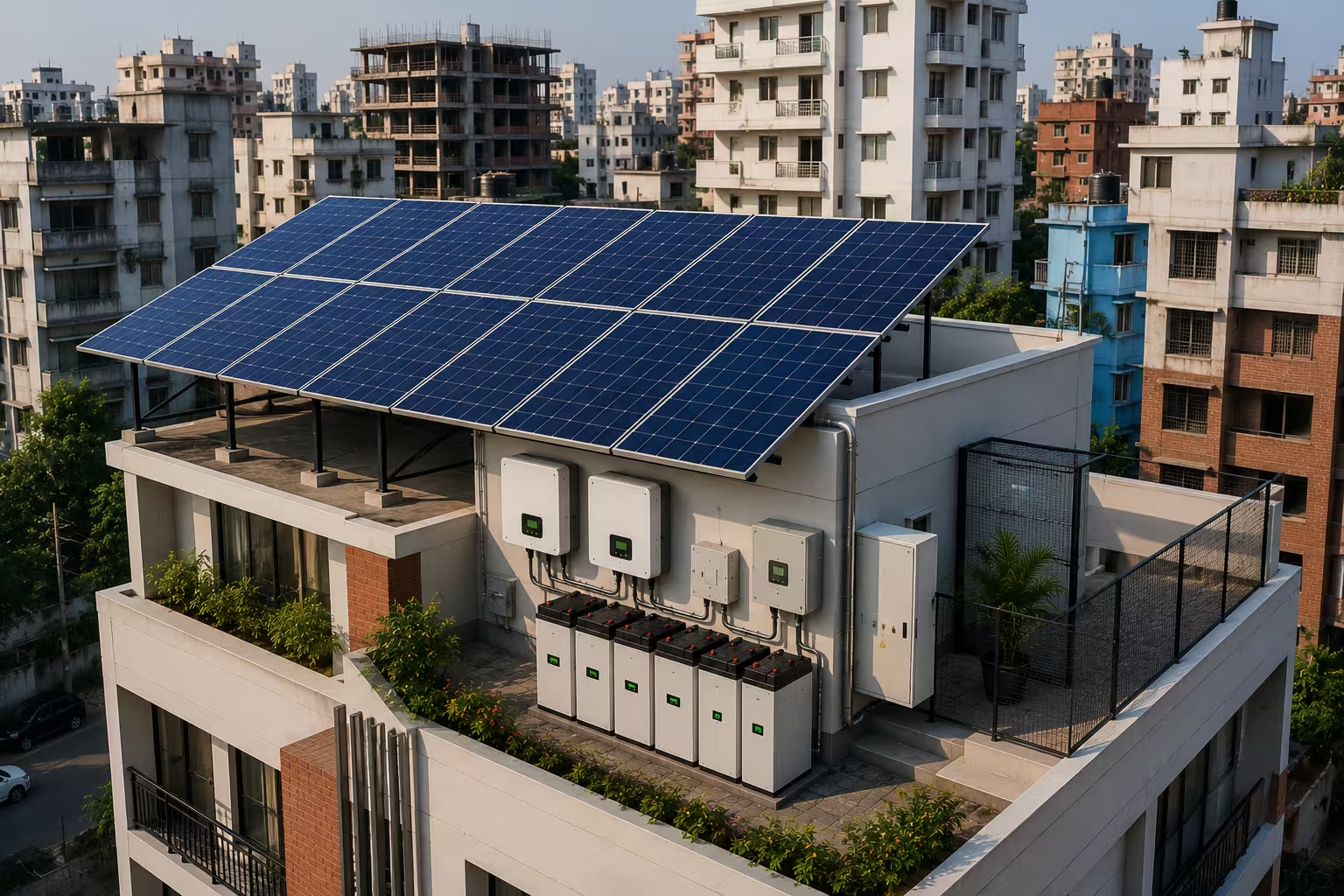
A decade ago, roughly 17% of people in Sub-Saharan Africa had access to electricity from a mini-grid or similar decentralized system. Today that number sits closer to 28%, with more than 11 million connections up and running. That’s not a pilot project anymore. That’s infrastructure.
So what’s actually behind that shift? Mostly, it’s solar mini-grids — small, localized power systems that skip the need for a country to string transmission lines across hundreds of miles of bush, mountain, or farmland just to reach one village.
What Is a Solar Mini-Grid, Exactly?
A solar mini-grid is a small-scale power system — solar panels, batteries, an inverter, and a local distribution network — that generates and delivers electricity to a cluster of homes, shops, or public buildings without being connected to the national grid. Think of it as a self-contained utility company sized for a village instead of a city.
It’s different from a microgrid solar system in scale (mini-grids usually serve dozens to hundreds of connections) and different from a plain off-grid solar system in that it’s shared infrastructure, not a single household setup. One system, many households, one shared meter-and-billing structure.
How These Systems Actually Get Built
This part tends to get glossed over in most explainers, which is a shame, because the design process is genuinely interesting — and it’s where most projects either succeed or quietly fall apart.
It starts with a load assessment. Before anyone orders a single panel, someone has to figure out how much power the community will actually use. That means lighting, phone charging, maybe a few appliances, and — critically — anything like a health clinic that needs refrigeration for vaccines. Underestimate this step and you end up with a system that brownouts every evening when everyone turns their lights on at once.
Then comes component selection. PV panels, batteries, and inverters get chosen based on efficiency, how well they’ll hold up in heat and dust, and — let’s be honest — cost. There’s always a tension here between “best available tech” and “what the budget and local supply chain can actually support.”
System sizing comes next, and this is where tools like HOMER software earn their keep. HOMER lets engineers simulate different combinations of panel capacity and battery storage against the load assessment data, so the system is sized to match real daily consumption instead of a rough guess. Get this wrong in either direction and you’re either overpaying for capacity nobody uses or leaving people without power on cloudy days.
Distribution network installation follows — essentially a small local grid connecting each household and facility back to the central generation and storage point. This is also where air mass and solar radiation considerations from the site assessment actually matter, since panel output depends heavily on local peak sun hours, not just nameplate capacity.
And finally, economic analysis — capital costs, ongoing operations and maintenance, and whether the whole thing pencils out over 10 or 15 years. This last step is where a lot of well-intentioned projects either get greenlit responsibly or get pushed through on optimism alone.
What a Solar Mini-Grid Actually Costs
Numbers help here, so let’s use a real one. A 15 kW solar mini-grid can supply roughly 72.5 kWh of electricity per day — enough to cover lighting, phone charging, small appliances, and basic refrigeration across a decent-sized cluster of homes and a shared facility or two. Capital costs for a system like that run around $122,000, with maintenance costs staying relatively low over a 10-year period.
Is that expensive? In absolute terms, yes. But context matters. Spread across a community and compared against the cost of extending a national grid line for miles into low-density terrain — plus the ongoing diesel costs of the generators it’s replacing — the math often works out in the mini-grid’s favor, especially in areas with strong solar insolation. That’s part of why financing models like pay-as-you-go have taken off: instead of a household needing $122,000 (or even a few hundred dollars) upfront, they pay a small weekly or monthly fee — often less than what they were already spending on kerosene or phone-charging services — and the system pays for itself over time through hundreds of small transactions rather than one large one.
The Real Benefits — Without the Hype
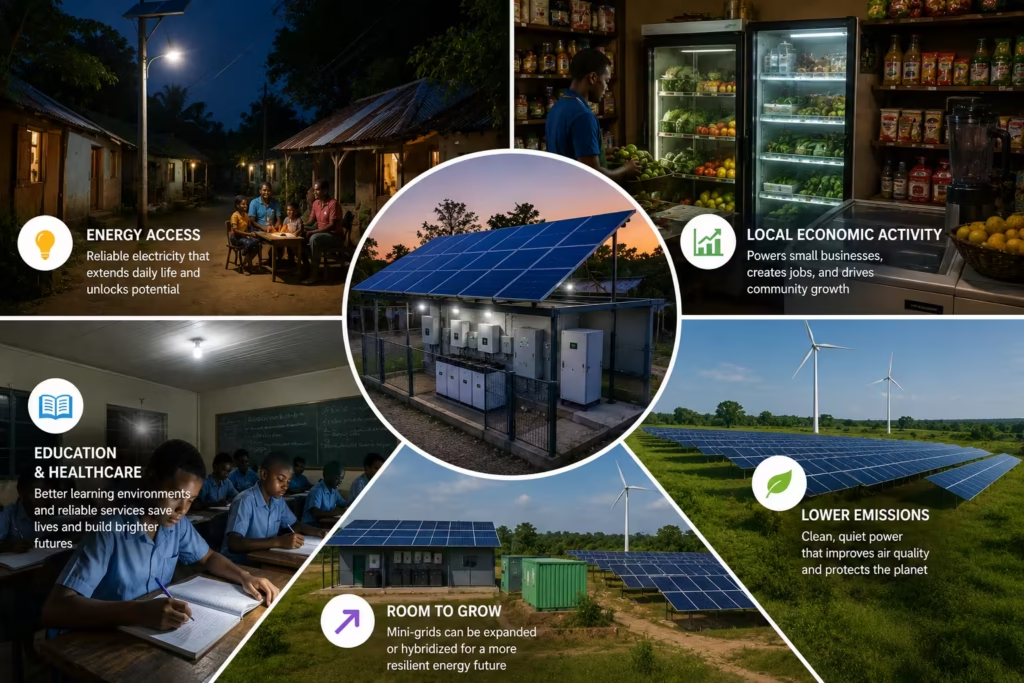
- Energy access. Reliable electricity where there wasn’t any, which sounds obvious but changes daily life in ways that are easy to underestimate — evening light alone extends the productive day.
- Local economic activity. Cold storage for produce, milling equipment, phone-charging kiosks — small businesses that simply can’t exist without consistent power.
- Education and healthcare. Lighting for schools means kids can study after dark. Refrigeration for a clinic means vaccines don’t spoil.
- Lower emissions. Displacing diesel generators, which are noisy, expensive to run, and a meaningful source of local air pollution, not just carbon emissions.
- Room to grow. Mini-grids can be expanded or hybridized with wind or biomass later, similar to how a hybrid solar system blends generation sources for reliability.
The Challenges Nobody Wants to Lead With
Here’s where it gets less rosy, and honestly, this is the part most articles skip entirely.
Upfront investment is still steep.
Panel and battery prices have come down a lot, but $122,000 for a 15 kW system is still real money, and someone has to front it — whether that’s a government, a donor, a private developer, or some blend of all three.
Policy and financing gaps kill projects that are technically sound.
A well-designed mini-grid can still fail to launch if there’s no supportive regulatory framework, no subsidy structure, or no clear tariff rules for how the operator gets paid. This is often the actual bottleneck, more than the technology itself. A developer can have the engineering sorted and the community on board, and still get stuck for a year waiting on a licensing decision or a tariff cap that makes the whole project unprofitable on paper.
Public-private partnerships have become the go-to workaround in a lot of markets — government provides land access, permitting support, or a subsidy on the capital side, while a private operator handles construction, billing, and day-to-day operations. It’s not a perfect model, but it spreads the risk in a way that pure private investment or pure government funding usually can’t manage on its own.
Maintenance is the quiet failure point.
This one deserves more attention than it usually gets. A mini-grid that works beautifully for the first two years can degrade fast if there’s no local technician trained to handle battery replacement, inverter faults, or basic troubleshooting. Projects that skip investment in local technical capacity tend to be the ones you hear about failing five years later — not because the engineering was bad, but because nobody nearby knew how to fix a blown fuse.
Where This Is Already Working
Kenya and Nigeria are probably the two best-known examples right now, both using mini-grids to power schools, clinics, and small agricultural operations in areas the national grid hasn’t reached and likely won’t for years. Pay-as-you-go financing has been a big part of making this accessible — it’s the difference between a family needing to save up for months and simply paying a bit each week, similar to how they’d already budget for phone credit or kerosene.
It’s not a universal fix, though, and worth saying plainly: in areas closer to existing grid infrastructure, extending the national grid is often still cheaper and simpler. Mini-grids make the most sense where distances are long, terrain is difficult, or population density is too low to justify a transmission line — which, as it happens, describes a lot of rural Sub-Saharan Africa.
Mini-Grid vs. the Alternatives
| Option | Best For | Typical Cost Profile | Timeline |
| Solar mini-grid | Villages/clusters too remote for grid extension | Moderate upfront, low ongoing O&M | Months to build |
| Grid extension | Communities near existing grid infrastructure | High upfront per mile, low per-household cost once built | Can take years |
| Solar home system (off-grid) | Individual households, very remote or scattered populations | Low upfront per household, limited shared capacity | Weeks |
| Diesel generator | Short-term or backup power | Low upfront, high ongoing fuel cost | Immediate |
A centralized system like grid extension makes sense where density supports it. A mini-grid fills the gap where that math doesn’t work but a shared, community-scale system still beats going fully individual with standalone units.
A Few Questions People Actually Ask
How much does it cost to build a solar mini-grid?
It varies with size, but a 15 kW system serving a village-scale community typically runs around $122,000 in capital costs, with relatively low maintenance expenses over its first decade.
What’s the difference between a mini-grid and a microgrid?
The terms overlap a lot in casual use, but mini-grids generally refer to community-scale systems serving a village or cluster of buildings, while microgrids can range from that same scale down to a single facility or campus with its own localized power loop.
How long do solar mini-grids last?
Panels themselves typically hold up for 20-25 years with gradual efficiency loss, though batteries usually need replacement well before that — often within 8-12 years depending on the type and how well the system is maintained.
Who actually pays for solar mini-grids in developing countries?
It’s usually a mix — government subsidies, development finance from organizations like the World Bank or regional development banks, private developers, and increasingly, the end users themselves through pay-as-you-go financing that spreads the cost over years instead of requiring it upfront.
Can a solar mini-grid fully replace a diesel generator?
In most cases, yes, especially with adequate peak sun hours and proper battery sizing for overnight and cloudy-day coverage — though some operators keep a small diesel backup for extended low-sun periods, similar to a solar-diesel hybrid setup.
None of this makes solar mini-grids some flawless solution — they’re not. They’re a genuinely useful tool for a specific problem: getting reliable power to places the grid isn’t reaching anytime soon, without leaving people dependent on diesel and kerosene indefinitely. The technology part is honestly the easy bit at this point. Panels, batteries, and inverters are mature, well-understood components — the failure rate on the hardware side is low compared to everything that surrounds it.
The harder part — the part that determines whether a system is still running in year eight or quietly broken and abandoned — is financing structure and local technical capacity. A mini-grid built on solid load assessment data, backed by a financing model people can actually afford, and supported by someone nearby who knows how to fix it when something breaks, tends to keep the lights on for a long time. Skip any one of those three, and even the best-engineered system starts to look shaky within a few years. Get them right, and the panels and batteries mostly take care of themselves.