A telecom tower in a spot with no grid access. A mine three hours from the nearest fuel depot. A resort on an island where the diesel barge shows up every ten days, if the weather cooperates. Ask anyone running one of these sites what keeps them up at night, and diesel logistics is usually near the top of the list — the cost, the delivery risk, the theft, the maintenance headaches that come with running a generator flat-out, day and night.
That’s the exact problem a solar diesel hybrid power plant is built to solve. Not by replacing diesel entirely — that’s rarely realistic for a true off-grid site — but by cutting how much of it you burn, while keeping the reliability that pure solar can’t always guarantee on its own.
This isn’t a sales pitch. It’s a practical look at how these systems actually work, what kind of fuel savings are realistic, where they make sense, and where they honestly don’t.
What Is a Solar-Diesel Hybrid Power Plant?
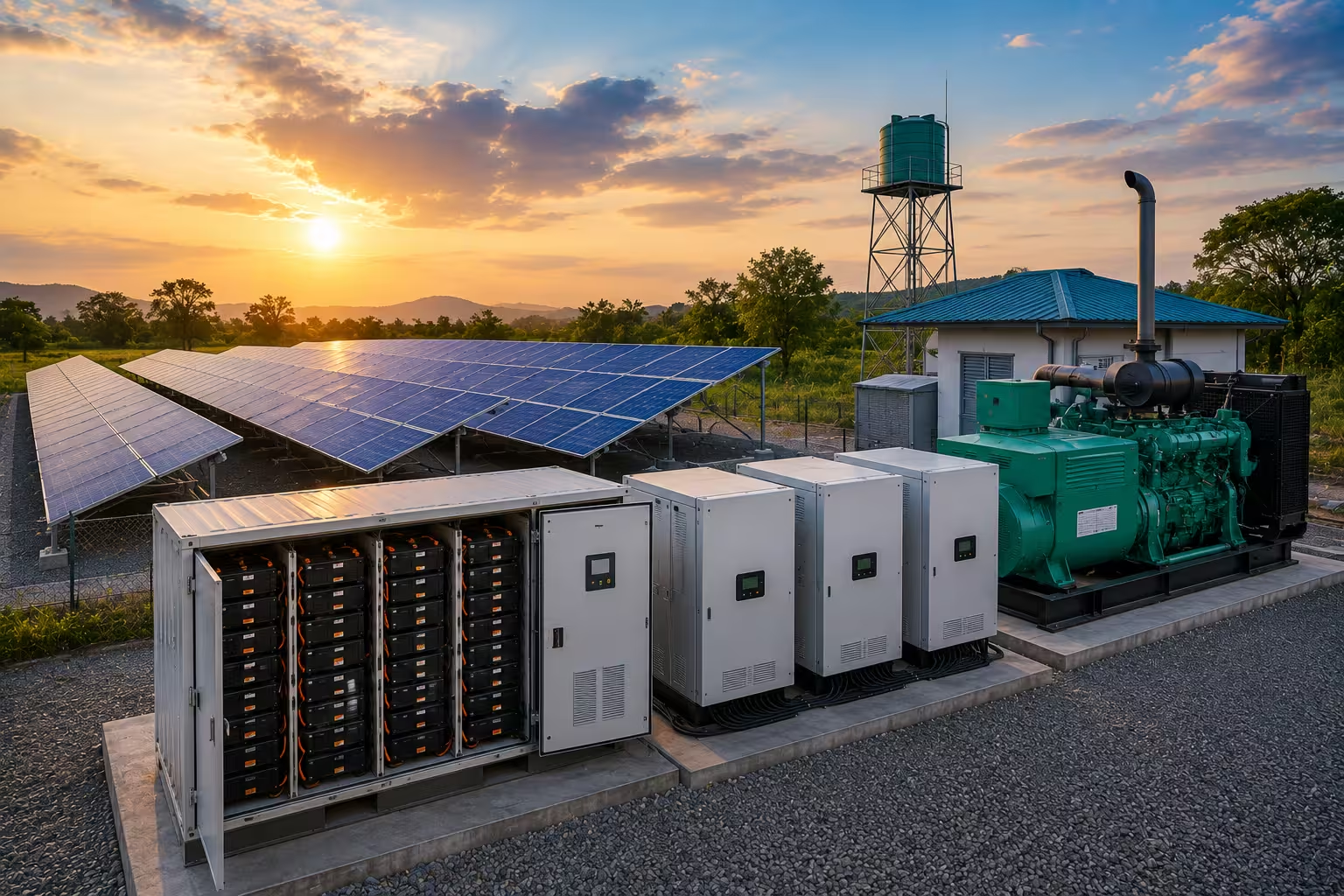
A solar diesel hybrid power plant combines solar panels, battery storage, and one or more diesel generators, managed by a hybrid controller that decides which source powers the load at any given moment. Solar covers as much of the daytime demand as possible, batteries smooth out the gaps, and diesel steps in when solar and storage can’t keep up.
Think of it less as “solar with a diesel backup” and more as two power sources sharing the workload, with software making the call on who does what and when.
If you’re weighing this against a straightforward off-grid solar system or a fully on-grid solar system, the hybrid setup sits in between — it’s built specifically for sites that need guaranteed uptime but can’t rely on a stable grid connection.
How the System Actually Works
Strip away the marketing language and the process is pretty logical. Here’s the sequence on a typical day:
- Solar generation during daylight hours. Panels produce electricity based on available sunlight and site conditions — this varies a lot depending on your location’s solar radiation and insolation levels and how many usable peak sun hours you actually get.
- The load gets fed first. Solar output covers the site’s real-time demand directly whenever it can.
- Excess solar charges the battery. Anything the load doesn’t use gets stored instead of wasted.
- The hybrid controller monitors everything in real time — solar output, battery state of charge, and current demand — and decides the cheapest, most reliable source to draw from second by second.
- Diesel kicks in when needed — at night, during extended cloud cover, or when demand spikes past what solar and battery can cover together.
- The generator runs efficiently, not constantly. Instead of idling at low load (which is genuinely bad for a diesel engine long-term), it’s scheduled to run at higher, more efficient loads for shorter windows.
That last point matters more than people expect. A diesel generator running at 30% load for 20 hours a day is inefficient and wears out faster than one running at 80% load for 6 hours. A well-tuned hybrid controller is basically a smart thermostat for power sources — it’s not just switching things on and off, it’s optimizing when and how hard each source works.
If you want the deeper mechanics of how solar cells convert sunlight into usable electricity in the first place, that’s covered in how sunlight becomes electricity and the photovoltaic effect.
How Much Diesel Can You Actually Save?
This is the question competing content dances around, so let’s just answer it: most solar-diesel hybrid systems reduce diesel consumption somewhere in the 20% to 50% range, depending heavily on a handful of variables.
What moves that number:
- Solar fraction — how much of your total energy the solar array is sized to cover. A site sized for 30% solar penetration saves less than one sized for 60%, obviously, but higher solar fractions also mean bigger batteries and higher upfront cost.
- Site solar resource — a location near the equator with consistently strong sun behaves very differently than a site further from it. This is where tropical vs. temperate solar performance actually changes your math.
- Load profile — a site with steady, predictable daytime demand gets more value from solar than one with heavy overnight loads (think cold storage or 24/7 telecom equipment).
- Battery sizing — bigger storage means more solar energy gets used instead of curtailed, but it’s also the most expensive single component in the system.
A realistic example: a 500kW mining site running diesel-only might burn through a significant fuel budget every month. Size solar and storage to cover 40–50% of daytime load, and it’s reasonable to see diesel consumption drop by roughly a third — without touching reliability, because the generator is still there as backup whenever it’s genuinely needed.
What nobody should promise you is 100% diesel elimination on a true off-grid site with no other backup. That’s not how these systems are designed to work, and any vendor claiming otherwise is oversimplifying.
Where These Systems Make the Most Sense
Solar-diesel hybrids show up most often in a specific set of situations:
- Mining operations — high, consistent daytime loads and often decent solar exposure make the fuel savings math work quickly.
- Telecom towers — remote sites where diesel delivery is expensive and theft is a real operational risk.
- Islands and coastal microgrids — fuel shipping costs alone can justify the switch. This is closely related to how microgrid solar systems and mini-grid solar setups are typically designed.
- Hospitals and clinics in remote regions — where uptime isn’t negotiable, but fuel budgets are tight.
- Agriculture and irrigation — daytime-heavy loads that line up naturally with solar production.
Where it makes less sense: very small loads where the upfront system cost can’t be justified by the savings, or sites with genuinely poor solar resource where the solar fraction ends up too low to matter. In those cases, a pure diesel setup, or a grid connection if one’s available at all, might actually be the more sensible call.
Sizing a Hybrid System: What to Consider
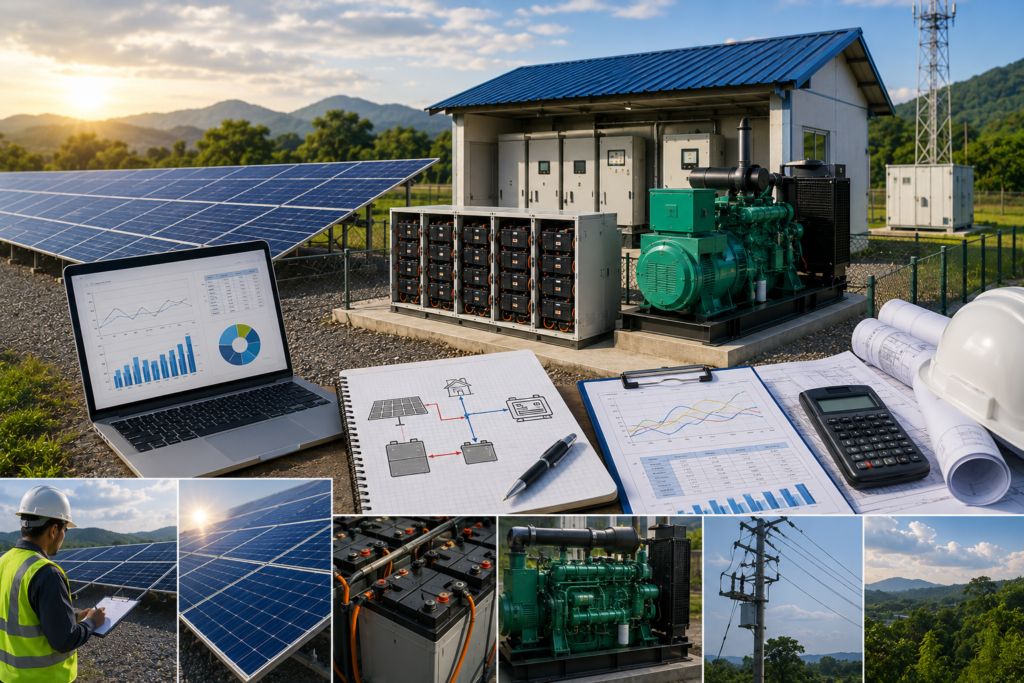
There’s no universal formula here, but the core inputs are consistent across every project:
Load profile. What does actual demand look like hour by hour, not just the peak number on a spec sheet? A site with a flat 24-hour load needs a different design than one with sharp daytime spikes.
Solar resource at the site. This comes down to available sunlight hours, seasonal variation, and shading — all things covered under solar angles and positioning.
Backup requirements. How much runtime does the diesel generator need to cover on its own during worst-case conditions — several cloudy days in a row, for instance?
Battery depth of discharge and lifespan. Cycling a battery too deeply too often shortens its usable life significantly. Sizing conservatively here costs more upfront but saves on replacement costs down the line.
System architecture. Whether the setup is DC-coupled or AC-coupled changes efficiency and flexibility — worth understanding before committing to a design, and something we break down in DC vs. AC coupled solar systems.
A reasonable starting point for most remote industrial sites: size solar to cover 30–50% of average daytime load, size the battery for 2–4 hours of autonomy, and keep the diesel generator sized to handle full site load on its own as a genuine fallback — not a scaled-down afterthought.
Solar-Diesel Hybrid vs. Other Options
| Solar-Diesel Hybrid | Pure Diesel | Solar + Battery Only | |
| Reliability | High — diesel covers any gap | High, but fuel-dependent | Lower without backup generation |
| Fuel cost | Reduced, not eliminated | Highest ongoing cost | None, but higher upfront battery cost |
| Upfront cost | Moderate to high | Lowest | Highest (large battery banks) |
| Maintenance | Split across two systems | Concentrated on generator wear | Mostly battery and inverter upkeep |
| Best for | Remote sites needing guaranteed uptime | Short-term or backup-only use | Sites with strong solar resource and no critical 24/7 load |
For a broader look at how these system types stack up structurally, comparing solar system types is worth a read before locking in a design direction.
Maintenance & Real-World Considerations
Nobody selling these systems loves talking about this part, but it matters. A hybrid setup means maintaining two separate systems, not one — the diesel generator still needs regular servicing, oil changes, and filter replacement, and now you’ve also got battery management, inverter checks, and controller software updates to stay on top of.
The upside: because the generator isn’t running constantly, its service intervals tend to stretch out, and total wear drops. Reduced run-hours is one of the most underrated benefits of hybridization — it’s not just about fuel, it’s about generator lifespan too.
Battery degradation is the other honest conversation to have. Lithium batteries used in these systems typically lose capacity gradually over years of cycling, and that’s a real cost that needs to be planned for in any payback calculation, not treated as a footnote.
Is It Worth It?
For most remote sites with meaningful daily fuel spend and decent solar resource, yes — the math tends to work out within a payback window of roughly 3 to 7 years, depending on local diesel prices, solar resource, and how the system’s sized. Sites with expensive fuel logistics (islands, deep remote locations) often see faster payback than sites where diesel is cheap and easy to access.
Where it doesn’t make sense: small, low-demand sites where system cost outweighs realistic savings, or locations where diesel is genuinely inexpensive and reliable and there’s no sustainability mandate pushing the decision. It’s also worth comparing against a straightforward solar vs. fossil fuel cost breakdown before assuming hybrid is automatically the better path — sometimes it isn’t, at least not yet, for that specific site.
The honest answer is that a solar-diesel hybrid system isn’t a universal fix. It’s a genuinely strong option for a specific, common problem: remote or unreliable-grid sites that can’t afford downtime but are tired of diesel eating the budget. Get the sizing right, go in with realistic savings expectations, and it tends to deliver exactly what it promises — nothing more dramatic, but nothing less either.
FAQs
What percentage of diesel can a solar diesel hybrid system save?
Most systems save between 20% and 50% of diesel consumption, depending on solar fraction, site sunlight resource, and how the load profile lines up with daylight hours.
How does the battery decide when to use solar vs. diesel?
A hybrid controller monitors solar output, battery state of charge, and real-time demand, then automatically routes power from the cheapest available source while keeping diesel in reserve for gaps solar and storage can’t cover.
Do solar diesel hybrids need less maintenance than pure diesel systems?
Generator wear typically drops because run-hours decrease, but overall system maintenance doesn’t shrink — it shifts, since batteries, inverters, and controllers now need their own upkeep alongside the generator.
What’s the payback period for a solar-diesel hybrid system?
Typically 3 to 7 years, depending on local diesel prices, site solar resource, system sizing, and how much of the load solar is designed to cover.
Can a solar-diesel hybrid system fully replace diesel generators?
Not usually, and not on a true off-grid site. The point of a hybrid system is diesel offset and reliability, not full elimination — diesel remains the backup for extended low-sun periods.
Is a solar-diesel hybrid better than solar with battery only?
It depends on the site. Solar-plus-battery works well where solar resource is strong and loads are moderate, but for critical 24/7 loads without a stable grid, the diesel backup in a hybrid system provides a reliability margin that battery-only setups can struggle to match without oversized, expensive storage.