Commercial Solar Carports: Cost, ROI & Benefits

Carport Solar Systems Design Guide

A solar carport can look like an obvious win for a commercial property.

You already have a parking area.

You need to provide shade and protection for vehicles.

And instead of leaving that space unused, you can install solar panels above the parking area and generate electricity at the same time.

But there is an important catch:

Solar carports generally cost more than rooftop solar.

So the real question is not simply:

“Can I install solar panels over my parking area?”

The better question is:

“Does a solar carport make financial and practical sense for my commercial property?”

For businesses in Bangladesh, the answer depends on your electricity consumption, available roof space, parking requirements, land value, project size, and how long you plan to operate from the property.

Let’s look at the numbers and the practical considerations.

What Is a Solar Carport?

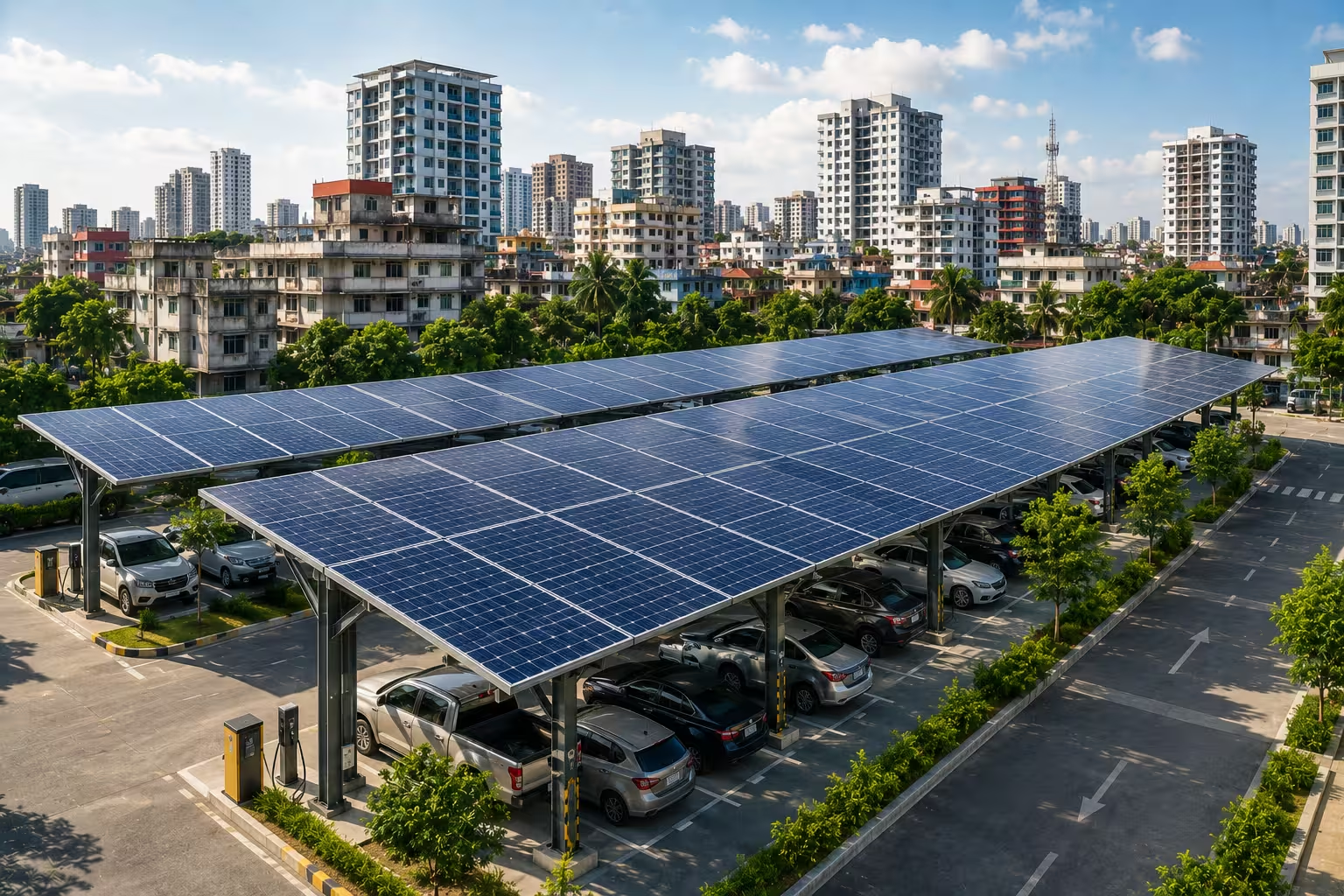
A solar carport is a raised structure that supports solar panels above a parking area.

Vehicles park underneath the structure while the panels generate electricity above them.

A commercial solar carport can provide two benefits from the same piece of property:

  • Covered parking
  • Renewable electricity generation

This makes solar carports particularly interesting for:

  • Shopping centres
  • Office buildings
  • Factories
  • Warehouses
  • Hotels
  • Hospitals
  • Educational institutions
  • Corporate offices
  • Commercial complexes
  • Large retail properties

Instead of using additional land for a separate solar installation, the business can use an existing parking area.

Why Are Commercial Solar Carports Becoming Interesting?

Commercial properties often have a problem that residential properties do not:

They consume a lot of electricity during the daytime.

Factories, offices, shopping centres and commercial buildings may operate:

  • Air conditioning
  • Lighting
  • Refrigeration
  • Computers
  • Pumps
  • Machinery
  • Elevators
  • Ventilation systems

This means solar electricity generated during business hours can potentially offset a meaningful portion of electricity purchased from the grid.

At the same time, the carport provides shade for vehicles and can improve the usability of the parking area.

Are Solar Carports Worth It?

The short answer is:

They can be—but not for every property.

If your building already has a large, structurally suitable roof with good solar exposure, rooftop solar will often be the simpler and lower-cost option.

A solar carport becomes more attractive when:

  • Your roof has limited usable space.
  • Your roof is structurally unsuitable.
  • You need covered parking anyway.
  • You have a large parking area.
  • You want to add EV charging.
  • Your business consumes significant daytime electricity.
  • You plan to hold the property for many years.

In other words:

The carport should provide value even without the solar panels.

When the structure solves a parking problem and the solar panels generate electricity on top, the economics can become much more attractive.

How Much Does a Commercial Solar Carport Cost in Bangladesh?

There is no single fixed price for a commercial solar carport in Bangladesh.

The total project cost depends on:

  • Solar capacity
  • Number of parking spaces
  • Structural steel
  • Foundation design
  • Solar panel type
  • Inverter capacity
  • Electrical infrastructure
  • Cabling
  • Protection equipment
  • Installation
  • Civil works
  • Drainage
  • Parking layout
  • EV charging requirements
  • Site accessibility

A solar carport normally costs more than rooftop solar because you are not only buying a solar system.

You are also building a structure to support it.

Therefore, a Bangladesh project should be priced in BDT based on a site-specific design, rather than relying on generic international price-per-watt figures.

Where Does the Extra Cost Come From?

The solar panels themselves are only one part of the project.

Structural Steel

The structure must support the solar panels and withstand local environmental conditions.

Foundations

Unlike rooftop solar, the carport requires its own structural foundations.

Foundation design depends on:

  • Soil conditions
  • Structure height
  • Wind loading
  • Parking layout
  • Structural configuration

Elevated Mounting

The panels must be installed high enough to allow vehicles to park safely underneath.

Electrical Infrastructure

A commercial solar carport may require:

  • Inverters
  • DC cables
  • AC cables
  • Distribution equipment
  • Protection systems
  • Metering
  • Monitoring

Engineering and Design

A proper commercial structure requires structural and electrical engineering rather than simply attaching panels to a parking canopy.

Solar Carport vs Rooftop Solar

If your only objective is generating electricity, rooftop solar will often be the first option to evaluate.

FactorSolar CarportRooftop Solar
StructurePurpose-builtUses existing roof
Upfront costUsually higherUsually lower
Parking benefitYesNo
Roof space requiredNoYes
Land/parking requiredYesNo additional land
Maintenance accessMore complexGenerally easier
EV charging integrationExcellentPossible
Best forLarge parking areasSuitable commercial roofs
Main advantageParking + solarLower-cost solar generation

The key question is:

What problem are you trying to solve?

If you only need solar electricity, rooftop solar may be better.

If you also need covered parking, the carport structure adds another source of value.

What About Ground-Mounted Solar?

Ground-mounted solar can also be an option for commercial properties with available land.

It may be cheaper than a carport because you do not have to build a parking canopy.

However, the land itself has value.

If that land could otherwise be used for:

  • Parking
  • Expansion
  • Warehousing
  • Manufacturing
  • Landscaping
  • Future development

then the opportunity cost needs to be considered.

A solar carport can be attractive because it generates electricity without giving up the parking function of the land.

ROI: Where Does the Return Come From?

A commercial solar carport can create value from several sources.

Electricity Bill Savings

The most obvious benefit is reducing electricity purchased from the grid.

The amount saved depends on:

  • Solar system size
  • Electricity tariff
  • Business operating hours
  • Solar generation
  • Self-consumption
  • Net-metering arrangements where applicable

Potential Export of Surplus Electricity

For eligible grid-connected systems, surplus renewable electricity may be exported to the grid under Bangladesh’s applicable net-metering framework.

This can improve the overall economics of a commercial solar project.

However, the eligibility requirements and settlement mechanism should be checked before making financial projections.

Covered Parking

The carport itself provides an additional business benefit.

Vehicles can be protected from:

  • Strong sunlight
  • Rain
  • Heat

For customers and employees, shaded parking can also improve the overall experience of visiting the property.

EV Charging

A solar carport can be particularly useful if your business plans to install electric vehicle charging stations.

The basic concept is:

Solar panels → Electricity → EV charging

Depending on the system design, battery storage can also be integrated.

This can make the parking infrastructure more useful as EV adoption increases.

Why Daytime Electricity Consumption Matters

Commercial solar projects often perform best when the business uses a significant amount of electricity during daylight hours.

For example, a factory operating from morning to evening may directly consume a large portion of its solar generation.

This reduces the amount of electricity it needs to purchase from the grid.

A commercial property that uses most of its electricity at night may benefit less from direct solar consumption unless battery storage or an appropriate grid-connected arrangement is included.

Therefore, before calculating ROI, look at your hour-by-hour electricity consumption, not just your monthly electricity bill.

A Simple ROI Example

Imagine a commercial property installs a solar carport.

Suppose the project costs:

৳50 lakh

And the solar system generates electricity that saves approximately:

৳7 lakh per year

The simple payback would be:

৳50 lakh ÷ ৳7 lakh ≈ 7.1 years

This is only an illustration.

A real project should also consider:

  • Maintenance
  • Inverter replacement
  • Financing cost
  • Electricity tariff changes
  • Solar degradation
  • Net-metering revenue
  • Structural lifespan
  • Insurance
  • Tax implications
  • Future electricity consumption

So a professional feasibility study should calculate lifetime ROI, not just simple payback.

Why Electricity Tariffs Matter So Much

The same solar carport can have very different financial returns for two businesses.

If Business A pays a relatively high effective electricity rate and consumes large amounts of electricity during solar production hours, solar can provide significant savings.

If Business B has lower electricity costs and uses very little power during the day, the same solar system may take considerably longer to pay back.

This is why an installer should ask for your actual electricity bills before giving you a serious ROI estimate.

What About Demand Charges?

For larger commercial consumers, the electricity bill can involve more than simply paying for total units consumed.

Depending on the applicable tariff and connection type, demand-related charges can also influence the economics of solar and energy management.

A properly designed system can potentially help reduce electricity demand during certain periods.

However, this should be evaluated using the specific tariff structure of the business.

A generic “solar will reduce your bill by X%” claim is not enough.

When Rooftop Solar Is Better

Rooftop solar will usually be the better option when:

  • Your roof has sufficient usable area.
  • The roof is structurally suitable.
  • Shading is limited.
  • You do not need covered parking.
  • Your main goal is electricity savings.
  • You want the simplest installation.

If you have a large warehouse with a strong, unobstructed roof, spending extra money on a carport may not provide enough additional value.

When Solar Carport Is Better

A solar carport becomes more attractive when:

  • Your roof is too small.
  • Your roof has structural limitations.
  • Your parking area is large.
  • Covered parking is already needed.
  • You want EV charging.
  • You have high daytime electricity consumption.
  • The property will be used for many years.

In this situation, the carport is not simply a solar mounting structure.

It is a piece of commercial infrastructure that performs multiple functions.

How Much Parking Space Do You Need?

The economics of a commercial solar carport usually improve as the project gets larger.

A small parking area may not justify:

  • Structural engineering
  • Foundation work
  • Electrical design
  • Installation mobilisation
  • Equipment costs

A larger parking facility can spread those costs across more solar capacity and more parking spaces.

However, there is no universal minimum number of parking spaces that makes a project viable.

The correct number depends on:

  • Parking layout
  • Solar capacity per parking space
  • Electricity consumption
  • Construction cost
  • Available roof space
  • Land value

Don’t Sacrifice Valuable Parking

One of the biggest mistakes would be building a solar carport that makes the parking area less useful.

Before construction, the design should consider:

  • Vehicle dimensions
  • Turning radius
  • Parking arrangement
  • Entry and exit routes
  • Emergency access
  • Pedestrian movement
  • Drainage
  • Maintenance access

The solar structure should improve the parking area—not create a new operational problem.

Maintenance of Commercial Solar Carports

Solar panels themselves are relatively low-maintenance.

But a commercial carport introduces additional maintenance requirements.

Solar Panels

Regular cleaning and inspection may be required depending on dust, pollution and environmental conditions.

Electrical Equipment

Inverters, cables, protection systems and monitoring equipment should be inspected periodically.

Steel Structure

The structure should be checked for:

  • Corrosion
  • Loose connections
  • Structural damage
  • Drainage issues

This is particularly important in areas exposed to moisture and heavy rainfall.

Access Equipment

Because the panels are elevated, some maintenance work may require:

  • Ladders
  • Lifting equipment
  • Maintenance platforms

This can increase maintenance costs compared with rooftop systems.

Engineering Is Extremely Important

A commercial solar carport should not be treated as a simple solar installation.

The structure needs proper engineering.

The design should consider:

  • Wind loading
  • Structural loads
  • Foundation design
  • Soil conditions
  • Panel weight
  • Drainage
  • Vehicle clearance
  • Corrosion protection
  • Electrical safety

For Bangladesh, local environmental conditions and site-specific structural requirements need to be considered carefully.

A cheaper structure is not necessarily a better investment if it creates long-term safety or maintenance problems.

What About Heavy Rain?

Bangladesh receives significant rainfall during the monsoon season.

A solar carport therefore needs proper drainage design.

Water should not simply fall from the panel edges into parking spaces or pedestrian areas.

A well-designed carport can use:

  • Gutters
  • Downpipes
  • Controlled drainage
  • Appropriate panel layout

This can actually become an additional benefit for a commercial parking facility.

What About Heat?

Vehicles parked under a solar canopy receive less direct sunlight than vehicles parked in an uncovered area.

This can make the parking environment more comfortable, particularly during Bangladesh’s hot months.

The solar panels also provide shade over the parking spaces while converting sunlight into electricity.

This creates a useful combination:

The sunlight is producing electricity instead of simply heating the vehicles below.

Solar Carports and EV Charging

One of the most interesting future applications of solar carports is EV charging.

A commercial property can potentially combine:

Solar Carport + EV Charging + Battery Storage

This can be useful for:

  • Office employees
  • Hotel guests
  • Shopping-centre customers
  • Corporate fleets
  • Delivery vehicles
  • Commercial EV fleets

The electricity generated by the canopy can be used partly for EV charging and partly for the building’s electricity demand.

However, EV charging can create substantial electrical demand, so the electrical infrastructure needs to be designed accordingly.

Should You Add Batteries?

Not every commercial solar carport needs batteries.

If the business consumes most of the solar electricity during the day, a grid-connected system may be sufficient.

Battery storage becomes more interesting when you want:

  • Backup power
  • Greater energy independence
  • EV charging flexibility
  • Peak-demand management
  • More control over when solar electricity is used

But batteries add significant cost.

The financial case should therefore be calculated separately rather than automatically adding them to every project.

Solar Carport vs Ground Mount vs Rooftop

For commercial property owners, the decision can be simplified into three options.

Choose Rooftop Solar If:

  • You have enough usable roof space.
  • The roof is structurally suitable.
  • You want the lowest practical solar installation cost.

Choose Ground-Mounted Solar If:

  • You have unused land.
  • The land has limited alternative value.
  • You have enough space for a dedicated solar field.

Choose Solar Carport If:

  • You need covered parking.
  • Roof space is limited.
  • Parking is already a major part of the property.
  • You want to integrate EV charging.
  • You want to use the parking area for both electricity generation and vehicle protection.

Common Mistakes Commercial Property Owners Make

Comparing Only the Solar Cost

A carport is not just a solar installation.

It is also a structure.

Compare the incremental cost of the solar carport against the cost of building a normal parking canopy.

That is a much more meaningful comparison.

Ignoring the Existing Roof

If your roof can easily support a large solar system, it may provide a faster return.

Assuming a Generic Payback Period

Your electricity tariff, consumption profile and project cost determine the actual payback.

Ignoring Structural Engineering

The carport must be designed for the site.

Forgetting Future EV Charging

If EV charging is likely to become important for your business, design the electrical infrastructure with future expansion in mind.

Underestimating Drainage

A large canopy can collect significant amounts of rainwater.

Drainage should be part of the original design.

Focusing Only on Panel Efficiency

A high-efficiency panel does not automatically make the project financially better.

The entire system matters:

  • Panel
  • Structure
  • Inverter
  • Electricity tariff
  • Solar generation
  • Installation
  • Maintenance

Questions to Ask Before Getting a Quote

Before signing a commercial solar carport contract, ask:

What is the total installed cost in BDT?

Do not compare only the solar panel price.

How much electricity will the system generate annually?

Ask for the expected annual energy yield based on your actual location.

What assumptions were used for the ROI?

Ask about:

  • Electricity tariff
  • Annual tariff increase
  • Solar degradation
  • Maintenance
  • Financing
  • Net-metering revenue

How much of the generated electricity will we use directly?

Self-consumption can have a major impact on financial returns.

What happens to surplus generation?

Understand the applicable grid and net-metering arrangements.

What structural calculations have been completed?

Ask for details of the engineering design.

What is included in the warranty?

Separate the:

  • Panel warranty
  • Inverter warranty
  • Structural warranty
  • Installation warranty

What happens if an inverter fails?

Ask about replacement time and service support.

How Long Does a Solar Carport Last?

The structural frame can potentially remain in service for decades when properly designed, installed and maintained.

Solar panels are also designed for long-term operation, although their output gradually decreases over time.

Inverters and other electrical equipment may need replacement during the overall life of the system.

For a commercial project, the financial model should therefore include both:

Long-term solar generation

and

Future component replacement costs.

Is a Solar Carport a Good Investment for Bangladesh Businesses?

It can be.

But the strongest business case usually comes when the property gets two benefits from the same investment:

Parking infrastructure + Solar electricity

If you need a parking canopy anyway, adding solar panels can turn that structure into an electricity-generating asset.

If you do not need covered parking and already have a suitable roof, rooftop solar may provide a better return.

That distinction is extremely important.

A Practical Decision Framework

Ask these five questions:

1. Do I already have a good commercial roof?

If yes, evaluate rooftop solar first.

2. Do I need covered parking?

If yes, a solar carport becomes more interesting.

3. How much electricity does the business consume during the day?

Higher daytime consumption generally improves the value of solar generation.

4. Do I have enough parking space?

A commercial carport requires appropriate space without disrupting normal operations.

5. How long will I keep the property?

Solar is a long-term investment.

If you expect to operate from the property for many years, the economics can become more attractive.

Final Verdict: Are Solar Carports Worth It?

For a commercial property in Bangladesh, a solar carport is not automatically better than rooftop solar.

Rooftop solar will usually be cheaper if you already have a suitable roof.

But that does not mean solar carports are a bad investment.

They can make excellent sense when:

  • You need covered parking.
  • Your roof cannot accommodate enough solar.
  • You have significant daytime electricity consumption.
  • You have a large parking area.
  • You want EV charging infrastructure.
  • You plan to keep the property for the long term.

The real value comes from combining multiple benefits into one structure.

Instead of building:

Parking canopy + solar system

you are effectively creating:

One structure that provides parking protection + solar generation + potential EV charging infrastructure.

That is where the economics become much more interesting.

At Muspana, we recommend evaluating a commercial solar carport as a complete infrastructure investment—not simply comparing its panel price against rooftop solar.

Before making a decision, calculate:

Total project cost

Annual solar generation

Electricity bill savings

Potential net-metering benefit

Parking value

Maintenance cost

Future inverter/battery replacement

And the expected payback period

If the numbers work, a solar carport can turn an ordinary commercial parking area into a productive energy asset.

If they do not, rooftop or ground-mounted solar may provide a better return.

The goal is not to build the most impressive solar structure.

The goal is to build the one that makes the most financial and practical sense for your property.

Frequently Asked Questions

What is a commercial solar carport?

A commercial solar carport is a parking structure with solar panels installed on its roof. It provides covered parking while generating electricity for the building, EV charging or other commercial loads.

Are solar carports more expensive than rooftop solar?

Usually, yes. A solar carport requires a dedicated structural frame, foundations, elevated mounting and additional engineering. Rooftop solar can use the existing building structure, reducing the amount of construction required.

How much does a solar carport cost in Bangladesh?

There is no fixed price. The cost depends on solar capacity, number of parking spaces, structural steel, foundations, inverter, electrical infrastructure, installation and site conditions. A proper commercial quotation should be prepared in BDT based on the actual site.

Is a solar carport better than rooftop solar?

Not necessarily. Rooftop solar is usually more cost-effective if the building has sufficient suitable roof space. A solar carport becomes more attractive when covered parking or EV charging infrastructure is also required.

Can solar carports charge electric vehicles?

Yes. EV charging stations can be integrated into the electrical design of a solar carport. The required electrical capacity should be calculated based on the number and type of chargers.

Can a solar carport work with batteries?

Yes. Battery storage can be integrated for backup power, energy management or EV charging. However, batteries significantly increase project cost, so their financial benefit should be evaluated separately.

Does a solar carport work during the monsoon?

Yes. Solar panels continue generating electricity during cloudy weather, although output can be lower than during strong sunlight. The annual financial model should account for seasonal changes in solar generation.

How long does a commercial solar carport last?

A properly engineered structural frame can potentially last for decades. Solar panels are also designed for long-term operation, while inverters and some electrical components may require replacement during the system’s lifetime.

Does a solar carport need maintenance?

Yes, but the solar panels themselves generally require relatively little maintenance. Commercial carports also require inspection of the structure, electrical equipment, drainage and mounting system.

Is a solar carport worth it for a factory?

It can be, particularly if the factory has large parking areas and significant daytime electricity consumption. The strongest case usually occurs when the factory also needs covered parking or plans to install EV charging.

What is the biggest advantage of a solar carport?

The biggest advantage is that the same space can serve two purposes: parking and electricity generation. This can be particularly valuable for commercial properties where land and parking space already have significant value.

Scroll to Top