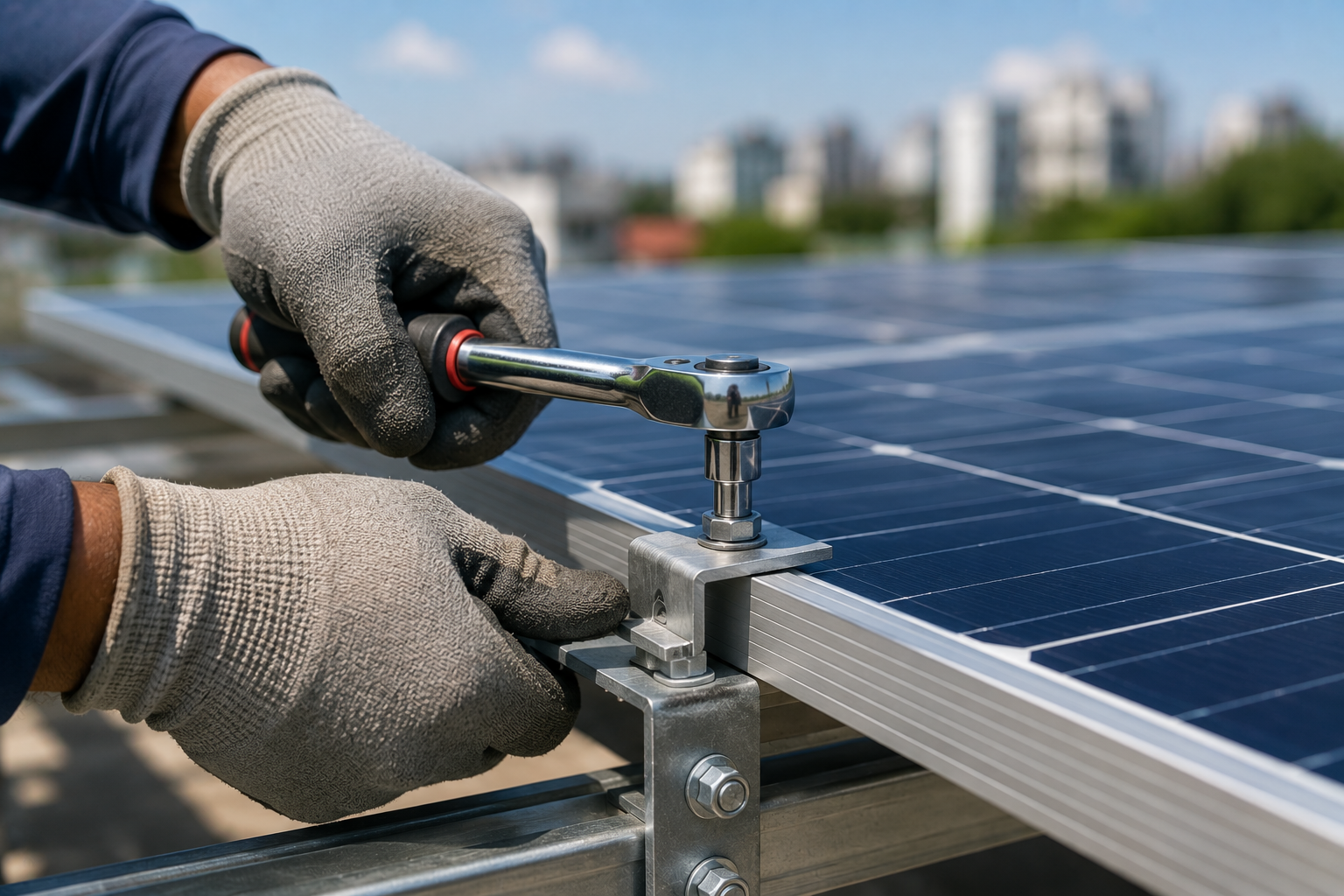
If you’re holding a torque wrench right now, here’s the number: most solar module clamps use M8 bolts torqued somewhere between 6 and 20 Nm, with 14-20 Nm being the range you’ll see most often across manufacturer manuals. That’s roughly 5-15 ft-lb if your wrench reads in imperial units.
Now the part that actually matters. That range isn’t one fixed number, and a lot of what’s floating around online blurs it with a completely different spec — the torque used on structural racking bolts, which can run into the hundreds of Nm. Apply that structural figure to a module clamp and you won’t get a tighter, safer installation. You’ll crack the glass, crush the panel frame, or shear the bolt clean off.
This is the distinction most guides skip. It’s also the one that matters most if you want your installation to survive its first storm and your warranty to stay valid.
Why the Torque Number Isn’t the Same Everywhere
Ask three manufacturers for their M8 clamp torque spec and you’ll get three different answers. ET Solar’s installation manual calls for 8-10 Nm. Trina’s Duomax manual specifies 16-20 Nm. Nophadrain’s ND Solar clamp system, used on green-roof mounting, sits at 6-7 Nm. Installers on forums like DIY Solar Power Forum generally settle around 15-20 Nm as a working consensus for standard rail-mounted mid-clamps.
None of these numbers is wrong. They’re specific to that manufacturer’s clamp design, bolt material, and how the clamp interacts with the module frame. That’s the reason a generic “solar torque chart” can only ever be a starting point — the number that actually governs your installation is printed in the box your panels came in.
If you don’t have that manual anymore, or you’re working with mixed hardware, the 14-20 Nm range is a reasonable default for standard M8 mid and end clamps. Treat it as a working range, not gospel.
Mid-Clamps vs. End-Clamps
Both typically use the same M8 hardware and fall in the same general torque range, but they’re doing slightly different jobs:
- Mid-clamps sit between two adjacent panels and often carry an integrated grounding pin that has to pierce the module frame’s anodized coating to create an electrical bond. Under-torque here doesn’t just risk a loose panel — it can leave you with a grounding connection that looks fine but isn’t actually conducting.
- End-clamps sit at the outer edge of a row, holding a single panel edge against the rail. There’s no grounding pin to worry about, but they take more of the wind-uplift load at the array’s perimeter, where wind pressure is highest.
What Torque Actually Does (and Why “Tighter Is Safer” Is Wrong)
Torque is a proxy for clamping force, not the thing itself. When you turn that bolt, roughly 90% of the force you’re applying is spent overcoming friction between the threads and washer. Only about 10% actually goes into stretching the bolt and creating the clamping preload that holds the panel down. That’s why doubling the torque doesn’t come close to doubling the holding force — and why over-torquing does a lot of damage for very little structural benefit.
Over-torque a module clamp and you risk:
- Crushing the aluminum lip of the module frame, which can start hairline glass cracks that spread slowly and aren’t always visible on install day
- Shearing the bolt shank outright, especially on stainless hardware if you’re using a torque spec meant for carbon steel
- Failing the grounding bond on mid-clamps, ironically, because a crushed frame lip can lift the grounding pin away from clean metal contact
Under-torque, and you risk:
- A panel that shifts or rattles under wind load, working the clamp and bolt loose over months
- A grounding pin that never fully seats through the anodized coating, leaving a bond that fails an inspection or, worse, doesn’t fail until there’s a fault current with nowhere safe to go
Neither direction is “the safe side.” The spec exists because it’s the point where both risks are minimized.
Bolt Grade Matters More Than People Assume
A 14-20 Nm spec written for a carbon-steel Class 8.8 or 10.9 bolt is not automatically safe for a stainless A2-70 or A4-80 bolt of the same size. Stainless has different yield characteristics, and pushing it to a carbon-steel torque figure can overstretch it well before you’d expect trouble. If your hardware kit doesn’t specify the bolt grade, that’s worth checking before you assume any general torque range applies as-is.
Module Clamp Torque vs. Structural Fastener Torque — Don’t Mix These Up
This is the mix-up that causes the most damage, and it’s easy to see how it happens. A single spec sheet or supplier catalogue will often list torque values for everything from M8 clamp bolts up to M16 structural bolts securing rails, purlins, or ground-mount steelwork — all in one table, without separating “this holds a panel down” from “this holds the whole rack together.”
Structural connections at M12 and M16 genuinely can run into the hundreds of Nm, because they’re transferring wind and dead load through a much larger steel or aluminum section, not clamping a thin panel frame. Module clamps almost never use M12 or M16 hardware in the first place — if your clamp kit specifies anything larger than M8, that’s a strong signal to double-check you’re reading the right table.
| Fastener type | Typical size | Typical torque | What it holds |
| Module clamp (mid or end) | M8 | 6-20 Nm | Panel frame to mounting rail |
| Green-roof wind bracing bracket | M16 | ~20 Nm | Rail bracing, not module clamping |
| Structural rail/purlin connection | M12-M16, Class 10.9 | Up to several hundred Nm | Racking to roof structure or ground foundation |
If a number you’re looking at seems dramatically higher than 20 Nm and someone’s calling it a “clamp” spec, it’s almost certainly a structural fastener figure that’s been mislabeled — and it does not belong anywhere near a panel frame.
Installing Without a Calibrated Torque Wrench
A calibrated Nm-range torque wrench isn’t something most households in Bangladesh already own, and it’s usually an imported tool rather than something you’ll find at a local hardware shop. A lot of residential and small rooftop jobs here still get hand-tightened by feel, which isn’t ideal, but it’s the reality on the ground.
If you’re working without one:
- Snug the bolt down until the clamp makes firm, flush contact with the frame — no visible gap, no wobble.
- Give it a further quarter to half turn past hand-tight with a standard wrench, checking that the frame isn’t visibly deforming or the clamp isn’t biting into the anodized coating unevenly.
- Check every clamp again after the first hard rain or windy day — hand-tightened hardware is more likely to need a follow-up check than torque-wrench-verified hardware.
- If the installation is commercial, institutional, or anywhere failure has real consequences, a basic click-type torque wrench is a worthwhile one-time purchase rather than something to skip. Muspana’s installers use manufacturer-specified torque settings rather than generic tables across the commercial and institutional systems they deploy, which is part of why torque verification is treated as a checklist item, not a guess.
Bangladesh’s monsoon winds and coastal salt exposure are also worth a mention here. Corroded or lower-grade bolts shear more easily under the same torque than fresh, correctly-specified stainless hardware — so if a system’s been up for a few years, a periodic clamp check is cheap insurance against a panel walking off the rail during storm season.
If you’d rather have someone verify this properly than second-guess a hand-tightened bolt on a roof, that’s the kind of quality check worth having a professional install team handle from the start.
FAQs
What torque should I use for solar panel clamps?
Most M8 module clamps fall between 6 and 20 Nm, with 14-20 Nm being the most commonly cited range across manufacturer manuals. Always check your specific module and clamp manufacturer’s manual first — this range is a fallback, not a universal standard.
What happens if you over-tighten solar panel clamp bolts?
Over-torquing can crush the panel frame’s aluminum lip, create micro-cracks in the glass that spread over time, or shear the bolt outright. It can also push a mid-clamp’s grounding pin out of clean contact, which undermines the electrical bond rather than improving it.
Do all solar panels use the same clamp torque?
No. Torque specs vary by manufacturer, clamp design, and bolt grade — figures for M8 hardware alone range from roughly 6 Nm to 20 Nm depending on the brand. There’s no single industry-wide number.
Can I hand-tighten solar panel clamps without a torque wrench?
It’s not ideal, but it’s common practice, especially on smaller residential jobs in Bangladesh where calibrated torque wrenches aren’t always on hand. Snug the clamp flush against the frame, add a quarter to half turn past hand-tight, and recheck after the first storm. For commercial or institutional installs, a proper torque wrench is worth the investment.
Is module clamp torque the same as the torque used on racking or rail bolts?
No, and this is where a lot of confusion comes from. Structural bolts holding rails, purlins, or ground-mount steel together can require torque figures in the hundreds of Nm because they’re carrying much larger loads through heavier hardware. Module clamp torque, by contrast, stays in the 6-20 Nm range for standard M8 bolts. Applying a structural spec to a module clamp will damage the panel.