
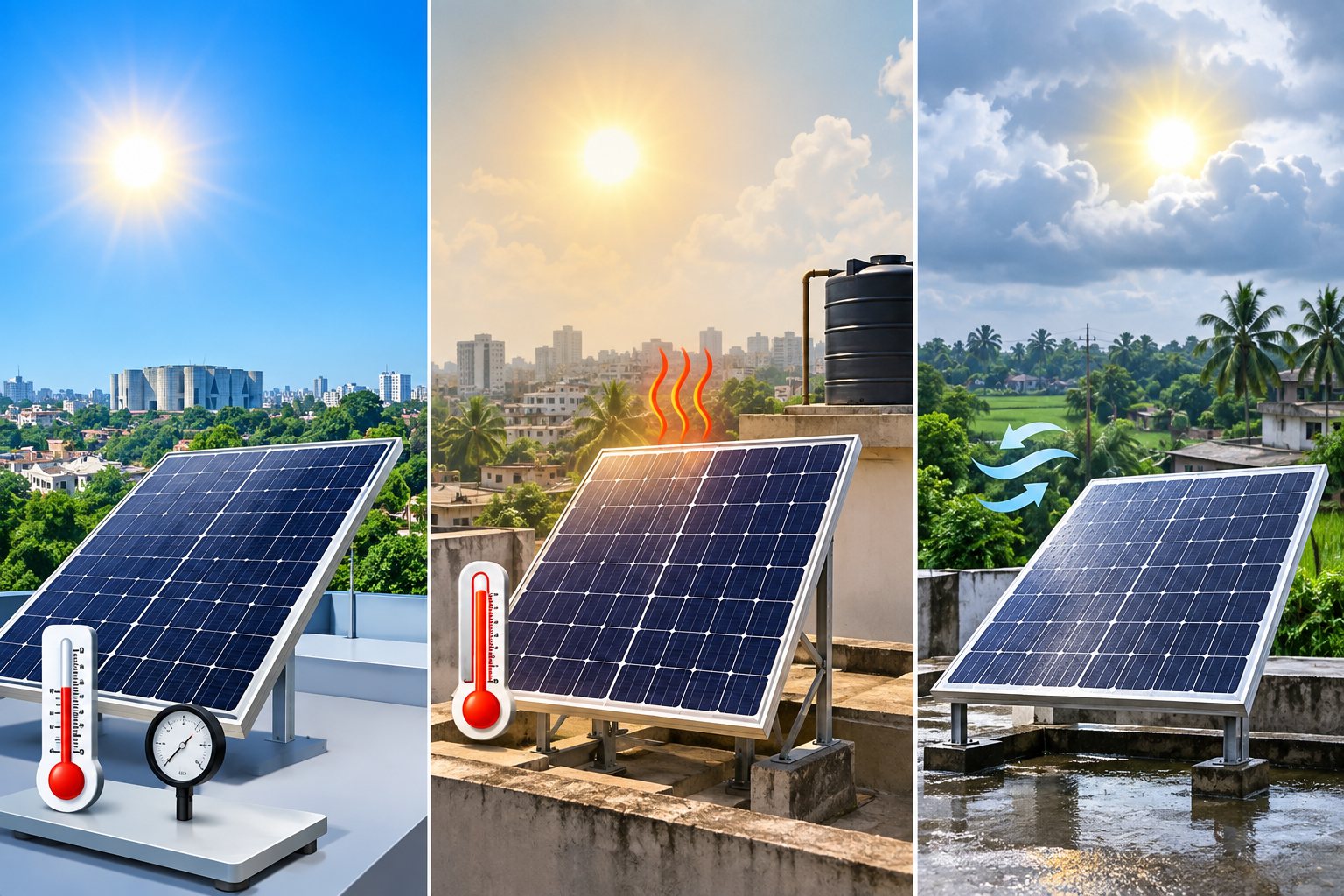
You bought a panel rated at 450 watts. On a bright afternoon, your monitoring app shows something closer to 380. Nothing is broken. Nothing is wrong with your installer’s work. You’ve just run into the gap between a lab test and a rooftop in Bangladesh.
Solar panels carry three different power ratings, and manufacturers rarely explain which one to trust. Understanding the difference between STC, NOCT (now often called NMOT), and PTC isn’t just spec-sheet trivia — it’s the difference between a realistic expectation and a disappointing one.
What STC actually measures
STC stands for Standard Test Conditions. It’s the number printed in bold on every panel box and datasheet, and it’s measured in a lab under three fixed conditions: 1,000 W/m² of sunlight, a cell temperature held at exactly 25°C, and a specific light spectrum called AM 1.5.
That 25°C detail matters more than it sounds. A solar cell sitting in direct sun rarely stays that cool — surface temperatures on a Bangladeshi rooftop in April or May can climb well past 60°C. STC exists to give buyers a consistent way to compare panels against each other, not to predict what a panel will produce on your roof. Think of it the way you’d think of a car’s fuel economy rating: useful for comparing models, less useful as a promise about your actual commute.
NOCT (NMOT): the thermal reality check
NOCT — Nominal Operating Cell Temperature, increasingly called NMOT (Nominal Module Operating Temperature) under newer IEC standards — tests the panel under milder, more field-like conditions: 800 W/m² irradiance, 20°C ambient air temperature, and a light 1 m/s breeze.
This rating tells you how a panel behaves once heat becomes a factor, which is exactly what happens on a real roof. Panels typically produce somewhere between 75% and 85% of their STC number once you shift to NOCT/NMOT conditions — the exact figure depends on the specific panel model and its build quality. A panel with a better NOCT/NMOT performance handles heat more gracefully, which is genuinely useful information if you live somewhere that stays hot for most of the year.
PTC: the closest thing to a field prediction
PTC (PVUSA Test Conditions) pushes the temperature assumption even further. It keeps the same 1,000 W/m² irradiance as STC, but lets the cell temperature rise to roughly 45–50°C, reflecting a 20°C ambient temperature and a 1 m/s wind — conditions meant to mimic a panel actually working outdoors on a clear day.
Because of that heat allowance, PTC ratings usually come in about 10–15% lower than STC. In the United States, PTC is the rating the California Energy Commission uses for incentive calculations, precisely because it tracks daily energy production more honestly than a lab-perfect STC number ever could. Bangladesh doesn’t use PTC in any regulatory sense, but the underlying logic — power output drops as the panel heats up — applies here just as much, arguably more.
Comparing the three ratings
| Rating | Irradiance | Cell / Ambient Temp | Wind Speed | Primary Use |
| STC | 1,000 W/m² | 25°C (cell) | None | Nameplate comparison, marketing |
| NOCT / NMOT | 800 W/m² | ~45°C (cell) / 20°C (ambient) | 1 m/s | Thermal selection, hot-climate efficiency |
| PTC | 1,000 W/m² | ~45–50°C (cell) / 20°C (ambient) | 1 m/s | Realistic power output, system sizing |
Why this matters more in Bangladesh than in a cooler market
Most of the content written about these ratings comes out of markets with mild summers, where the STC-to-real-world gap is a minor footnote. That’s not the case here.
Bangladesh runs hot for most of the year, and a large share of residential and industrial installations sit on corrugated tin or CI-sheet roofing — a material that soaks up heat and radiates a good deal of it straight back up at the panels mounted above it. It’s a reasonable engineering expectation, not a measured statistic, that cell temperatures on a poorly ventilated tin roof can run hotter than even the NOCT/NMOT test assumes. That’s exactly why airflow underneath a mounting structure isn’t a minor installation detail — it has a direct bearing on how close your system gets to its rated output. If you’re curious how much this varies by mounting choice, our guide to selecting a mounting structure covers ventilation considerations in more depth, and solar performance in extreme climates looks at hot-weather behaviour more broadly.
None of this makes STC a dishonest number. It’s a legitimate, standardized baseline — every panel on the market is tested the same way, so it’s genuinely useful for side-by-side comparison. The mistake is treating it as a promise rather than a benchmark.
How to actually use these numbers
When you’re comparing two panels or reviewing a quote, here’s a practical way to think about it:
- Use the STC wattage to compare panels of similar size and technology against each other — it’s a fair, standardized starting point.
- Look for NOCT/NMOT figures (or a listed temperature coefficient) if you want to judge how well a panel handles heat — a smaller drop-off between STC and NOCT generally signals better thermal performance.
- Mentally apply PTC-style thinking — expect real daily output to land noticeably below the STC number — when you’re projecting how much energy a system will actually generate over a year, not just what its nameplate capacity says.
If an installer’s yield projection is built entirely off STC wattage with no allowance for temperature losses, soiling, shading, or inverter losses, it’s worth asking how they arrived at that number. Our page on evaluating solar quotes walks through the other assumptions worth checking. For anyone designing or sizing a system rather than just buying one, common solar sizing mistakes and how performance ratio and CUF are calculated go into this in more technical detail.
At Muspana, this is part of why system design shouldn’t stop at matching STC wattage to a target capacity — accounting for real thermal behaviour, roof type, and ventilation is what separates a projected output from an actual one.
FAQs
Is NOCT the same as NMOT?
Essentially, yes. NMOT is the updated term used under newer IEC standards for what was traditionally called NOCT. Both describe the same test — panel output at 800 W/m² irradiance, 20°C ambient temperature, and 1 m/s wind — measuring realistic thermal performance rather than lab-perfect conditions.
Which rating should I trust when comparing two solar panels?
Use STC to compare panels on equal footing, since every manufacturer tests to the same standard. If you want to know how well a panel handles heat specifically, check its NOCT/NMOT figure or temperature coefficient rather than relying on STC alone.
Why doesn’t my solar panel produce its rated wattage?
STC ratings are measured at a cool 25°C cell temperature, which real rooftops rarely stay at. Once a panel heats up in direct sun — which happens quickly in Bangladesh’s climate — output naturally drops below the STC number. This is expected behaviour, not a fault.
How much lower is real-world output compared to STC?
It varies by panel and conditions, but as a general guide, NOCT/NMOT-based output typically falls to about 75–85% of STC, while PTC ratings run roughly 10–15% lower than STC. Actual performance on any given roof depends on additional factors like shading, soiling, and mounting ventilation.