Your Roof Isn’t a Textbook Diagram — and That Changes This Decision
Most solar comparisons assume a perfect, unshaded, south-facing roof. Real rooftops rarely look like that. There’s a water tank throwing a shadow across two panels by mid-morning. The building next door blocks the low afternoon sun. Half the roof faces one way, half faces another because that’s just how the structure was built.
This is exactly the situation where the choice between microinverters and power optimizers stops being a spec-sheet exercise and starts actually mattering. Get it right, and a partially shaded roof still produces close to its full potential. Get it wrong, and one shaded panel can quietly drag down the output of panels that never see a shadow at all.
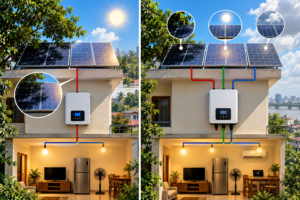
Quick answer: A microinverter converts DC electricity to AC power right at each individual panel, so every panel works independently. A power optimizer conditions the DC power at the panel level but still sends it to one central string inverter to actually convert it to AC. The difference sounds small. It isn’t — it shapes shading performance, cost, battery compatibility, and how easily you can expand the system later.
What’s Actually Different Between Them
Every solar panel produces DC (direct current) electricity, but homes and the grid run on AC (alternating current). Something has to do that conversion — that’s the inverter’s job.
In a traditional string inverter setup, panels are wired together in a series, and one central inverter handles the DC-to-AC conversion for the whole group. It’s simple and inexpensive, but it has a well-known weakness: if one panel in the string underperforms — because of shade, dirt, or a partial fault — it can drag down the output of every other panel wired to it, the same way one slow runner slows down an entire relay team.
Microinverters and power optimizers both exist to fix that weak point, just in different ways.
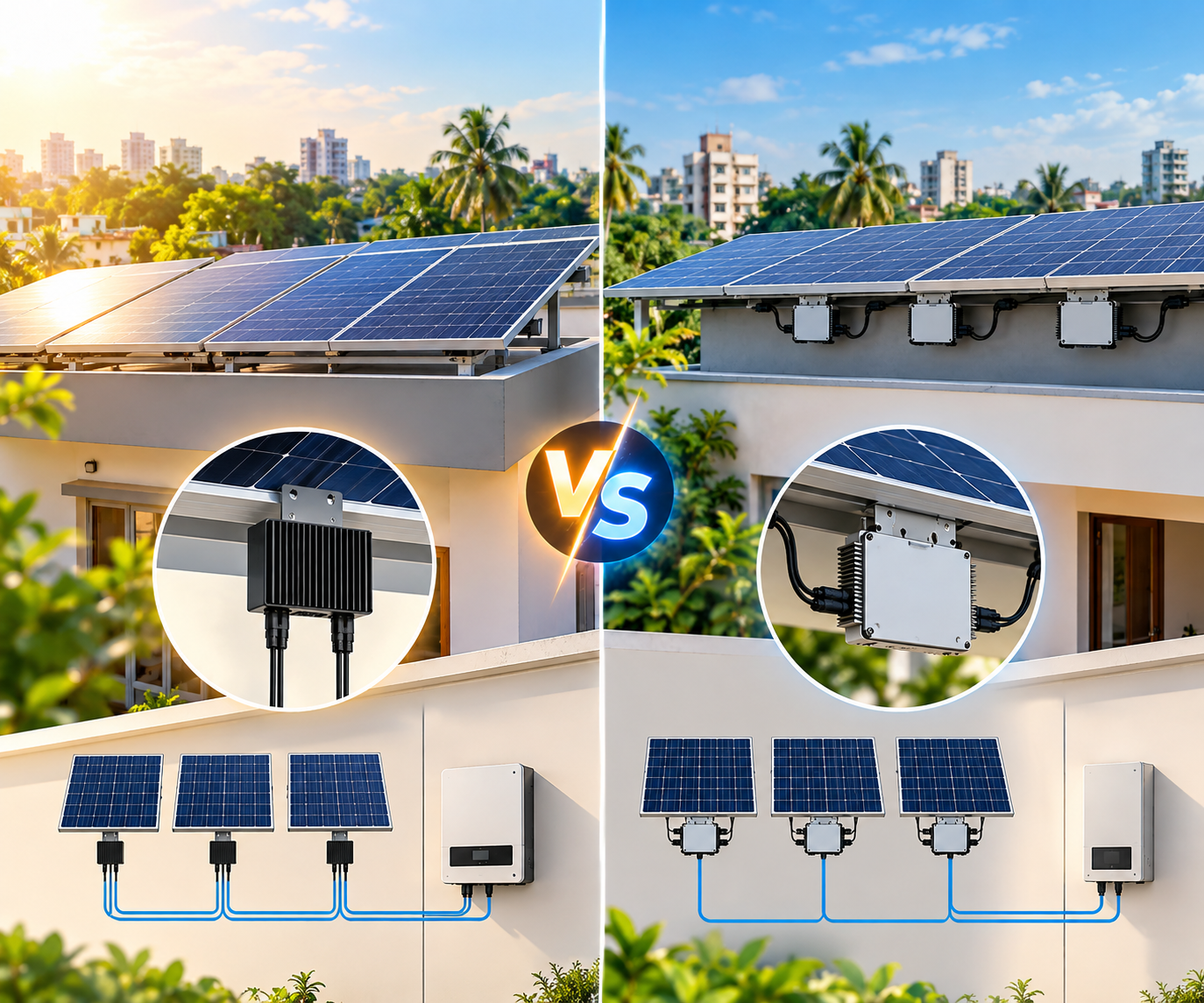
- A microinverter sits on the back of each individual panel and converts that panel’s DC output to AC on the spot. Every panel is its own independent power producer. Nothing else on the roof affects it.
- A power optimizer also sits at each panel, but it doesn’t do the AC conversion itself. It “conditions” the DC power — correcting for shading and mismatch — and sends optimized DC downstream to a single central inverter, which then converts everything to AC in one place.
Think of it this way: microinverters give every panel its own engine. Power optimizers give every panel its own accelerator, but the car still has one engine.
Which One Handles Shading Better?
This is usually the deciding factor for anyone dealing with a genuinely tricky roof.
Because each microinverter operates completely independently, one shaded panel simply produces less — it doesn’t drag its neighbors down with it. In heavily shaded or mixed-orientation setups, microinverters typically deliver somewhere in the range of 3-5% higher energy output compared to optimizer-based systems. That figure comes from general industry testing, not a Bangladesh-specific study, and the real-world gap will depend on how severe and how frequent the shading actually is on your particular roof.
Power optimizers aren’t far behind, though. Because each one still corrects for mismatch at the panel level before sending power downstream, optimizer-based systems typically produce 15-25% more energy than a plain string inverter system in the same shaded conditions. The catch is that they still rely on one central inverter to do the final conversion — so if that inverter fails or needs servicing, the whole system stops producing until it’s fixed. Microinverters don’t have that single point of failure; if one unit dies, the rest of the roof keeps working.
For a rooftop with a shared water tank, a neighboring building, or an irregular flat-roof layout — genuinely common on dense urban rooftops in Bangladesh — this is worth thinking through honestly rather than assuming shading “isn’t that bad.”
Cost and Installation: What You’re Actually Paying For
Here’s where the trade-off flips. Power optimizers are generally the more budget-friendly path to panel-level performance. Industry figures put optimizer systems at roughly 15-25% above a standard string inverter setup, while microinverter systems typically run 20-30% higher. Again, these are general industry ranges from equipment comparisons, not confirmed Bangladesh market prices — actual cost will depend on your installer, system size, and equipment brand, so treat any specific taka figure you’re quoted as the real number to compare, not these percentages.
Installation-wise, optimizer systems tend to have fewer roof-level components and can sometimes go up faster with lower material costs, since you’re still running one central inverter rather than one unit per panel. Microinverters mean more individual units to mount and wire on the roof itself, but they simplify the AC-side wiring, which can offset some of that time.
If you’re getting quotes from installers, the smartest move is to ask for the full system price broken down by equipment type — not just the headline number — so you can actually compare what you’re paying for the shading/reliability difference.
Scalability: Can You Add Panels Later?
This matters more in Bangladesh than in markets where solar financing is easier to come by. A lot of homeowners here install solar in phases — a manageable number of panels now, more later once the budget allows.
Microinverters are genuinely easier to scale. Since every panel works independently, you can add panels one at a time without needing to worry about matching an existing string’s electrical characteristics.
Power optimizers can also be expanded, but there’s a practical limit: your central inverter has a maximum capacity, and if you eventually want to add enough panels to exceed it, you’ll need to upgrade or add a second inverter. If phased installation is part of your plan from day one, it’s worth telling your installer that upfront so the system is sized with room to grow — see our guide on sizing a solar system correctly for how that planning works.
What About Battery Storage?
If backup power during load-shedding is part of your plan — and for a lot of homes and businesses in Bangladesh, it is — this is a point worth understanding before you commit to either technology.
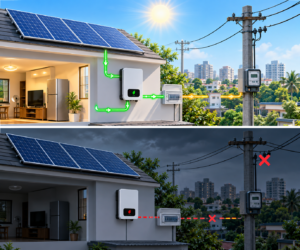
Power optimizers are naturally DC-coupled with battery systems, meaning the DC power they condition can flow relatively directly into a battery without needless conversion steps. Microinverter systems, because they’ve already converted everything to AC, need to convert that AC back to DC to charge a battery — and then back to AC again when you actually use that stored power. Every conversion step loses a small amount of energy. Our guide on DC-coupled vs AC-coupled solar breaks this down in more depth if battery backup is a serious consideration for you.
None of this means microinverters are a bad match for battery storage — plenty of AC-coupled battery systems work well. It just means power optimizers have a natural efficiency edge if a battery is already part of your plan, rather than an afterthought added years later.
Microinverters vs Power Optimizers: Side-by-Side
| Feature | Microinverters | Power Optimizers |
| Where AC conversion happens | At each individual panel | At one central inverter |
| Typical cost premium | Higher (~20-30% above string inverter) | Moderate (~15-25% above string inverter) |
| Shading performance | Strongest — panels work fully independently | Very good — slightly behind microinverters |
| Battery compatibility | AC-coupled (extra conversion steps) | DC-coupled (more direct, generally more efficient) |
| Adding panels later | Easy, one at a time | Possible, but may need an inverter upgrade eventually |
| Single point of failure | None — each panel is independent | Yes — the central inverter |
So Which One Should You Choose?
There’s no universally “better” option here — it genuinely depends on your roof, your budget, and your plans.
Microinverters tend to make more sense if:
- Your roof has real, unavoidable shading from nearby buildings, water tanks, or mixed orientations
- You want zero single point of failure — one unit failing shouldn’t affect the rest of the roof
- You’re planning to add panels gradually over time and want that to be as simple as possible
Power optimizers tend to make more sense if:
- Your roof gets mostly consistent sun with only minor, occasional shading
- Keeping upfront cost lower matters more than squeezing out the last few percent of shaded-panel performance
- You’re planning to add a battery for backup power and want the more efficient DC-coupled path
For a home in a fairly open area, a power optimizer setup is often the more practical choice. For an apartment building with a shared rooftop water tank, or a commercial building boxed in by taller neighbors, microinverters’ independence from panel to panel can genuinely pay for itself over the system’s lifetime.
For Industrial and Commercial Rooftops
The calculation shifts a bit at scale. On a large factory or commercial roof with hundreds of panels, a single central inverter failure under a power-optimizer setup means a much bigger chunk of production stops until it’s repaired — which is a different level of business risk than a home losing part of its output for a few days.
Facility managers and procurement teams also tend to value the panel-level monitoring that both technologies offer over a basic string inverter, since it makes fault diagnosis across a large array far faster — you can see exactly which panel is underperforming instead of troubleshooting an entire string. Our piece on solar monitoring systems and string monitoring boxes covers what that visibility actually looks like in practice, and our commercial solar guide goes deeper into how these decisions play out for larger sites.
Whichever way a facility leans, the lifecycle cost — not just the upfront quote — is usually the number worth focusing on, especially for a system expected to run for two decades or more.
Talking This Through With Your Installer
Neither technology is a bad choice on its own — the mismatch happens when a system is sized or specified without actually looking at your roof’s shading pattern, growth plans, or battery ambitions. That’s the conversation worth having before signing off on any quote, and it’s the kind of assessment we walk through with clients at Muspana when a rooftop has real complexity — a mix of orientations, partial shade, or phased installation plans — rather than defaulting to whatever an installer happens to keep in stock.
If you’re getting quotes, ask specifically why that installer is recommending one technology over the other for your roof. “That’s what we usually install” isn’t the same answer as “here’s why it fits your shading and your plans.” Our guide on evaluating solar quotes has more on questions worth asking before you commit.
FAQs
Can I mix different panel brands with microinverters?
Generally yes, since each panel and its microinverter operate independently of the others — this is one of the practical advantages over a string-based system, where mismatched panels can create problems. That said, always confirm compatibility with your installer, since microinverter models are still matched to specific panel wattage and voltage ranges.
What fails first — a microinverter or a central string inverter?
There’s no fixed answer to this; it depends on the specific equipment, installation quality, and operating conditions. What’s structurally different is the impact of a failure: one microinverter failing affects only its single panel, while a central inverter failure (in a power optimizer or string system) can affect the whole array’s output until it’s repaired.
Do I even need microinverters or optimizers if my roof isn’t shaded?
If your roof genuinely gets consistent, unobstructed sun all day, the performance gap between these technologies and a standard string inverter narrows considerably. In that case, cost may matter more than shading performance, and a simpler string inverter setup is worth discussing with your installer as a lower-cost baseline.
Can I add more panels later if I choose power optimizers?
Yes, within the capacity of your existing central inverter. Once you’d exceed that capacity, you’d need to upgrade the inverter or add a second one. If phased expansion is part of your plan, mention it before installation so the system is sized with that headroom in mind.
Is one technology more suitable for load-shedding backup than the other?
Power optimizers have a natural efficiency edge for battery charging because they’re DC-coupled, avoiding the extra AC-to-DC-to-AC conversion steps that AC-coupled microinverter systems require. It’s not a disqualifying difference for microinverters, but it’s worth factoring in if backup power is a priority from the start rather than an afterthought.