The brochure says “10-year warranty”. The warranty document says something more careful.
That gap is where most disappointment starts. A battery is often the most expensive single part of a home solar system, so it is worth understanding what your solar battery warranty actually promises before you pay, not after something goes wrong.
Key takeaways
- Most warranties cover manufacturing defects and a minimum remaining capacity, not everything that can go wrong.
- The warranty period is often “X years or Y kWh of energy delivered, whichever comes first”.
- Labour, transport and removal are frequently not included. Ask in writing.
- Heat, poor installation, missing registration and unapproved changes can cancel coverage.
- In Bangladesh, the most practical question is: who will actually honour the claim?
What does a solar battery warranty actually cover?
In most cases, a solar battery warranty covers two things: defects in the battery itself, and a minimum level of capacity over time. If the battery fails because of a manufacturing fault, or drops below the capacity the maker guaranteed, the maker will repair or replace it, subject to the terms.
Everything else depends on the wording. That is why two batteries with the same “10 years” on the box can offer very different protection.
Varies by brand. Check your document.
“10 years” often has a second clock
This is the rule people miss most often. Many battery warranties run for a number of years or until a total amount of energy has passed through the battery, whichever happens first. That total is called the throughput limit, usually written in kWh or MWh.
Here is a simple example. It is an illustration, not a real warranty.
Example (not a real warranty): A battery has 10 kWh of usable capacity. Its warranty says “10 years or 28 MWh throughput, whichever comes first.”
If you use the full 10 kWh once a day, that is about 3,650 kWh a year. At that pace you reach 28,000 kWh in a little under eight years. The warranty ends then, even though the paper says ten.
A household that uses only half the battery each day would take much longer to reach the limit.
So a battery you cycle hard for daily backup or self-consumption can use up its warranty faster than one that mostly sits ready for load-shedding. Neither is wrong. You just need to know which clock is running.
Product warranty vs performance warranty
These two terms appear in many warranty documents, and they protect different things.
- Product warranty: covers defects in materials and workmanship. If the battery stops working because of a fault, this is the part that applies.
- Performance warranty: covers how much capacity the battery must still hold after a set time or throughput. It is often written as a percentage, such as “70% or 80% of original capacity”.
Batteries lose capacity gradually, and that is normal. The performance warranty does not promise it will never happen. It sets the floor. A battery at 85% of its original capacity after years of use has not “failed” in the warranty sense if the guaranteed floor is lower.
The percentage and the number of years vary by brand and battery type, so treat any figure you read online, including these, as a typical example rather than a rule.
What most warranties leave out
Read this section before you sign anything.
- Labour. Someone has to disconnect, remove, reinstall and commission the replacement. Many warranties cover the battery but not the work.
- Shipping and removal. Batteries are heavy. Transport of a faulty unit, and of the replacement, may be your cost.
- Normal ageing. Gradual capacity loss within the guaranteed limit is not a defect.
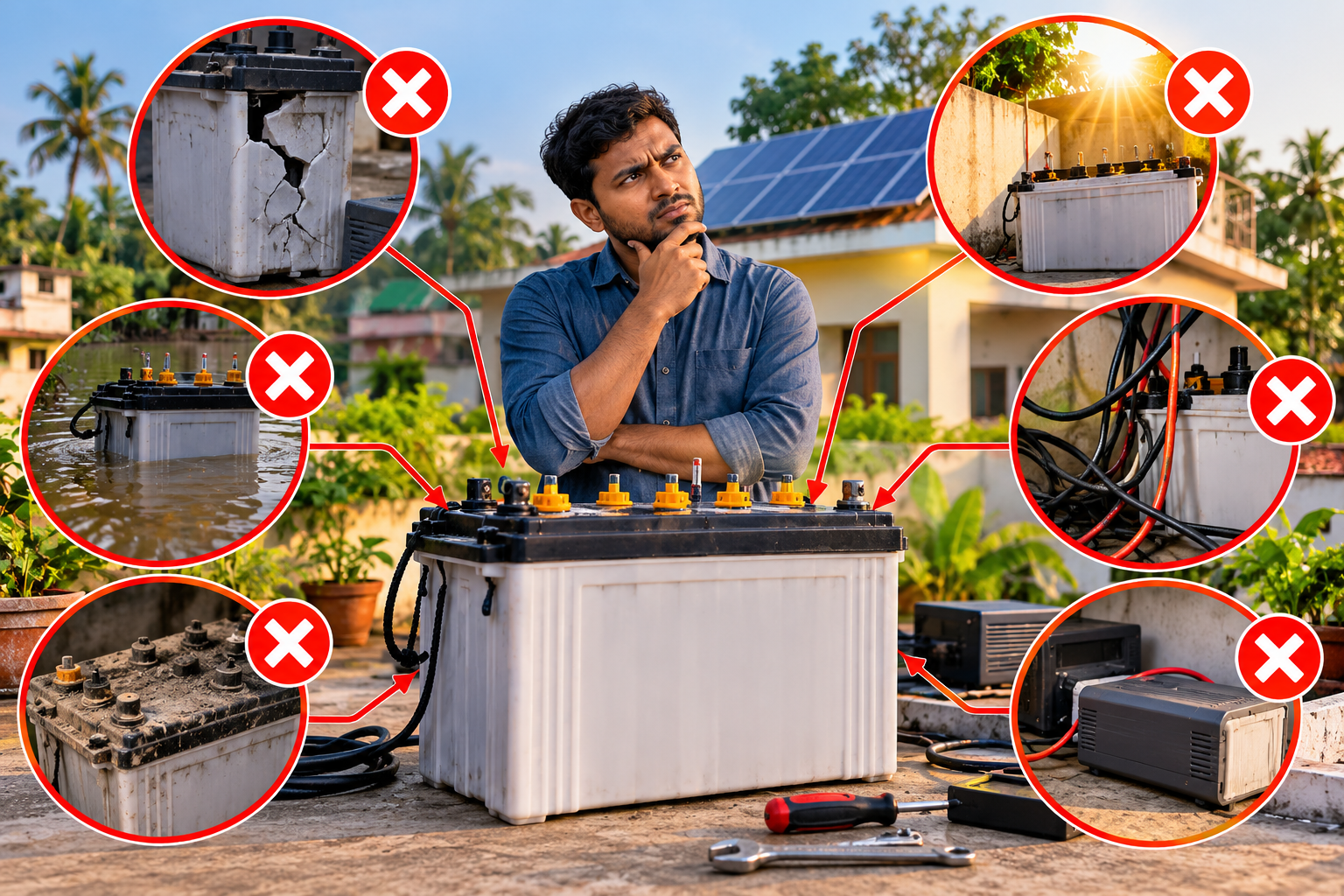
- Damage from the environment or the electrical supply. Water, flooding, corrosion, surges and similar events are commonly excluded.
- Damage from other equipment. If a faulty inverter or wiring harms the battery, the battery maker may not cover it.
None of these are unusual. They are only a problem when you find out late. Ask the seller directly: “If this battery is replaced under warranty, who pays for the labour and the transport?” Get the answer in writing.
What can void a solar battery warranty
Voiding means the maker can refuse a claim even for a genuine fault. The conditions differ by brand, but these are the ones that come up most:
- Installation by someone the manufacturer does not accept. Some brands require an approved or trained installer.
- Unapproved changes. Adding equipment, changing settings, opening the unit or attempting repairs yourself.
- Operating outside the stated conditions. Temperature limits, ventilation, enclosure and mounting requirements are often written into the terms.
- Missing registration. Some warranties only start, or only stay valid, once the battery is registered.
- Skipped firmware updates or prolonged offline periods. Some brands set a time limit for how long a connected system may stay offline. The exact limit is brand-specific, so do not assume any number.
- Wrong system design. A battery paired with an incompatible inverter, or a bank wired incorrectly, can breach the terms.
Most of these are avoidable. They are also the reason a proper installation record matters, which we cover below.
Where Bangladesh conditions make this harder
A warranty written for a large overseas market does not always fit Bangladeshi reality. A few points deserve extra attention.
Who actually honours the claim. The manufacturer may be abroad. The importer or distributor may handle service locally. Some warranties are backed by the maker, others only by the local seller. Ask three things: who do I contact, how long does a replacement usually take, and who pays for transport? If the importer stops trading, does the manufacturer still stand behind the warranty here?
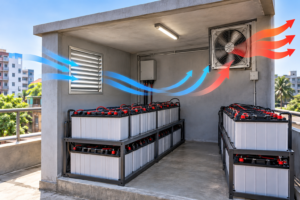
Heat and humidity. Batteries have an allowed operating temperature range. A battery in a hot, closed rooftop room or a poorly ventilated corner may be operating outside its terms. Good placement and airflow are protection for your warranty as well as for safety. Our guide on battery room ventilation covers this in more detail.
Load-shedding, voltage swings and surges. Check whether the warranty covers damage from surges, and whether the maker requires surge protection or a voltage stabiliser in the system. If it does and you skipped it, a claim may be refused.
Weak internet at the installation. Many systems are meant to stay connected for monitoring and updates. If your Wi-Fi is unreliable, ask how the warranty treats a system that is offline for long periods, and how to register it properly.
Coastal air. In coastal areas such as parts of Chattogram and Cox’s Bazar, salt-laden air can corrode equipment. Corrosion is a common exclusion, so check the enclosure rating and any coastal-use conditions in the document.
Apartment placement. Space in apartments is limited. Confirm that the location you plan (balcony, utility room, near the DB) meets the maker’s installation conditions before the system is installed, not after.
Import time. If a replacement has to be imported, ask for a realistic timeline. A warranty that replaces the battery after months of waiting may not help a family that relies on backup power.
Lithium and lead-acid warranties are not the same
Both types are common in Bangladesh, and their warranties usually differ. The table shows general tendencies only. Your actual document decides.
| Lithium (e.g. LiFePO₄) | Lead-acid (tubular, gel, AGM) | |
| Typical warranty style | Often longer, with capacity and throughput terms | Often shorter, sometimes pro-rata |
| Capacity guarantee | Frequently included | Less commonly stated |
| Usage conditions | Temperature, registration and BMS-related conditions are common | Charging, water top-up (where applicable) and maintenance conditions are common |
| Common trap | Throughput limit reached before the years end | Poor charging or deep discharge leading to a refused claim |
Typical tendencies. Varies by brand. Check your document.
A pro-rata warranty, by the way, means the amount the maker pays reduces as the battery ages. It is not the same as a full replacement guarantee.
If you are choosing between the two, our guides on energy storage and battery bank sizing explain how battery type and capacity fit your load.
Questions to ask the seller before you pay
Copy these into a message if it helps.
- Is the warranty from the manufacturer or only from your company?
- Who handles claims in Bangladesh, and how do I contact them?
- Is the warranty based on years only, or years or throughput?
- What capacity is guaranteed at the end of the warranty?
- Is the warranty full replacement or pro-rata?
- Who pays for labour, transport and removal?
- Must the battery be registered, and how?
- What happens if the system stays offline for a long time?
- Which installers or conditions does the warranty require?
- Does the warranty cover surge damage? Is surge protection required?
- Can I see the full warranty document before I pay, not just a summary card?
- Is the warranty transferable if I sell the property?
A seller who answers clearly, and in writing, is a good sign. Vague answers to questions 2 and 6 are a warning worth taking seriously.
What to do on installation day and afterwards
A claim is much easier when you can show that you followed the rules. Keep a small file, paper or phone folder, with:
- The invoice and the full warranty document
- The battery serial number, photographed clearly at installation
- Photos of the installed system, including the location and ventilation
- The commissioning report or handover record
- Proof of registration, if required
- Notes on any firmware updates or service visits
- Records of any maintenance done, and by whom
Then, a few habits help:
- Do not open the battery or change settings the installer has not approved.
- Keep the system connected if the warranty depends on monitoring.
- Do not add loads or new equipment without checking the impact.
- Report unusual behaviour early, in writing, with photos.
Our guides on solar installation quality checks, the commissioning checklist and choosing a solar installer go deeper on getting the installation right the first time.
A note for shops, clinics and factories
For a business, the same rules apply but the stakes are different. Daily cycling is common, so the throughput limit matters more. Downtime has a cost, so response time matters as much as replacement. Ask for the support terms in writing: who responds, how quickly, and what is covered. If the maker’s warranty is only backed by a local seller, understand what happens if that seller is unavailable. For larger systems, the warranty should be reviewed alongside the maintenance arrangement, not separately. See our guides on solar storage economics and operation and maintenance.
A good warranty is worth having, but it does not replace a well-designed, well-installed system. Most claim disputes come down to conditions that could have been checked on day one. If you want to go further, our solar warranty guide and guide to evaluating solar quotes are good next steps, and our note on hidden solar costs shows where labour and transport charges tend to appear.
FAQs
How long is a solar battery warranty?
It varies by brand and battery type. Many lithium batteries come with warranties measured in years, often with a throughput limit as well, while lead-acid warranties are usually shorter. Check both the time period and the throughput in your document.
Does a solar battery warranty cover replacement or only repair?
It depends on the terms. Some warranties offer repair or replacement, some replace only if repair is not possible, and some are pro-rata, meaning the payout shrinks as the battery ages. Ask which one applies.
Does the warranty cover labour and shipping?
Often not. Many warranties cover the battery itself but not removal, installation labour or transport. Ask the seller who pays for these and get the answer in writing.
What is a throughput limit?
It is the total amount of energy the battery may deliver during the warranty, usually in kWh or MWh. If you reach it before the years end, the warranty can end early.
Does load-shedding or voltage fluctuation void a solar battery warranty?
Load-shedding on its own usually should not, since backup is what the battery is for. Surge damage and operating outside stated conditions can be excluded, so check the surge and voltage terms and any protection the maker requires.
Do I need to register my battery?
Some warranties require registration to start or stay valid. Ask whether registration is needed, how to do it, and keep proof of it.
Can I install a solar battery myself and keep the warranty?
Often no. Many makers require an approved or trained installer, and DIY installation or repair can void coverage. Confirm the requirement before you install.
Is a lead-acid battery warranty the same as a lithium one?
Not usually. Lead-acid warranties tend to be shorter and are more likely to be pro-rata, and they depend heavily on correct charging and maintenance. Compare the actual documents rather than assuming.
What happens if the importer or seller closes down?
That depends on whether the manufacturer backs the warranty directly. Ask this before buying, and keep your invoice, serial number and warranty document safe.