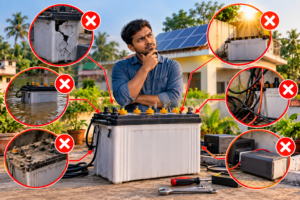
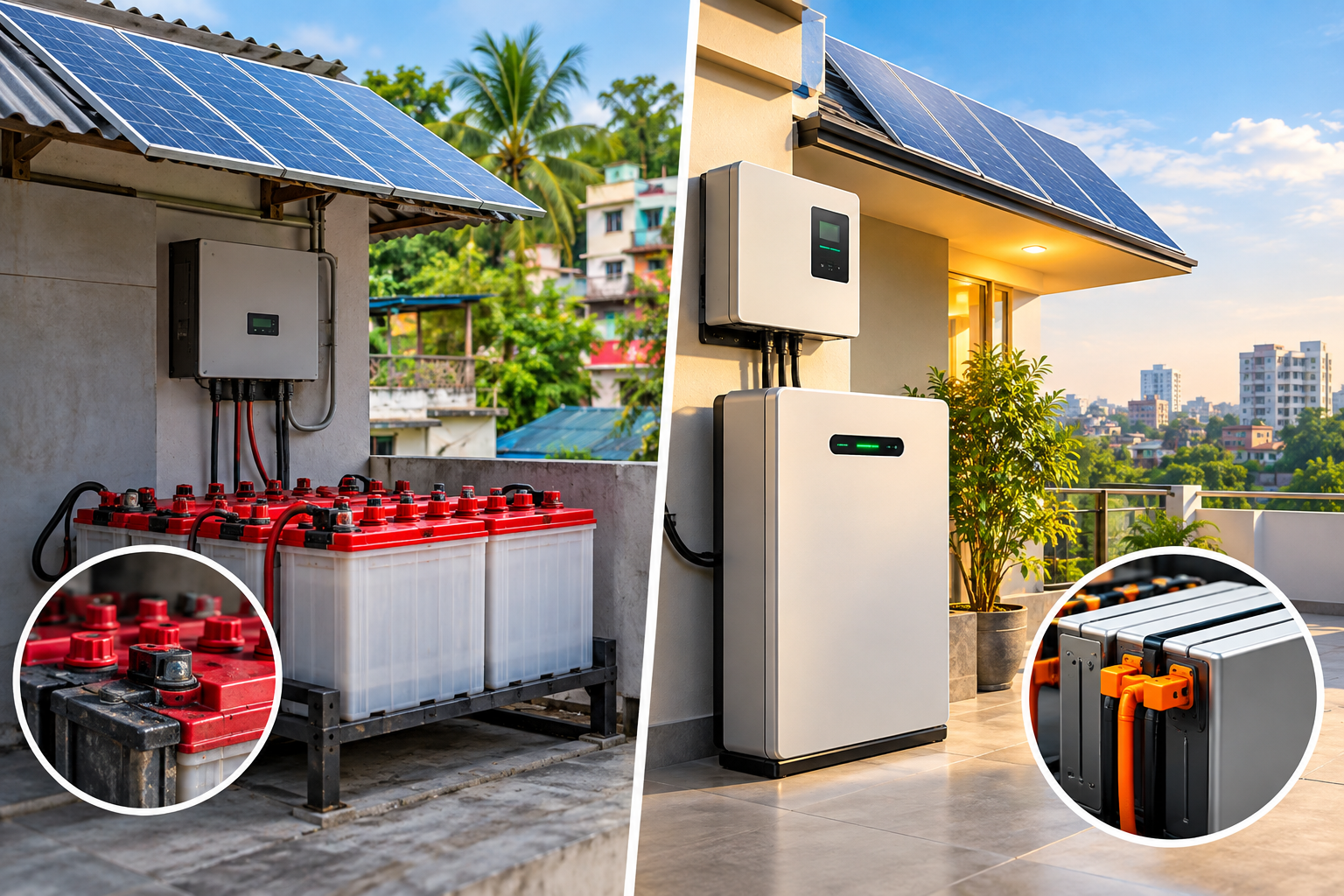
Your tubular battery starts sagging halfway through a long load-shedding spell. The shop offers a replacement for a few thousand taka. A friend says lithium would fix the problem for good, but the price makes you hesitate. That hesitation is reasonable.
The short answer: for a solar system that cycles every day, a LiFePO4 lithium battery usually costs more upfront and less over its life. A tubular lead-acid battery still makes sense on a tight budget, for occasional backup, or when your inverter can’t charge lithium safely.
This lithium vs lead-acid solar battery comparison keeps the maths in taka and shows every assumption, so you can swap in your own quote and check the result.
Which battery fits which situation? A quick comparison
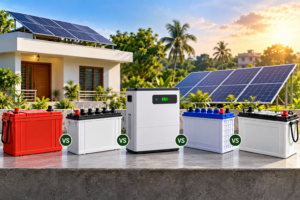
| Tubular lead-acid | LiFePO4 lithium | |
| Usable share of rated capacity | About 50% is the usual guideline | Roughly 80–95% |
| Cycle life | Source ranges run 500–1,000 cycles for basic lead-acid; good tubular models claim more, so check the datasheet | Roughly 3,000–6,000 cycles |
| Typical lifespan | Roughly 3–5 years | Roughly 10–15 years |
| Round-trip efficiency | About 80–85% | About 95% or higher |
| Upfront price | Lower | Higher |
| Maintenance | Distilled-water top-ups on flooded types | None |
| Weight and space | Heavy, bulky | Much more compact |
| Inverter needs | Works with almost any IPS | Needs a compatible inverter and settings |
These are general industry ranges, not Bangladesh test results. Manufacturer datasheets vary, and the numbers depend heavily on how hard the battery is used.
What is actually different inside these batteries?
A tubular lead-acid battery is the familiar IPS battery: lead plates in acid, built to handle repeated deep discharges better than a car battery. It’s cheap, easy to find, and works with almost any inverter.
“Lithium-ion” is a broad label, and most home solar storage today uses one chemistry in particular, lithium iron phosphate (LiFePO4). It’s usually chosen for its stability and long life. Other lithium chemistries behave differently on safety and lifespan, so when you see “lithium” on a quote, ask which chemistry it is.
A lithium battery also carries a battery management system (BMS), a small circuit board that guards against overcharge, over-discharge and overheating. Lead-acid has nothing equivalent.
Two terms make the rest easier to follow:
- Depth of discharge (DoD): how much of the battery you can safely use before recharging.
- Usable capacity: the rated capacity multiplied by that safe share. This is the number that decides what you actually get.
Is lithium really more expensive? The maths in taka
Prices vary by brand, seller and month, and nobody should quote you a single “market price”. As an illustration, one Bangladeshi marketplace page lists a Hamko 100Ah IPS battery at ৳13,900, and 12.8V 100Ah LiFePO4 batteries at ৳23,500 to ৳28,500 (LVTOPSUN, Sako and UTL). These are listing snapshots, not verified retail prices, so re-check before you buy.
On the sticker, lithium costs roughly 1.7 to 2 times as much, not the 3 to 4 times you’ll see in foreign articles. Now adjust for usable energy:
| Example calculation | Tubular 12V 100Ah | LiFePO4 12.8V 100Ah |
| Listed price (snapshot) | ৳13,900 | ৳23,500 |
| Rated energy | 1,200 Wh | 1,280 Wh |
| Assumed usable share | 50% | 80–90% |
| Usable energy | about 600 Wh | about 1,020–1,150 Wh |
| Price per usable kWh | about ৳23,200 | about ৳20,400–22,900 |
Assumptions: prices from the snapshot above, DoD from the general industry ranges. This is an example, not a quote.
So on day one the two are close, and lithium can even come out slightly ahead per usable kWh. Replacement is where they separate.
Suppose a tubular battery lasts 4 years and a LiFePO4 battery lasts 10 (both inside the general industry ranges). Over 10 years you’d buy three tubular batteries (years 0, 4 and 8) for ৳41,700 in today’s prices, against one lithium battery at ৳23,500. Per usable kWh, that’s roughly ৳69,500 for tubular and ৳20,400–22,900 for lithium.
Where this can change:
- If your tubular battery lasts 6 years, you’d buy two, about ৳27,800. Lithium is still ahead, but the gap narrows a lot.
- If your tubular battery lasts far longer than the usual range, the gap nearly closes.
- If lithium fails early, is under-rated, or needs an extra inverter or charger upgrade, the result flips.
- Labour, delivery, and the trade-in discount on your old battery aren’t included.
Use your own quotes. The method is what matters.
Can you swap your IPS battery for lithium?
Sometimes, but not automatically. This is the question most people skip, and the one behind many disappointing upgrades.
Many home IPS and older hybrid inverters are set up for lead-acid charging. Lithium needs different voltage limits and, on some systems, communication with the battery’s BMS. Before you buy:
- Look for a lithium or user-defined battery mode in your inverter manual or settings menu.
- Match the system voltage (12V, 24V or 48V) and check the battery’s series and parallel limits.
- Ask whether the inverter talks to the BMS or works on voltage alone, and whether the battery maker lists your inverter as compatible.
- Compare current limits. The battery’s maximum charge and discharge current must suit what your inverter pushes and pulls.
- Get the compatibility confirmed in writing by the seller or installer, including how warranty works if settings are wrong.
- Have an installer check older lead-acid-only units before you assume they’ll cope.
If you’re building a new hybrid system, choosing the inverter and battery together avoids most of this. Our guides on hybrid solar systems and DC vs AC-coupled solar explain how the pieces connect.
What about heat, safety and fake batteries?
Heat. High temperatures shorten the life of lead-acid batteries, and lithium BMS units limit charging when a battery gets too hot or too cold. That’s a general engineering point, not a Bangladesh statistic. In practice, give either battery shade and airflow, and don’t tuck it into a sealed cupboard.
Safety. LiFePO4 is generally regarded as one of the more stable lithium chemistries, but “lithium” on a label doesn’t tell you the chemistry, so ask. Flooded lead-acid batteries have their own risks: acid handling and hydrogen released during charging, which is why they need ventilation.
Under-rated capacity. A battery that promises far more capacity than its price and weight suggest deserves suspicion. Ask for the datasheet, buy from an authorised dealer, and get the warranty terms in writing before you pay.
What happens to your old battery in Bangladesh?
Disposal is part of the true cost, and it’s rarely discussed.
Old lead-acid batteries have resale value because of their lead, which is why trade-in offers are so common. That same value feeds an informal trade. A 2020 UNEP-commissioned assessment documented informal used lead-acid battery recycling and its impacts in Bangladesh, and a Daily Star piece argues that shop trade-in discounts are driven by lead’s resale value rather than environmental concern. If you hand over an old battery, ask where it goes.
Lithium is less settled. One industry interview says Bangladesh has no lithium battery recycling factories. Treat that as one industry voice rather than a final word, and ask any seller what they do with end-of-life lithium batteries. Our page on solar panel disposal covers the wider picture.
When does lead-acid still make sense?
Tubular lead-acid isn’t the “wrong” answer. It fits when:
- Your budget is tight and you can’t stretch to lithium this year.
- Backup is occasional, so the battery rarely cycles deeply.
- Your existing inverter is lead-acid-only and you don’t plan to replace it soon.
- You’re comfortable with periodic top-ups and want easy local servicing.
When is lithium the better buy?
For homes. Lithium tends to win when the battery works hard every day: hybrid systems that store daytime solar for the evening, homes with long load-shedding, or flats where space and weight matter. A LiFePO4 pack is compact, quiet and doesn’t need water top-ups or ventilation for fumes. A family in a Dhaka apartment with a small utility room will feel that difference.
For factories and commercial sites. The logic shifts to cost per cycle and uptime. Larger systems typically use 48V stacks or dedicated storage units, not 12V batteries. Look at:
- Cost per usable kWh over the warranty period.
- Space, weight and cooling needs.
- Who supports the system locally.
- Whether storage offsets diesel generator running during outages, as it might for a mid-sized factory in an industrial cluster like Gazipur or Narayanganj. Our guide to solar-diesel hybrid systems goes further.
Getting the size right matters as much as the chemistry, and battery bank sizing walks through it.
Five questions to ask before you pay
- What’s the usable capacity, not just the rated capacity?
- Which inverters is this battery confirmed to work with?
- What does the warranty cover, and what voids it?
- Who services it here, and how fast?
- What happens to my old battery, and to this one at end of life?
If you’d rather have a second opinion, Muspana can review your load, your inverter and your backup hours against the battery you’re considering. It’s worth doing before the purchase, not after.
FAQs
Which is better for solar: lithium or lead-acid?
For daily cycling, LiFePO4 lithium usually wins on lifetime cost, usable capacity and maintenance. Tubular lead-acid can still be the better choice on a tight budget, for occasional backup, or with a lead-acid-only inverter.
Can I replace my IPS battery with a lithium battery?
Only if your inverter can be set for lithium and the voltage and current limits match. Check the manual, ask the battery maker for a compatibility list, and get it confirmed in writing.
How long does a tubular battery last with solar?
General industry figures put lead-acid at roughly 3 to 5 years, but real life depends on depth of discharge, heat and charging settings. Your datasheet and warranty are more reliable than a general number.
Is a LiFePO4 battery safe to keep in a flat?
LiFePO4 is generally regarded as one of the more stable lithium chemistries, and a BMS adds protection. Buy from an authorised dealer, follow the installation guidance, and give it airflow.
What happens to old solar and IPS batteries in Bangladesh?
Old lead-acid batteries are usually traded in for their lead value, and informal recycling is a documented concern. Ask where your battery goes. Established lithium recycling options appear limited, so ask sellers about end-of-life handling.
How can I spot a fake or under-rated battery?
Ask for the datasheet, buy from an authorised dealer, and be wary of a price that’s far below comparable batteries. Get the warranty terms in writing.
Is a lithium solar battery worth it just for load-shedding backup?
If outages are frequent and the battery cycles most days, lithium often pays off. If backup is rare and cycles are few, a tubular battery may be the better value.