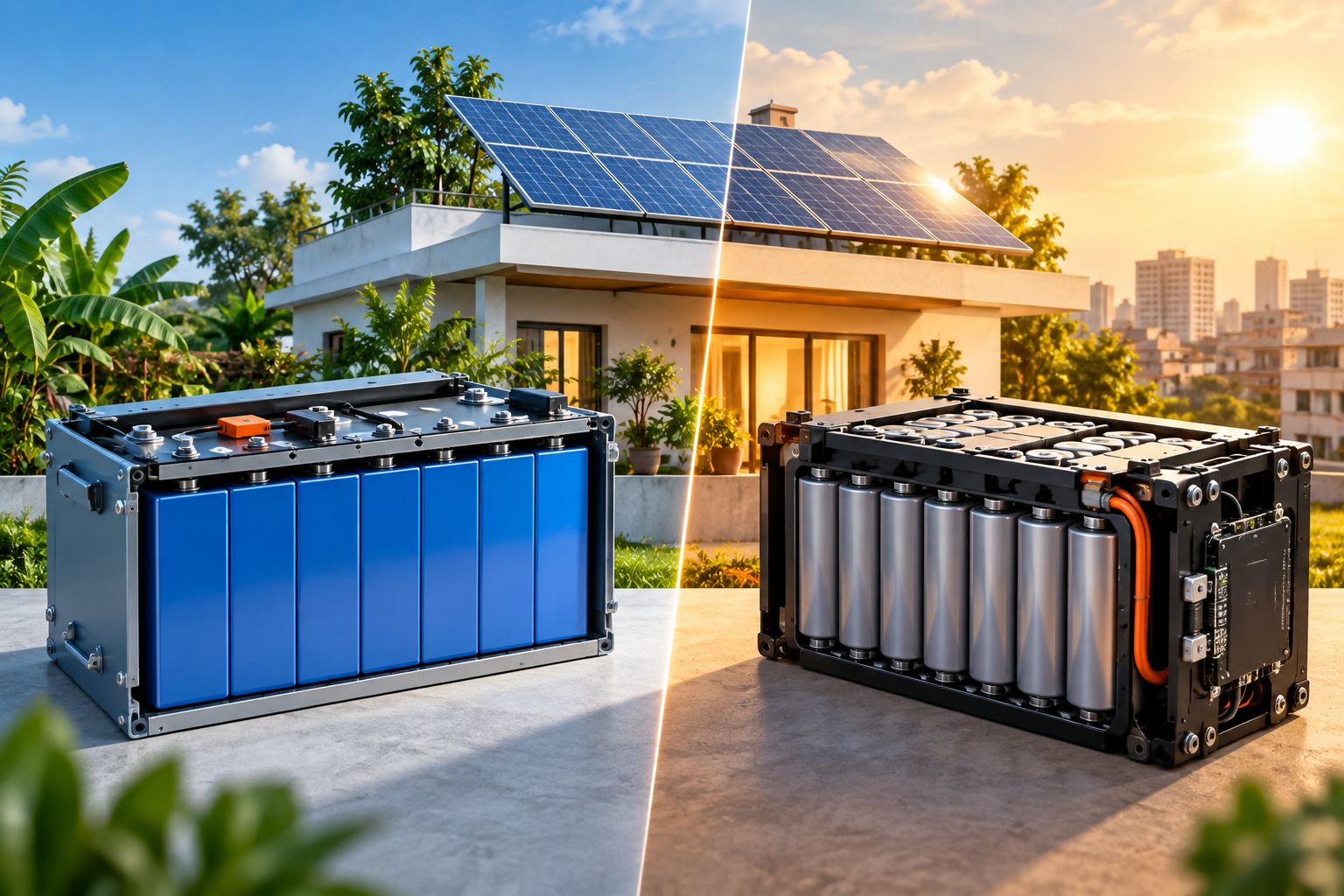
Your solar quote arrives, and somewhere in the battery line it says “LFP” or “NMC.” Nobody explains what it means, but the price difference is real. This is the question behind every LFP vs NMC solar battery search: which chemistry should you pay for?
For most home solar systems in Bangladesh, LFP is the safer bet. It is built for the kind of daily charging and discharging solar storage involves, and it handles heat better. NMC is not a bad battery, though. It just solves problems most home solar buyers here don’t have.
The short answer
LFP (lithium iron phosphate) is usually the better choice for stationary home solar storage. It offers a longer cycle life, better thermal stability and a lower long-term cost per kWh. NMC (nickel manganese cobalt) packs more energy into less space and weight, so it makes sense mainly where space is tight. For a battery that sits in one place and cycles every day, LFP is the sensible default.
What are LFP and NMC, really?
Both are lithium-ion batteries. The difference is what the positive electrode is made of, and that one choice changes how the battery behaves.
- LFP uses iron and phosphate. The chemical bonds are stable, which is why LFP is known for safety and long life.
- NMC uses nickel, manganese and cobalt. It stores more energy per kilogram, which is why it dominates in places where weight matters, such as electric vehicles.
If you see “LiFePO4” on a datasheet, that is simply LFP written out in chemical shorthand.
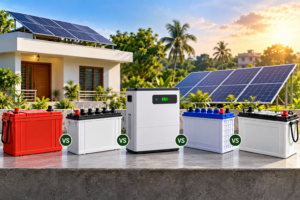
LFP vs NMC solar battery: side by side
| LFP | NMC | |
| Safety margin | Higher thermal stability; lower fire risk | More sensitive; needs tighter thermal management |
| Cycle life | Generally longer (often several thousand cycles) | Generally shorter |
| Usable depth of discharge | Commonly high, but check the datasheet | Often lower if you want long life |
| Size and weight | Bulkier and heavier per kWh | More compact and lighter |
| Heat tolerance | Handles heat better than NMC, but not immune | Ages faster in sustained heat |
| Cold performance | Weaker in freezing conditions | Better in freezing conditions |
| Cost per kWh | Generally lower over the battery’s life | Generally higher |
Treat every entry above as a general industry pattern. Actual numbers depend on the manufacturer, the model and how the battery is used. The datasheet and warranty for your specific battery are the real reference.
Which is safer for a flat or home?
This is where most people’s real worry sits, especially in an apartment where the battery may end up in a utility room or on a balcony.
LFP has a higher thermal runaway threshold, meaning it is much harder to push into the chain reaction that causes lithium battery fires. NMC is more chemically volatile, so it depends more heavily on a well-built battery management system (BMS) and thermal design.
That does not make LFP risk-free. Fire safety depends on the quality of the cells, the BMS, the installation, and where the battery sits. A well-built NMC unit can be perfectly safe, and a poorly made LFP unit can still cause trouble. But if you are choosing between two comparable products and safety is the tiebreaker, LFP starts with the advantage.
How long will each one actually last?
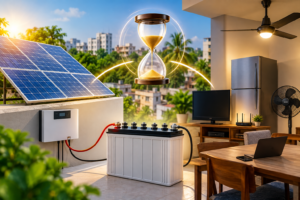
Cycle life is the number of full charge-and-discharge rounds a battery can handle before its capacity drops noticeably. Commonly quoted industry ranges put LFP in the thousands of cycles and NMC noticeably lower.
Here is what that means in years, as a simple illustration (not a promise):
- One cycle per day is 365 cycles a year.
- A battery rated for 3,000 cycles would last around 8 years at that pace.
- A battery rated for 6,000 cycles would stretch to roughly 16 years, in theory.
In practice, the warranty is usually shorter than the theoretical cycle life, and batteries also age simply with time and heat. So use the cycle number to compare products, then read the warranty for what the manufacturer will actually stand behind.
Depth of discharge (DoD) matters too. That is how much of the battery’s capacity you use each day. LFP generally tolerates deep daily use better, while NMC tends to age faster if you regularly drain it deeply. Always check the rated DoD and the usable capacity in kWh, not just the label on the box.
In Bangladesh, some households cycle their batteries lightly, mostly for backup during load shedding, while others use them daily to shift solar power into the evening. The first group may see less cycle wear, but calendar ageing and heat still count. If you are unsure how much battery you need, the battery bank sizing guide is a good place to start.
Heat, humidity, and the cold-weather point that doesn’t apply here
You will see one line in almost every foreign comparison: NMC performs better in the cold. That is true, and it barely matters here. Bangladesh winters are mild, and home batteries are not exposed to the sustained freezing conditions that make cold-weather performance a serious concern in colder countries.
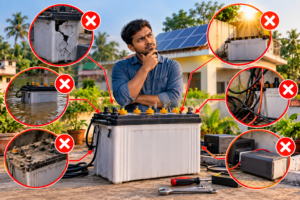
What matters here is heat and humidity. LFP generally handles high temperatures better than NMC, which is a genuine point in its favour. But “handles heat better” is not the same as “ignores heat.” A battery in direct sun, or in a sealed rooftop room that bakes all afternoon, will age faster whichever chemistry it uses.
Some practical points:
- Keep the battery out of direct sunlight and away from enclosed, unventilated spaces.
- Choose a location with airflow. A shaded, ventilated wall inside the house often beats a hot rooftop room.
- Look at the enclosure’s ingress protection (IP) rating and the stated operating temperature range, especially where humidity and monsoon moisture are a concern.
- Read your warranty terms on operating conditions, because some can be affected by poor placement.
For the wider picture on how climate affects solar systems, see tropical vs temperate solar.
Size, weight and cost: where NMC still has a case
LFP’s main drawback is that it is larger and heavier for the same capacity. General industry figures suggest NMC can be noticeably more compact, though the exact gap varies by product. For a wall-mounted home unit, that difference is often manageable. In a tight flat with limited wall space, it can be the deciding factor.
On cost, LFP is generally cheaper over the life of the battery because it lasts longer and is manufactured with less expensive materials. Upfront prices in Bangladesh depend on the brand, the import route, the warranty and the supplier, so compare actual quotes instead of relying on a general rule. Our guide to hidden solar costs covers what tends to get left out of quotes.
NMC can make sense when:
- Space or weight is genuinely limited and nothing else fits.
- A specific compact product suits your installation better and comes with solid warranty and local support.
- The installer can clearly explain the thermal management and safety design.
Outside those situations, LFP is usually the safer recommendation for a stationary home battery.
What about factories and commercial sites?
The logic is similar but the priorities shift. For a factory, warehouse or commercial building, the questions are less about wall space and more about lifecycle cost, uptime and safety compliance.
- Lifecycle cost: a longer cycle life spreads the battery cost over more years of use, which matters when you are storing a lot of energy.
- Thermal management: larger systems generate more heat, so cooling and monitoring design becomes a serious engineering topic, not a detail.
- Fire safety and compliance: confirm the applicable fire-safety requirements with the relevant authorities and your insurer before finalising a design.
- Warranty and support: for a business, downtime is expensive, so local service response matters as much as the chemistry.
Space is usually less of a constraint on a factory site, which tends to favour LFP. For broader context, see solar for commercial buildings and solar for industries.
Ask your installer these before you sign
Chemistry is only one line on a quote. These questions tell you far more about what you are actually buying:
- Which chemistry is it, and who makes the cells and the battery?
- What is the usable capacity in kWh, not just the nominal capacity?
- What depth of discharge is the battery rated for?
- How many cycles is it rated for, at what DoD and at what temperature?
- What does the warranty cover: years, energy throughput, and what capacity it guarantees at the end?
- What is the operating temperature range and IP rating?
- Is the BMS confirmed to communicate properly with your inverter? See hybrid solar systems and DC vs AC coupled solar for how batteries connect.
- Who provides local service and replacement if something goes wrong?
- Can you see the product’s safety and test documentation?
Imported batteries make the last two questions especially important. A great battery with no local support can become a long-term headache.
If you want a second opinion on a quote, Muspana can help you check the battery line against your real backup needs. Our guide on evaluating solar quotes is a good starting point, and the solar warranty guide explains what to look for in the fine print.
FAQs
Is LFP better than NMC for home solar?
For most home solar systems, yes. LFP generally offers better safety, a longer cycle life and lower long-term cost. NMC only makes sense when space or weight is a serious limitation.
Is an LFP battery safe to keep inside a flat?
LFP has a higher thermal stability than NMC, so it carries a lower fire risk. No lithium battery is risk-free, so choose a certified product, install it professionally, and keep it in a ventilated spot away from direct heat.
How long does an LFP solar battery last?
It depends on the product, how deeply you discharge it, and the temperature it runs at. Rated cycle life is often in the thousands of cycles, but your warranty is a more realistic guide to what the manufacturer will stand behind.
Does Bangladesh’s heat damage lithium batteries?
Sustained heat speeds up ageing in all lithium batteries. LFP tolerates heat better than NMC, but placement still matters. Keep the battery shaded and ventilated.
Is NMC ever the better choice?
Yes, when a compact, lightweight unit is a real requirement and the product comes with good safety design, warranty and local support.
Can my hybrid inverter work with either chemistry?
Only if the battery’s BMS is compatible with the inverter. Check compatibility with your installer before buying, regardless of chemistry.
Should I choose LFP just because it is cheaper?
No. Compare usable capacity, warranty terms and local support alongside price. A cheaper battery with weak support can cost more in the long run.