Why This Is the Part of a Solar Installation Nobody Checks
Ask most people what makes a rooftop solar system safe, and they’ll talk about the panels, the inverter brand, maybe the warranty. Almost nobody asks about the earthing.
That’s a problem, because earthing and bonding are the parts of a solar installation you can’t see once the job is finished — no visible wire running down the side of the house, no component on the spec sheet a buyer would recognise. It’s easy for an installer under time or cost pressure to skip, and easy for a homeowner to have no idea it was skipped, right up until something goes wrong.
In Bangladesh, “something going wrong” isn’t hypothetical. This is a country with one of the highest lightning-fatality rates in the world, and the pre-monsoon Kalbaishakhi storm season brings exactly the kind of sudden, violent electrical activity that a poorly earthed rooftop array is least equipped to handle. Add to that a solar market where a meaningful share of installers are small, local vendors rather than established engineering firms, and you get a real gap between what should happen on a rooftop and what actually does.
This article explains what earthing and bonding are, why they’re two different jobs rather than one, what Bangladesh’s own building code actually requires (spoiler: it isn’t the American code most English-language articles quote), and what you can reasonably check on your own system without an electrical engineering degree.
Grounding and Bonding Are Not the Same Job
People use “earthing” as a catch-all word, but a solar installer is really doing two distinct things.
Grounding connects part of the electrical system — or the metal frame of the array — to the earth itself, bringing it to zero electrical potential. Its main purpose is to give lightning strikes, voltage surges, and stray current somewhere safe to go instead of through a person or a piece of equipment.
Bonding connects the metal parts of the equipment to each other, so that every metal surface — module frames, mounting rails, the inverter casing — sits at the same electrical potential as every other metal surface. The point isn’t to send current to earth; it’s to make sure that if you touch two different pieces of metal on the system at once, there’s no voltage difference between them to shock you.
| Grounding | Bonding | |
| Connects to | The earth (via an earth electrode / earth pit) | Metal equipment parts to each other |
| Main purpose | Gives fault current and lightning a safe path away from people and equipment | Prevents a dangerous voltage difference between metal surfaces |
| Protects against | Lightning strikes, voltage surges, electric shock from a live fault | Electric shock from touching two differently-charged metal parts |
| Typical hardware | Earth rod/pit, earth conductor | Module racking, bonding jumpers, equipment grounding conductor |
A system can have one without the other, and both are needed. A bonded-but-ungrounded array still gives a lightning strike nowhere useful to go. A grounded-but-unbonded array can still have a dangerous voltage difference between two metal panels a technician might touch during maintenance.
Does Bangladesh Follow the Same Rules as the US or India?
Here’s where a lot of the English-language content on this topic quietly misleads Bangladeshi readers. Most of what ranks on Google for “solar grounding” is written around the US National Electrical Code (NEC) — a detailed, specific standard, but one that has no legal standing in Bangladesh. Some India-focused content leans on IS 3043 instead, which is closer in spirit but still a different country’s standard.
Bangladesh’s own rulebook is the Bangladesh National Building Code (BNBC), specifically its Electrical Part, most recently updated in 2020. Rather than being written from scratch, BNBC’s electrical provisions draw substantially on IEC international standards and the UK’s BS 7671 (IEE Wiring Regulations) — not the American NEC. If you’ve read an article listing specific NEC clause numbers and assumed they apply to a rooftop installation in Dhaka or Bogura, they don’t, at least not as the enforceable rule. They’re useful as background engineering logic, not as the code you or your installer are actually bound by.
For a grid-tied system applying for net metering, there’s a second layer: Bangladesh’s Sustainable and Renewable Energy Development Authority (SREDA) reviews the design package before approving the connection, and that package is expected to document earthing for the PV frame and inverter — kept separate from the building’s pre-existing earthing system — along with equipment drawn from SREDA’s approved product list. Incomplete or missing earthing documentation is one of the more common reasons an application gets sent back. If you’re going through this process, it’s worth confirming the current requirements directly at SREDA’s site before you finalise a design, since approval processes can be updated.
None of this is meant to turn a homeowner into a code inspector. It’s meant to make one thing clear: if an installer or an article is quoting a foreign standard as though it’s the rule in Bangladesh, that’s a signal to ask more questions, not fewer.
What Proper Earthing and Bonding Actually Look Like on a Rooftop
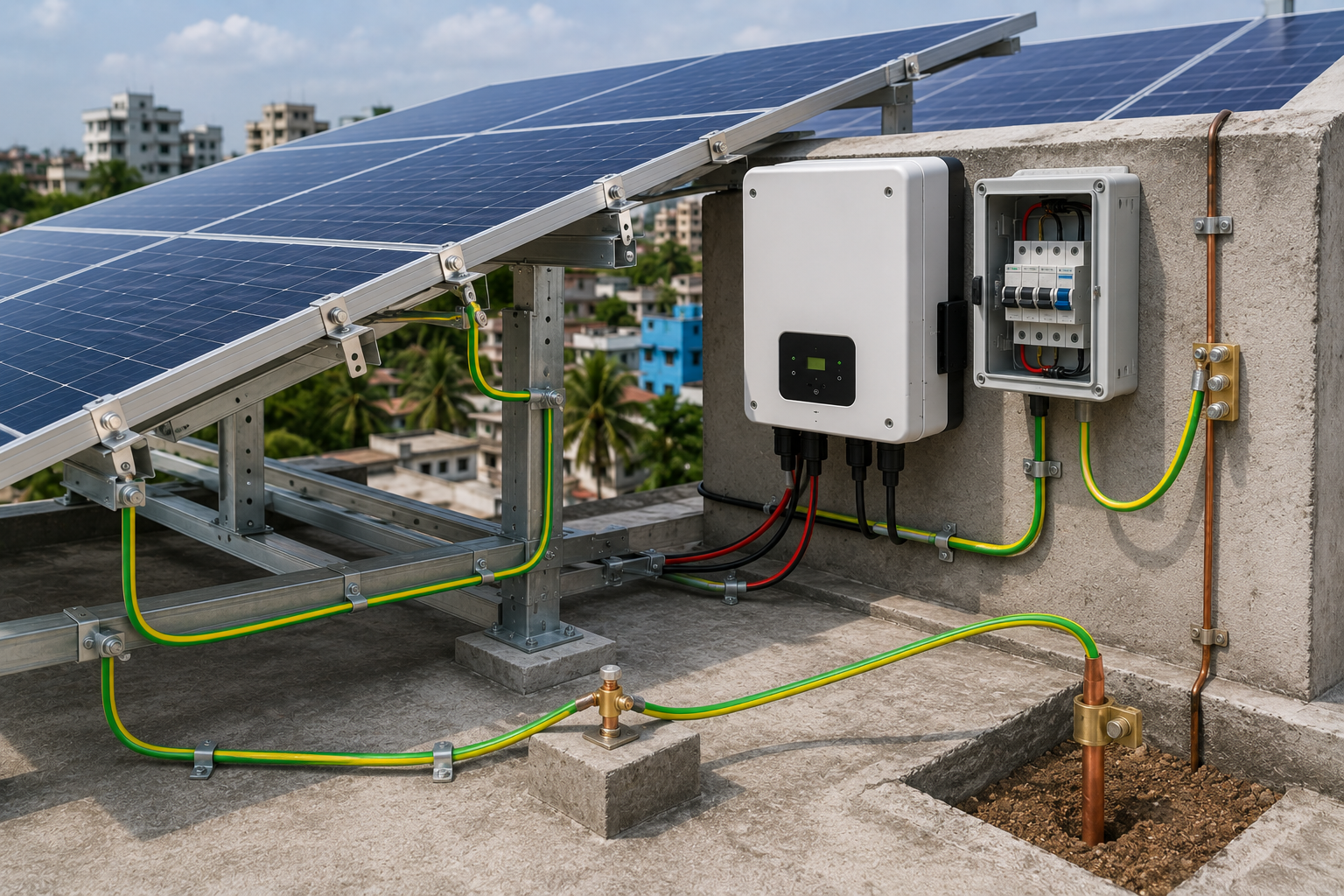
In practice, a competently earthed and bonded system usually includes:
- An earth pit or earth electrode, typically a rod or plate buried in soil with enough moisture contact to keep resistance low, connected back to the array frame and the inverter.
- Bonded module racking — most modern aluminium racking systems are designed to bond modules together as they’re clamped in, which is a real improvement over the older method of drilling each module frame and running a separate copper strap between them by hand. That older method has a specific failure point worth knowing about: aluminium frames develop an oxide layer when exposed to weather, and that oxide layer behaves like an insulator, which can quietly break the electrical continuity a bonding connection is supposed to provide.
- An equipment grounding conductor running with the circuit cabling back to the main distribution point, sized to carry fault current safely.
- Surge protection devices (SPDs) on the DC side near the array and the AC side near the inverter, which absorb voltage spikes that grounding alone doesn’t fully handle.
One genuinely local detail worth knowing: while copper is the better conductor for an earthing connection, galvanized iron (GI) conductor is common practice in Bangladeshi installations, partly because copper carries a real theft risk once it’s buried or exposed on a rooftop. It’s a trade-off — somewhat higher resistance in exchange for a connection that’s less likely to be stolen and left unrepaired — and it’s the kind of practical compromise you won’t find mentioned in an American or European guide, because copper theft simply isn’t a live concern in those markets. For more detail on how conductor sizing and material choice actually get decided for a given system, our guide on solar earthing practices goes deeper into the hardware itself.
Lightning Protection Is Related to Grounding — It Isn’t the Same Thing
This is worth separating clearly, because a lot of readers conflate the two. Grounding an array gives it a path to safely dissipate a surge that reaches it. A dedicated lightning protection system (LPS) — an air terminal positioned above the array, a down conductor, and its own earth connection — is designed to intercept a direct strike before it reaches the panels at all.
For a household system on a low-rise building in a less exposed location, solid grounding and bonding, paired with SPDs, is often considered adequate. For a rooftop array on a taller building, an exposed site, or a commercial/industrial installation, a dedicated LPS becomes a much more serious consideration — and in a country where pre-monsoon storm activity is a genuine, seasonal, felt risk rather than an abstract one, it’s not a purely theoretical upgrade.
This is also where it’s fair to mention that Muspana works on both sides of this — solar installation and dedicated lightning protection systems, having installed over 500 LPS units alongside more than 10 MW of solar capacity across Bangladesh. That combination matters here specifically because grounding, bonding, and lightning protection are really one continuous safety conversation, not three separate vendors’ worth of expertise. If you want to understand how the two disciplines fit together on a real rooftop, our page on solar lightning protection covers where an LPS becomes worth the additional cost.
Home Rooftop, Apartment Building, or Factory Floor — the Differences That Matter
A single-family home rooftop is usually the simplest case: one earth pit, one array, one inverter, reasonably direct wiring runs. The main risk is an installer cutting the earthing scope to shave the quote, since it’s the one part of the job a homeowner can’t easily inspect.
An apartment building rooftop raises a question that rarely comes up in Western content: whose earthing system does the array tie into? A shared rooftop installation needs to either tie into the building’s existing earthing system correctly (not just physically connect to the nearest metal railing) or have its own independent, properly sized earth pit — and it needs the building committee’s sign-off on where that goes. Skipping this conversation is a common, quiet source of poorly executed apartment solar installations.
A factory or commercial facility operates under different pressure entirely. The concern isn’t just shock risk — it’s a ground fault taking down a production line, an inspection failing under the Department of Inspection for Factories and Establishments (DIFE), or an insurance policy that assumes a documented, compliant electrical safety setup. Industrial arrays typically involve a combiner box, bonding at the main LT panel, and a facility-wide earth grid rather than a single earth pit, and the earthing design usually needs to be part of the same load and safety documentation used for the rest of the facility’s electrical system. Our overview on solar for industrial facilities covers how these requirements tend to fit into a broader installation plan.
What It Costs, and How to Check Your Installer Actually Did It
Earthing and bonding materials aren’t the expensive part of a solar system, which is exactly why it’s a strange place for an installer to cut corners — the savings from skipping it are small, but the safety cost of skipping it isn’t. Actual pricing varies by system size, site conditions, and conductor material choice (GI versus copper, as covered above), so treat any number you see quoted, including on other sites, as an estimate rather than a fixed market rate. If you’re comparing quotes, it’s worth asking directly whether earthing/bonding materials and labour are itemised separately or folded vaguely into an “installation” line — a quote that can’t break this out is harder to trust. Our guide to evaluating solar quotes walks through how to read a quote line by line.
A few things you can reasonably check yourself, or ask an installer to show you, without technical training:
- Ask to see the earth pit or earth electrode location before the roof is closed up — it should be a visible, documented part of the installation, not something described verbally after the fact.
- Ask whether the racking system is a bonded, listed system, or whether module frames were individually drilled and strapped — the latter isn’t automatically wrong, but it’s more failure-prone over time and worth knowing about.
- Ask what conductor material was used for the earth connection and why.
- Ask whether SPDs were installed on both the DC and AC sides.
- For a net-metered system, ask to see the earthing documentation that was actually submitted as part of the SREDA application, rather than taking “it’s included” at face value.
None of this requires confrontation. A competent installer will be able to answer every one of these questions in under a minute; if they can’t, that’s useful information in itself. Our broader checklist on solar installation safety covers the rest of what’s worth verifying beyond earthing specifically.
Earthing Isn’t a One-Time Job — Especially in a Humid Climate
Most content on this topic treats earthing as something you get right once, at installation, and never think about again. That’s a reasonable assumption in a dry climate. It’s a less safe assumption here.
High humidity, monsoon flooding, and — for installations near the coast in places like Chattogram or Cox’s Bazar — salt-laden air all accelerate corrosion at bonding connections and earth conductor joints faster than the drier climates most grounding guides are written for. A connection that tested fine at commissioning can develop measurably higher resistance after a single monsoon season, particularly at points where dissimilar metals meet.
Earth resistance testing — measuring how easily current actually flows from the earth electrode into the surrounding soil — is the standard way to catch this before it becomes a real risk, and it’s worth treating as a periodic maintenance item rather than a one-time installation checkbox, especially for systems more than a couple of years old or in particularly humid or coastal locations. Our page on solar operation and maintenance covers where this fits alongside other routine checks like panel cleaning and inverter servicing.
Battery and Hybrid Systems Need the Same Attention
A large share of residential solar in Bangladesh isn’t simple grid-tied — it’s hybrid, with battery backup sized to cover load-shedding periods. That’s a meaningful difference from markets where grid-tied-only content is the default, because a hybrid system’s grounding and bonding scope needs to account for the battery bank and its own inverter, not just the array. Skipping proper earthing on the battery side doesn’t just risk a shock hazard — it risks damage to what’s usually the single most expensive component in a hybrid setup. If you’re weighing which system type fits your situation, our comparison of off-grid and hybrid solar systems is a useful starting point before the earthing conversation even comes up.
Earthing and bonding will never be the part of a solar system anyone shows off. There’s no photo of it, no spec sheet line a buyer compares between quotes. But it’s the part of the installation actually standing between a lightning-heavy monsoon season and a fire, a fried inverter, or worse — and in a market where it’s genuinely easy for a rushed or under-resourced installer to skip it quietly, knowing what to ask for is the most useful thing a Bangladeshi solar buyer can walk away wit
FAQs
What’s the actual difference between grounding and bonding in a solar system?
Grounding connects the system to the earth to give surges and fault current somewhere safe to go. Bonding connects the system’s metal parts to each other so there’s no dangerous voltage difference between them. A safe installation needs both, not one or the other.
Does Bangladesh follow the same electrical code as the US for solar grounding?
No. Bangladesh’s solar and electrical installations fall under the Bangladesh National Building Code (BNBC), Electrical Part, which draws on IEC standards and the UK’s BS 7671 — not the US National Electrical Code (NEC) that most English-language grounding articles are written around.
Do I need a separate lightning protection system if my panels are already grounded?
Grounding and bonding give a strike or surge a safe path away from people and equipment, but they don’t stop a direct strike from hitting the array in the first place. A dedicated lightning protection system (air terminal, down conductor, its own earth connection) is a separate layer, and it’s worth taking more seriously for taller buildings, exposed sites, or commercial installations in a lightning-heavy climate like Bangladesh’s.
Is a separate earthing electrode required for a solar array, or can it share the building’s existing one?
Both approaches are used in practice, and the right choice depends on the site and, for net-metered systems, what SREDA’s current design requirements specify. If sharing an existing electrode, it needs to be properly bonded to it rather than loosely connected; check current requirements directly with SREDA if you’re going through net metering.
How often should earthing on a solar system be inspected?
There’s no single fixed interval that fits every site, but given Bangladesh’s humidity and monsoon exposure, periodic earth resistance testing — rather than a one-time installation check — is the safer approach, especially for systems in coastal or highly humid locations or those more than a couple of years old.
What does proper earthing and bonding typically cost in Bangladesh?
It varies by system size, site conditions, and conductor material (GI versus copper), so there’s no single reliable market figure to quote. As a buyer, the more useful question is whether your installer itemises earthing/bonding materials and labour separately in the quote, rather than folding it vaguely into a general installation cost.
Why do installers sometimes skip proper earthing?
It’s rarely a large cost saving in absolute terms, but it’s invisible once the roof is closed up, which makes it an easy scope item to shortcut under time or cost pressure. Asking to see the earth pit before installation is finished, and asking what conductor material was used and why, are simple ways to check.