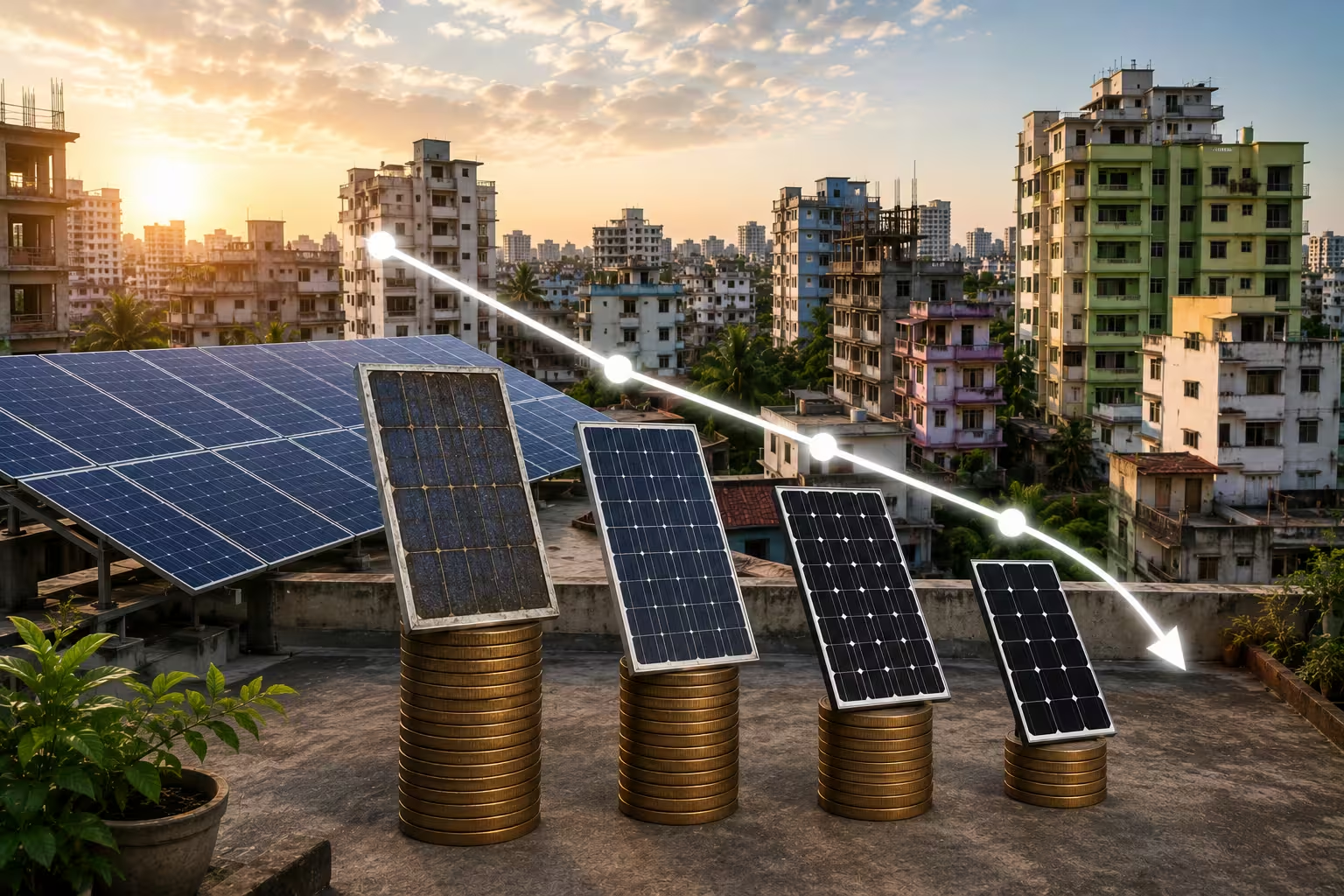
If you got a solar quote last year and then talked to a neighbor who installed panels back in 2015, you probably noticed something strange. Their old system cost more than double what yours would, for less power. That’s not a fluke, and it’s not a sales pitch. Solar panel prices have dropped roughly 90% over the past decade, and it comes down to four things happening at once: panels got dramatically more efficient to make, manufacturing scaled up worldwide, the “invisible” costs around installation slowly came down, and manufacturers — especially in China — fought each other hard enough on price that everyone else had to follow.
That’s the short version. The longer version is more interesting, and honestly more useful, because it tells you something the four-bullet-point articles rarely do: which parts of that price drop are still happening, and which parts have basically stalled out.
So What Actually Made Solar This Cheap?
Let’s go through the real mechanics, one at a time, instead of just naming them and moving on.
Panels Got Better at Turning Sunlight Into Power
Back in the early 2010s, a typical residential panel converted somewhere around 15% of the sunlight hitting it into usable electricity. Today’s panels are commonly hitting 21-22% efficiency, with some premium models pushing higher. That might not sound like a huge jump, but it means you need fewer panels to hit the same output — less aluminum, less glass, less wiring, less labor to mount them. Every percentage point of efficiency gain quietly removes cost from the whole system, not just the panel itself.
This isn’t magic. It’s mostly incremental engineering — better cell architecture, improved wafer-cutting techniques, and refined manufacturing processes that waste less raw material. If you want the deeper mechanics of how sunlight actually becomes electricity in the first place, the photovoltaic effect is worth understanding, because it explains why these efficiency gains matter as much as they do.
The Industry Went from Niche to Massive
Ten, fifteen years ago, solar manufacturing was a specialty business. Now it’s an industrial-scale one. Factories that used to produce a few hundred megawatts a year now produce gigawatts. That kind of scale changes the economics of everything — raw material purchasing, factory automation, shipping logistics, even how quickly defects get caught and fixed.
This is just standard manufacturing economics, but it’s easy to underestimate how much it matters. When you go from making thousands of units to making millions, your cost per unit doesn’t just drop a little — it can fall by an order of magnitude. Solar followed that same curve that things like flat-screen TVs and LED bulbs followed before it. If you’re curious how quickly this shift happened globally, solar adoption trends over the last decade tell that story pretty clearly.
Soft Costs Came Down — But Slower Than Everything Else
Here’s the part almost nobody breaks down properly, and it’s honestly the most important piece if you’re actually shopping for solar right now.
“Soft costs” refers to everything that isn’t the panel itself: permitting, inspection, installer labor, sales and marketing, financing, and the paperwork involved in connecting your system to the grid. A decade ago, soft costs made up a huge chunk of a residential solar quote — sometimes more than the hardware itself.
These costs have dropped too, but nowhere near as fast as the panels. Permitting still varies wildly by city. Installer labor is still, well, labor — you can’t automate a rooftop install the way you can automate a factory line. And customer acquisition (all that advertising and sales overhead) is still baked into most residential quotes.
This is the honest gap in the “solar got 90% cheaper” narrative. The equipment got dramatically cheaper. The process of actually getting it installed on your roof didn’t drop nearly as much. If two installers quote you wildly different prices for the same hardware, this is usually why — you’re not paying for different panels, you’re paying for different soft-cost structures.
Global Competition, Especially from China, Pushed Prices Down Hard
China didn’t just enter the solar manufacturing business — it came to dominate it. Massive government-backed investment, aggressive scaling, and fierce domestic competition among Chinese manufacturers created a race to the bottom on panel pricing that rippled out globally. Whether you love or hate the trade politics around this, the effect on price was real: when supply floods a market and manufacturers are competing on razor-thin margins, prices fall fast.
This is also the piece of the story that’s currently in flux, which brings us to the question most articles skip entirely.
Will Solar Prices Keep Dropping?
Here’s the honest answer: probably not at the same pace, and in some cases, they might tick back up.
A few things are worth knowing if you’re trying to time a purchase:
- Tariffs are a real wildcard. Trade policy on imported panels and components — particularly from Chinese manufacturers — has pushed some hardware costs up in certain markets, even while global manufacturing costs kept falling. This is a genuine tension: the raw manufacturing economics still favor cheaper solar, but policy can override that in specific countries.
- Polysilicon prices swing. Polysilicon is a core raw material in most panels, and its price has been volatile — spiking during supply shortages, then dropping again. This ripples through panel pricing with a lag.
- Efficiency gains are hitting diminishing returns. Going from 15% to 21% efficiency was a huge leap. Going from 22% to 24% is a much smaller, harder-won gain. The easy efficiency wins are mostly behind us.
- Soft costs have more room to fall, but slowly. Permitting reform, standardized installer training, and better financing options could still meaningfully reduce soft costs — but this kind of change happens over years, not months.
So the realistic take: hardware prices have mostly found their floor, at least for now, and soft costs will keep grinding down slowly rather than collapsing. If you’re waiting for another 90% drop, you’ll likely be waiting a very long time. If you’re waiting for modest, steady improvement, that’s a much safer bet.
What This Actually Means If You’re Considering Solar Now
If you’re sitting on the fence, here’s the practical takeaway. The dramatic price collapse already happened — you’re not early to this trend, and you’re not late either. You’re arriving at a point where the technology is mature, the manufacturing is efficient, and the remaining cost differences between installers mostly come down to soft costs: labor, permitting speed, and how lean (or bloated) their sales process is.
That means the smartest move isn’t waiting for panels to get cheaper. It’s shopping around on soft costs — comparing installer quotes, asking specifically what’s included in “installation,” and understanding your local permitting timeline. Two installers quoting the same panel brand can differ by thousands of dollars, and it’s rarely the hardware causing that gap.
It’s also worth understanding what kind of system actually fits your situation before comparing quotes. A grid-tied setup, a fully off-grid system, and a hybrid system with battery backup all come with very different cost structures and soft-cost profiles — it’s worth reading up on how these solar system types compare before you start collecting quotes, since it changes what a “fair price” even looks like.
It also helps to have a sense of how solar stacks up against the alternative you’re actually walking away from. If you’re weighing this against sticking with your utility bill, comparing solar to fossil fuel-based power puts the cost trajectory in context — because solar’s price drop only matters relative to what else is happening to your electricity costs.
The Bigger Picture
Solar didn’t get cheap by accident, and it didn’t get cheap all at once. It was a decade of overlapping trends — better engineering, bigger factories, slowly maturing installation practices, and brutal manufacturing competition — all pushing in the same direction at the same time. That’s rare, and it’s part of why the price drop looks so dramatic when you zoom out.
But “solar got 90% cheaper” is a headline, not the whole story. The honest version is that hardware got dramatically cheaper, installation got somewhat cheaper, and the industry matured from a niche product into a mainstream one. Understanding which part of that story is still moving — and which part has mostly settled — is what actually helps you make a good decision, instead of just repeating a stat you saw somewhere online.
If any of this is new territory, it’s worth stepping back even further to what solar energy actually is and how it’s captured, or the broader history of solar technology that got us here — both give useful context for why this price collapse happened when it did, and not decades earlier.
FAQs
Will solar panel prices keep dropping?
Hardware prices have leveled off more than most people expect, since the biggest efficiency and manufacturing gains have already happened. Soft costs like installation and permitting still have room to fall, but that tends to happen gradually rather than in dramatic jumps.
Are Chinese solar panels cheaper, and why?
Yes, generally. Massive scale, aggressive domestic competition among manufacturers, and heavy investment in production capacity have made Chinese-made panels some of the cheapest globally. Tariffs in certain markets can offset some of that price advantage for buyers outside China.
What percentage of solar cost is installation versus equipment?
This varies by market, but soft costs — installation, permitting, sales, and financing — often make up a significant share of a residential quote, sometimes close to half. This is exactly why two installers quoting the same panels can land on very different final prices.
Is solar cheaper than it was a few years ago?
Yes, though the pace of that decline has slowed compared to the 2010s. Most of the dramatic drop already happened; recent years have seen more modest, incremental declines alongside some upward pressure from tariffs and material costs.
What’s the average cost per watt today compared to 2010?
Residential solar cost per watt has fallen dramatically since 2010, driven mostly by cheaper panels and larger-scale manufacturing. The exact number varies by region, installer, and system size, so it’s worth getting a few local quotes rather than relying on a single national average.