Walk into a conversation about solar with a school principal, a hospital administrator, and a hotel GM, and you’ll get three completely different sets of questions. The principal wants to know if it’s worth the paperwork. The hospital administrator wants to know what happens the moment the sun disappears behind a cloud during surgery. The hotel GM wants to know if it’ll actually move the needle on next quarter’s electricity bill.
Most articles on “solar for institutions” answer none of these questions properly, because they treat schools, hospitals, and hotels as one interchangeable category with the same five generic benefits — lower bills, energy independence, a smaller carbon footprint. That’s not wrong, exactly. It’s just not useful. These three types of buildings run on completely different load patterns, carry completely different risks, and are bought by people with completely different priorities. A system that makes perfect sense for a school campus can be the wrong shape entirely for a hospital ward.
So instead of another generic list, here’s how solar actually plays out across these three facility types in a Bangladesh context — and where the differences matter enough to change your decision.
Does solar work for schools, hospitals, and hotels in Bangladesh?
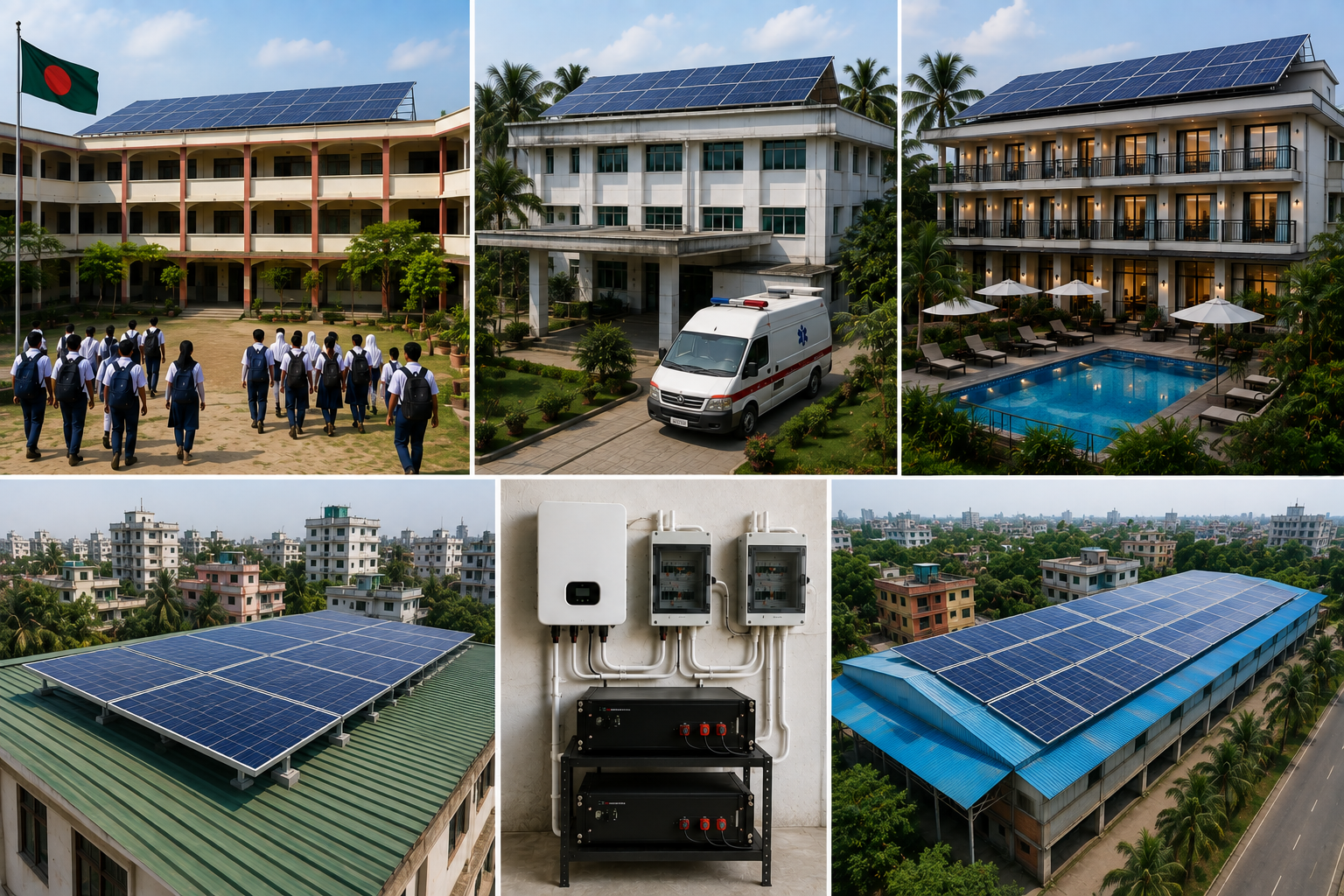
Yes, but not in the same way for each. Schools tend to be the easiest fit, because their electricity use is concentrated in daylight hours, which lines up naturally with solar generation. Hospitals are the hardest fit on paper, because they can’t tolerate any gap in power for critical equipment — which usually means solar has to be paired with battery backup rather than standing on its own. Hotels sit in between: their loads are heavier and less predictable (think air conditioning and laundry running around the clock), but the financial case is often the strongest of the three, because electricity is one of their biggest and most controllable operating costs.
Schools, hospitals, and hotels compared
| Facility type | Typical load pattern | Best-fit solar approach | Primary driver |
| Schools | Mostly daytime, weekday-heavy, drops off in evenings and holidays | On-grid solar, sized to daytime use | Budget relief, sometimes CSR/grant eligibility |
| Hospitals | Constant, 24/7, with non-negotiable critical loads | Hybrid solar with battery backup | Reliability during outages, diesel offset |
| Hotels | Heavy and variable — AC, laundry, kitchens, occupancy swings seasonally | On-grid or hybrid depending on backup needs | Operating cost reduction, guest and brand value |
Solar for schools: the easiest case, if the budget process cooperates
Schools are, honestly, close to a textbook fit for solar. Classes run during daylight hours. Fans, lights, computer labs, and photocopiers are all switched off by evening, and the building sits mostly idle over weekends and long holidays. That means a well-sized on-grid solar system can offset a meaningful chunk of daytime consumption without needing expensive battery storage to cover night-time use nobody’s doing anyway.
The real obstacle for schools usually isn’t the engineering — it’s the process. Government and semi-government schools often move through longer procurement and budget-approval cycles, and private schools may be weighing solar against a dozen other capital priorities (classroom renovation, lab equipment, staff salaries). This is where the “government subsidies make it more affordable” claim you’ll see repeated everywhere needs a caveat: incentive availability and eligibility criteria change, so any subsidy or tax benefit a school might qualify for should be checked directly with the relevant authority rather than assumed. Don’t let a vendor pitch built on an unconfirmed subsidy number be the reason you say yes.
Where solar does carry a nice secondary benefit for schools is education itself — a visible rooftop system genuinely lends itself to lessons on energy and sustainability, which is a fair reason to lean into it if the school already has that focus. It shouldn’t be the main reason to invest, but it’s a legitimate bonus.
Solar for hospitals: the reliability question comes first
Ask a hospital administrator in Bangladesh what keeps them up at night about power, and load-shedding and diesel genset costs come up fast. Grid reliability outside the major urban cores can be inconsistent enough that many hospitals already run gensets as a standing backup — and diesel isn’t cheap, especially when it’s running for hours at a stretch.
This is the honest, practical reason solar makes sense for hospitals — not “energy independence” as an abstract ideal, but a concrete reduction in how much diesel a facility burns and how dependent it is on grid stability. The catch is that a hospital’s load never really stops. ICU equipment, oxygen concentrators, refrigeration for blood and medication, ventilators — none of it can tolerate a gap while a system switches sources. That’s a different problem from “reduce the electricity bill,” and it changes the whole design.
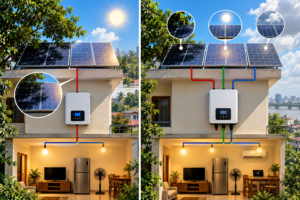
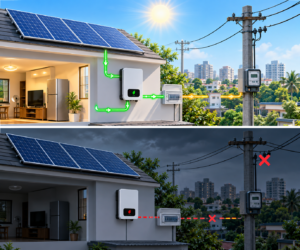
For most hospitals, that means solar has to be paired with a hybrid solar system with battery storage rather than a simple grid-tied setup — the panels generate during the day, the battery holds enough charge to bridge outages, and the grid (plus, realistically, the existing genset) remains the fallback. It’s worth being upfront that this is a bigger investment than an on-grid system, and it’s not automatically justified for every facility — a small outpatient clinic with no overnight critical load has a very different case than a hospital running a 24-hour ICU. The right starting point is an honest look at which loads genuinely can’t lose power, and sizing the backup around those specifically rather than the whole building.
Solar for hotels: where the ROI conversation is clearest
Hotels tend to be the most commercially straightforward of the three, mostly because the person making the decision is usually already thinking in terms of operating margin. Electricity is a heavy, constant line item — air conditioning alone can be one of the largest single costs in a Bangladeshi hotel’s utility bill, especially during the hotter months, on top of laundry, kitchen equipment, lighting, and common-area systems running through the day and into the evening.
Because hotel loads are large and fairly consistent through daylight hours (with AC and kitchen use often peaking exactly when solar generation is strongest), an appropriately sized on-grid or hybrid system can offset a real portion of that draw. Whether battery backup makes sense depends heavily on how the property currently handles outages — a hotel that already treats uninterrupted power as part of the guest experience (particularly ones courting business travelers or international guests) has a stronger case for adding storage than a smaller budget property that can tolerate brief switchovers.
There’s also a brand angle worth naming honestly rather than oversold: hotel chains and independent properties increasingly get asked about sustainability practices by corporate clients and booking platforms, and a visible solar installation is a genuine, verifiable answer to that question — not just marketing language. That’s a legitimate secondary benefit, but the core decision for most hotel owners still comes down to the electricity bill and the payback math, which is exactly how it should be evaluated.
What all three have in common
However different the load patterns, a few practical realities apply across schools, hospitals, and hotels alike:
- Net metering and utility approval. Any institution above a certain sanctioned load goes through a formal approval and net metering process with its distribution utility (which one — DESCO, DPDC, BPDB, or another — depends on the facility’s location). It’s a real step in the timeline, not paperwork you can skip, and it’s worth reading up on separately through our net metering application guide.
- Roof space isn’t always what it looks like. Schools and hospitals in particular often have generous flat rooftops on paper, but water tanks, satellite dishes, rooftop water treatment units, and future expansion plans can eat into usable area fast. A proper site assessment before committing to a system size saves a lot of disappointment later.
- Maintenance responsibility needs deciding upfront. Some institutions have in-house facilities staff who can handle routine solar panel cleaning and basic checks; others are better served by an outsourced operation and maintenance arrangement. Deciding this before installation avoids a system that quietly underperforms because nobody owns its upkeep.
- The numbers should be facility-specific, not generic. Payback periods and savings figures you’ll see quoted online are rarely built around an institution’s actual load profile. A proper load calculation and system sizing exercise, done against your facility’s own consumption data, is the only way to get numbers you can actually trust.
If there’s one thread running through all three sections, it’s this: the right system size and type follows directly from how a building actually uses power, not from a generic checklist of solar benefits. That’s a conversation worth having with someone who can look at your facility’s specific load pattern — whether that’s the daytime-only rhythm of a school, the 24-hour critical demands of a hospital, or the heavy, consistent draw of a hotel — and size a system around it rather than around a template. That’s the kind of assessment Muspana works through with institutional clients before recommending anything.
FAQs
Is solar power reliable enough for a hospital in Bangladesh?
On its own, a standard on-grid solar system isn’t enough for critical hospital loads, because it still depends on the grid being up. Pairing solar with battery storage — a hybrid system — is what actually bridges outages for equipment that can’t lose power, like ICU machines or refrigerated medication storage.
Do schools in Bangladesh actually save money with solar panels?
Often yes, because school electricity use is concentrated during the same daylight hours solar panels generate power. The savings depend on the school’s actual consumption and system size, so it’s worth getting a proper load calculation rather than relying on generic percentage claims.
Can a hotel run entirely on solar power?
Rarely, and it’s usually not the goal. Most hotels use solar to offset a meaningful share of daytime consumption (especially air conditioning) rather than to go fully off-grid, since hotel loads are typically too large and constant for solar alone to cover without a very large and expensive battery system.
Do government subsidies make solar cheaper for institutions in Bangladesh?
Incentive and subsidy programs do exist at various points, but eligibility and availability change, so any specific subsidy claim should be verified directly with the relevant authority or utility rather than taken from a general article — including this one.
How long does it take to get solar approved for a school, hospital, or hotel?
It varies by facility size, sanctioned load, and which distribution utility serves the area, since larger institutional systems typically require formal utility approval and net metering registration before installation is complete.
Does solar require a lot of maintenance for an institution?
Not a lot, but it does require someone responsible for it. Routine tasks like panel cleaning and periodic performance checks matter, and deciding upfront whether in-house staff or an outsourced maintenance provider will handle this avoids a system that quietly loses efficiency over time.